


A sudden, unexplained spike in your monthly water bill is rarely a clerical error; more often, it’s the first warning sign that your home’s foundation is under silent attack. You’ve likely felt that knot of anxiety while staring at a warm spot on the kitchen floor or hearing the faint sound of running water when every faucet is off. It’s natural to worry about foundation collapse or the high cost of tearing up your expensive flooring just to locate a single broken pipe. You need to understand how to find a slab leak quickly and accurately to protect your investment and your peace of mind.
We believe that homeowners in Broward County deserve a solution that doesn’t involve guesswork or unnecessary destruction. This guide will teach you the exact steps to identify, verify, and locate a hidden slab leak before it compromises your home’s structural integrity. You’ll learn how to perform a simple meter test to confirm your suspicions and discover how professional non-invasive technology pinpoints the exact source of the trouble. We are going to move from immediate DIY triage to a methodical explanation of the professional detection process, ensuring you have a clear path to a permanent fix without the need for a jackhammer.
Key Takeaways
- Recognize early warning signs like unexplained floor “hot zones” and rising water bills to prevent foundation compromise.
- Learn how to find a slab leak using your home’s water meter as a primary diagnostic tool to confirm a hidden break.
- Use simple DIY methods like moisture mapping and acoustic listening to narrow down the leak’s location before professional arrival.
- Discover why non-invasive acoustic technology is the gold standard for pinpointing leaks without the need for exploratory digging.
- Evaluate the best restoration path, from precise spot repairs to long-term pipe rerouting, to protect your property’s future value.
Identifying the Early Warning Signs of a Slab Leak
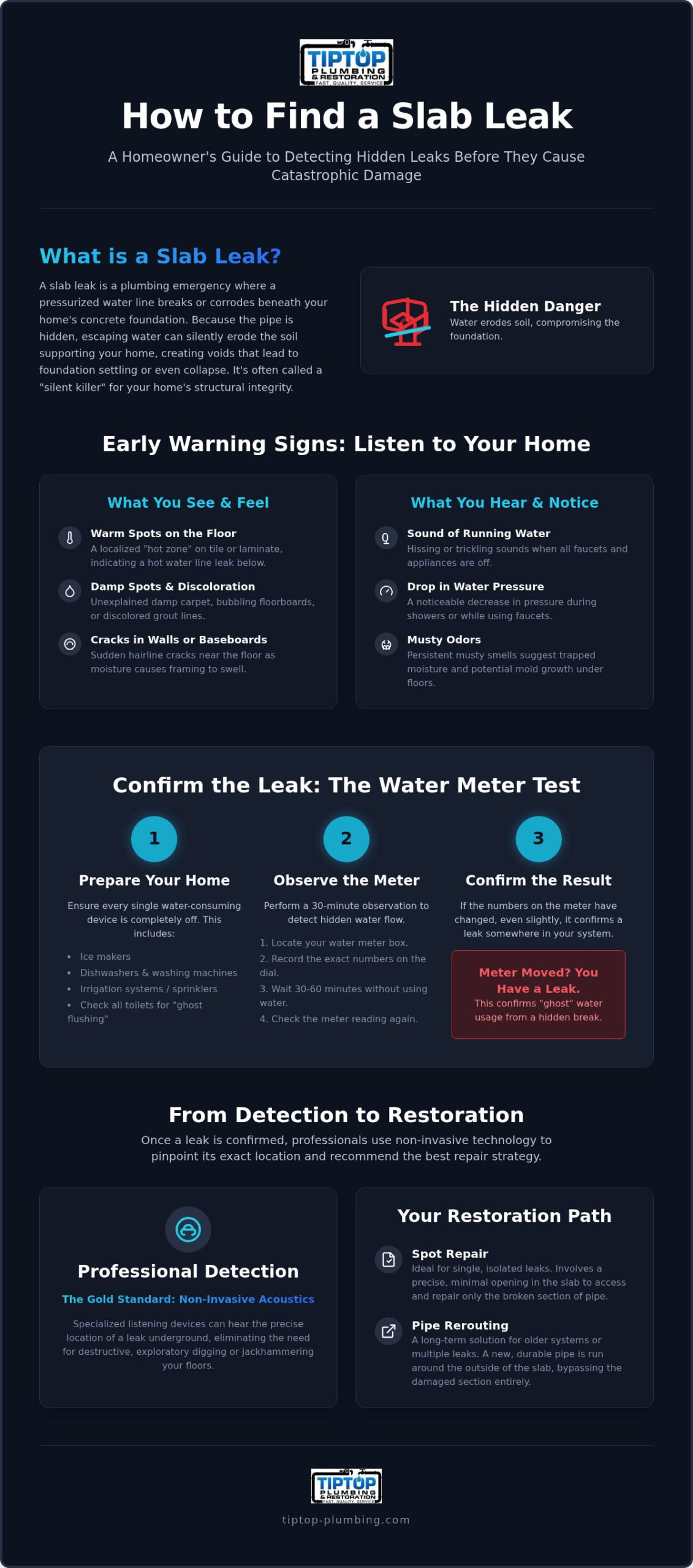
A slab leak is more than a plumbing nuisance; it’s a structural emergency. By definition, a slab leak occurs when a pressurized water line breaks or corrodes beneath your home’s concrete foundation. Because these pipes are buried under inches of reinforced concrete, the water has nowhere to go but up or out into the surrounding soil. This is why understanding how to find a slab leak early is essential for preventing catastrophic property damage. If left unaddressed, the constant flow of water can undermine the very ground your house stands on.
In South Florida, our homes are typically built with slab-on-grade construction. This design, combined with our naturally high water tables in areas served like Weston and Miramar, makes slab leaks particularly volatile. When a pipe bursts under the slab, the escaping water can quickly erode the sandy soil supporting your home. This creates voids that lead to foundation settling or even collapse. Because the leak is hidden from sight, it often earns the title of a “silent killer,” running for months before a homeowner notices the subtle sensory cues that demand immediate attention today.
Visual and Physical Indicators in Your Living Space
Your flooring often provides the first clues of a subsurface disaster. If you walk across your kitchen or bathroom and feel a localized warm spot on the tile or laminate, you’re likely standing over a hot water line leak. The heat from the escaping water transfers through the concrete and into your flooring material. You might also notice damp spots in the center of a room, discolored grout lines that never seem to dry, or “bubbling” in your floorboards. As the moisture builds, it can cause the wooden framing of your house to swell. This leads to sudden, hairline cracks in your baseboards or drywall near the floor level that weren’t there a week ago.
Auditory and Performance Warnings
Silence is your best diagnostic tool. When your house is quiet and all faucets are firmly closed, listen for the sound of rushing, hissing, or trickling water. This sound is often most audible near the water heater or in bathrooms. Beyond what you hear, pay close attention to how your plumbing performs. A noticeable drop in water pressure during a shower or while running the dishwasher often indicates that water is being diverted through a break in the line. Persistent musty odors, even after a deep clean, suggest that moisture is trapped beneath your floors and may be fostering mold growth. Recognizing these signs is the first step in determining how to find a slab leak, but confirming the source usually requires professional leak detection methods to avoid unnecessary digging.
Step-by-Step Guide: Using Your Water Meter to Confirm a Leak
The water meter is your plumbing’s lie detector. While visual signs like warm floors or damp drywall suggest a problem, the meter provides the objective data needed to confirm your suspicions. By monitoring the flow of water into your property during a period of total inactivity, you can determine with absolute certainty whether the spike in your bill is due to a simple leaky faucet or a more serious structural issue. Learning how to find a slab leak begins here, as this test separates “ghost” water usage from a legitimate pipe failure.
Phase 1: Preparing Your Home for the Test
Precision is vital during this phase. You must ensure that every single water-consuming device in your home is completely dormant. Start by turning off the ice maker in your refrigerator and ensuring the dishwasher and washing machine are not mid-cycle. Disable your automated irrigation system, as a scheduled sprinkler run will invalidate your results. Finally, check every toilet in the house for “ghost flushing.” If you hear a hiss or see ripples in the bowl, the flapper valve is leaking and will skew your meter reading. If you need assistance locating your property’s connection point, you can refer to our guide on finding your main water shut off valve to help isolate your system.
Phase 2: The 30-Minute Meter Observation
Once the house is silent, locate your meter box, usually found near the street or sidewalk under a heavy concrete or plastic lid. Record the exact numbers on the display, making sure to include the small digits or the position of the sweep hand. For many homeowners, Using Your Water Meter to Confirm a Leak is as simple as watching the “low flow” indicator. On analog meters, this is often a small red or silver triangle or a star-shaped wheel that spins even during a pinhole leak. On digital meters, look for a flashing faucet icon or a numerical flow rate higher than zero. Wait at least 30 minutes; however, waiting two hours provides a much more accurate picture of slow, pressurized leaks hidden deep beneath your foundation.
If the meter shows movement after this period of zero usage, you have confirmed a leak in your pressurized system. If you have already ruled out toilets and dripping faucets, the water is likely escaping from the copper or PEX lines embedded in your concrete slab. This diagnostic step is a critical part of how to find a slab leak because it provides the evidence needed to move forward with specialized detection. If your meter confirms a steady loss of water, you should schedule a professional diagnostic test immediately to prevent further soil erosion and foundation damage.
Narrowing the Search: DIY Methods to Locate the Leak
Once the water meter has confirmed a loss of pressure, the next challenge is narrowing down the general area of the break. Most homes in Broward County cities like Miramar or Pembroke Pines follow a predictable plumbing layout. Lines typically enter the slab from the perimeter and branch out toward kitchens, laundry rooms, and bathrooms. By visualizing this map, you can focus your search on high-pressure zones rather than checking every square inch of the house. Understanding the path of your plumbing is a fundamental part of how to find a slab leak without resorting to destructive guesswork.
Start your search by walking the exterior perimeter of your home. Look for pooling water against the foundation or patches of grass that are noticeably greener and taller than the rest of the lawn. In our local environment, these “lush spots” often indicate that a pipe has failed near the edge of the slab, allowing water to seep into the surrounding soil and nourish the roots from below. If the exterior looks dry, move your search indoors and pay close attention to the transition points where pipes emerge from the concrete to meet your fixtures.
Utilizing Affordable Technology
Infrared thermometers are surprisingly effective at detecting hot water line leaks through tile or laminate flooring. By scanning the floor surface in a grid pattern, you can identify “hot zones” where the temperature is significantly higher than the surrounding area. Similarly, a pinless moisture meter can be pressed against baseboards or the lower portion of drywall to detect hidden dampness that hasn’t yet reached the surface. While these DIY tools are excellent for confirming the general vicinity of a problem, they lack the acoustic precision required to pinpoint a leak’s exact coordinates for a non-invasive repair.
The Isolation Strategy
You can further narrow the search by using the “Stethoscope Method.” Place the tip of a long screwdriver against a cold water pipe or a hose bib and press your ear firmly to the handle. If you hear a distinct vibration or a constant hissing sound, you’re getting closer to the source of the break. To determine if the leak is on the hot or cold side, simply close the cold water supply valve on top of your water heater and check your meter again. If the meter stops spinning, the leak is isolated to your hot water lines. Stop your DIY efforts immediately if valves feel stuck or brittle; forcing an old valve can cause a secondary emergency that complicates the professional restoration process. Knowing how to find a slab leak through isolation saves time, but it’s the point where technical expertise must take over to ensure a permanent fix.
Professional Slab Leak Detection: Precision Without Destruction
While DIY steps confirm the existence of a problem, knowing how to find a slab leak with surgical precision requires specialized technology that goes far beyond what is available at a local hardware store. The goal of professional detection is to eliminate the need for “exploratory digging,” a destructive and outdated practice where sections of a foundation are jackhammered based on a plumber’s best guess. Instead, we utilize electronic pipe locators to map the exact path of your underground lines before any repair begins. This mapping, combined with rigorous pressure testing, allows us to confirm the severity of the break. By isolating sections of the plumbing and monitoring pressure drops, we can determine if you’re dealing with a minor pinhole or a major line failure. This methodical approach ensures we never compromise your home’s structural integrity unnecessarily, providing a clear roadmap for the restoration phase.
Acoustic and Ultrasonic Detection
The primary method for pinpointing a pressurized leak is acoustic detection. Our technicians use high-frequency microphones to listen for the distinct “whoosh” or “hiss” of water escaping a pipe under the concrete. Because Broward neighborhoods can be noisy with traffic, lawn equipment, and air conditioning units, we use ultrasonic sensors that filter out background interference. These sensors focus exclusively on the specific frequencies generated by a pipe burst, even through several inches of reinforced concrete and luxury flooring. This level of precision is what distinguishes a professional “fixer” from someone just making an educated guess. It provides the peace of mind that comes from knowing the repair will be targeted, efficient, and clean.
Sewer Camera Inspections and Tracer Gases
Not all slab leaks occur in pressurized supply lines; some happen in the drainage system where sounds are much harder to detect. We utilize sewer camera inspections in Weston, FL to visually inspect the interior of your drain lines for cracks, offset joints, or root intrusions. These high-resolution cameras provide a real-time view of the structural health of your pipes without any digging. For leaks that are too small or deep to generate an audible sound, we employ inert tracer gases. We introduce a safe, pressurized gas mixture into the plumbing lines and use a sensitive electronic “sniffer” to detect the exact point where the gas permeates the slab. By layering these advanced technologies, we eliminate the uncertainty that often accompanies foundation repairs and ensure that when we finally access the pipe, we are working in exactly the right spot.
From Detection to Restoration: Your Next Steps
Once the diagnostic phase is complete and you understand how to find a slab leak using professional technology, the focus shifts immediately to restoration. Pinpointing the break is a major victory, but the method you choose for the repair will dictate the long-term health of your home. In South Florida, we often see older copper systems that have reached the end of their lifespan. While a localized spot repair might stop the immediate flow of water, it doesn’t address the underlying corrosion that caused the failure. If your home has a history of pinhole leaks, investing in whole house repiping is often the most responsible way to ensure you never have to deal with foundation damage again.
Evaluating Repair vs. Repiping
A spot repair involves removing a small section of your flooring and concrete to access the pipe directly. This makes sense for a single, localized break in a relatively new system. However, many homeowners in Broward County prefer pipe rerouting. This process involves abandoning the failing line under the slab and running a new, durable line through the attic or walls. Rerouting is a non-invasive solution that completely removes the risk of future leaks in that specific run. As you plan your budget, you should check our guide on slab leak repair cost in Florida to understand how different methods impact your total investment. Deciding between a quick fix and a permanent reroute depends on the age of your plumbing and your plans for the property.
Restoring Your Home’s Health
The repair of the pipe is only the first half of the “fixer” process. Because water has been pressurized under your slab, it has likely saturated the soil and the porous concrete of your foundation. Professional water remediation and dry-out services are mandatory to prevent the structural settling that occurs when saturated soil shifts. We use industrial-grade dehumidifiers and air movers to extract every ounce of moisture from your subfloor and walls. In our humid climate, mold doesn’t wait. Even a small amount of trapped moisture can lead to a full-blown infestation within 48 to 72 hours. This is why certified mold testing is a critical step in our restoration protocol. We also recommend documenting every step of the professional detection and repair process. Having a detailed report from a specialist who knows how to find a slab leak and restore the damage makes working with your insurance company much smoother, ensuring you receive the coverage you deserve for these high-stakes repairs.
Securing Your Home Against Subsurface Damage
A slab leak doesn’t have to result in the destruction of your foundation or the loss of your expensive flooring. By combining your own vigilance with the diagnostic steps outlined in this guide, you now understand how to find a slab leak before it escalates into a structural emergency. Remember that while a water meter test provides the proof you need to act, professional non-invasive technology is the only way to pinpoint the source without unnecessary digging. We serve our neighbors in Weston, Miramar, and all of Broward County with 24/7 emergency response and specialized expertise in acoustic detection.
Our team acts as a reliable local authority, providing the calm, expert-led guidance required to navigate these stressful crises. We don’t just stop the water; we provide total restoration through certified dry-out services and mold testing to ensure your home remains a safe environment for your family. You’ve already taken the most important step by identifying the warning signs early. Now, let’s focus on a permanent, professional solution that protects your property investment for years to come.
Your home is your most valuable asset, and we’re here to help you defend it with precision and integrity.
Frequently Asked Questions
Will my homeowners insurance cover the cost of finding a slab leak?
Most standard Florida policies cover the cost of “accessing” the leak, which includes the labor to reach the pipe, though they often exclude the actual plumbing repair itself. You should review your specific policy for “leak detection” coverage, as many insurers pay for professional diagnostics to mitigate further property damage. We provide comprehensive reports and thermal imagery to help you document the loss for your insurance adjuster.
How long does it take for a professional to find a leak under a slab?
A professional diagnostic typically takes between one and three hours depending on the size of the property and the complexity of the plumbing layout. Using acoustic equipment and tracer gases, we can usually pinpoint the source during a single visit. This efficiency is why understanding how to find a slab leak through expert means is faster and more reliable than DIY guesswork.
Can a slab leak cause my house to collapse or shift?
Yes, a persistent slab leak can lead to foundation shifting or localized collapse by eroding the supporting soil beneath the concrete. In South Florida’s sandy environment, water creates voids that cause the slab to settle unevenly. This movement results in structural cracks in your drywall, tile, and exterior masonry if the leak isn’t addressed immediately by a professional team.
Why did my copper pipes start leaking under the concrete in the first place?
Copper pipes often fail due to “pitting corrosion” caused by a chemical reaction between the metal and the surrounding soil or concrete. In some cases, poor installation leads to pipes rubbing against the abrasive slab during thermal expansion. These small friction points eventually wear through the copper wall, creating the pressurized leaks we frequently see in older Broward County homes.
Is it possible for a slab leak to go away on its own?
No, a slab leak will never resolve itself and will only intensify as the pressurized water gradually expands the breach in the copper or PEX line. Ignoring the problem leads to exponentially higher water bills, hazardous mold growth, and eventual structural failure. The only way to stop the flow and protect your foundation is through a professional repair or a strategic pipe reroute.
What is the most non-invasive way to fix a leak under the floor?
Pipe rerouting is the most non-invasive solution because it abandons the broken line under the concrete and runs a new pipe through the attic or walls. This avoids the need to jackhammer your flooring and foundation. While spot repairs are possible, rerouting provides a permanent bypass that eliminates the risk of future leaks in that specific area of your home.
Can I still live in my house while a slab leak is being repaired?
Yes, you can typically remain in your home during the detection and repair process, although your water will be temporarily shut off during the work. Most repairs are completed within a single day. If extensive water remediation or dry-out services are required, we work in sections to minimize the impact on your daily routine and your living space.
How much water is typically lost during a standard slab leak?
A pinhole leak can waste thousands of gallons of water per month, significantly increasing your utility costs and stressing your plumbing system. Larger breaks can lose hundreds of gallons per hour, leading to rapid soil erosion and foundation instability. Confirming how to find a slab leak early through a meter test is the best way to stop this waste.
Disclaimer
The information provided in this article is for general educational and informational purposes only and should not be considered professional plumbing, restoration, mold remediation, or legal advice. Every plumbing system, property, and situation is unique, and the recommendations discussed may not apply to your specific circumstances.
While Tip Top Plumbing & Restoration strives to provide accurate and up-to-date information, we make no warranties regarding the completeness, accuracy, or reliability of the content. Any actions you take based on this information are at your own risk.
Plumbing repairs, water damage restoration, and mold remediation should be performed by qualified professionals and in accordance with applicable local building codes and regulations. If you are experiencing a plumbing emergency, water leak, or property damage, contact a licensed professional for an on-site evaluation.
Tip Top Plumbing & Restoration is licensed and insured to provide plumbing and restoration services throughout Broward County, Florida.