

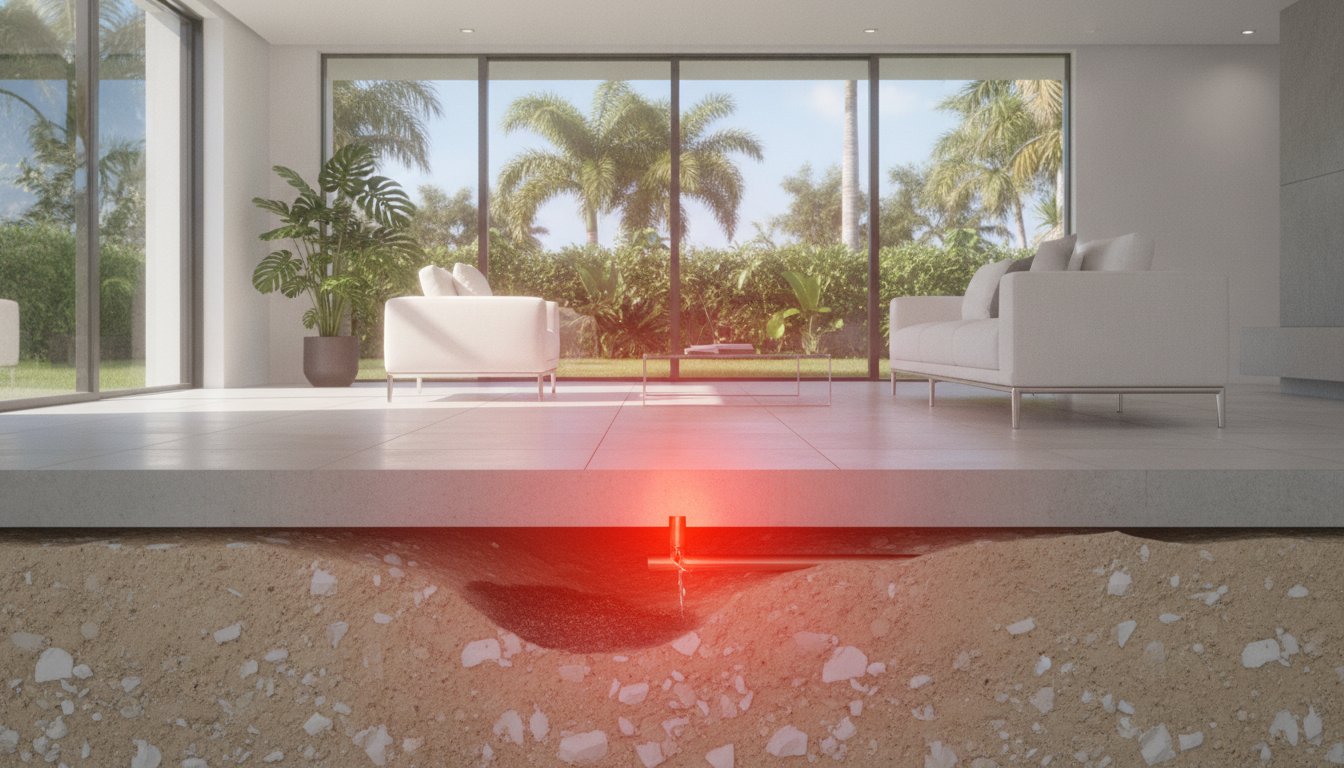
How can a copper pipe buried beneath several inches of reinforced concrete suddenly spring a leak? It feels like a physical impossibility until you notice a persistent warm spot on your tile or hear the muffled sound of water running beneath your feet. If you are worried about the structural integrity of your home, you aren’t alone. Understanding what causes a slab leak is the first step toward regaining control over a high-stakes household crisis. In the unique environment of South Florida, factors like shifting limestone soil and high water tables create a perfect storm for foundation pipe failure.
This guide will uncover the hidden chemical and geological triggers specific to our region so you can identify the root cause of your leak. We’ll help you determine if your situation is an immediate emergency and explain how modern, non-invasive repair solutions can resolve the issue without the need for destructive excavation. You don’t have to face the stress of potential foundation damage without a clear plan. By the end of this article, you’ll have the expert knowledge required to protect your home and restore your peace of mind.
Key Takeaways
- Identify the “silent threat” of water lines rupturing beneath your foundation and why these leaks often remain hidden until structural damage occurs.
- Learn exactly what causes a slab leak, from chemical corrosion in copper pipes to minor installation errors that evolve into major blowouts years later.
- Understand how Broward County’s unique limestone terrain and high water table create specific risks for South Florida plumbing systems.
- Recognize the early warning signs, such as unexplained warm spots on your flooring or sudden spikes in your water bill, to prevent mold growth and foundation erosion.
- Discover non-invasive diagnostic technologies like thermal imaging that pinpoint leaks with precision, allowing for targeted repairs without destroying your home’s interior.
Understanding the “Silent Threat”: What Exactly is a Slab Leak?
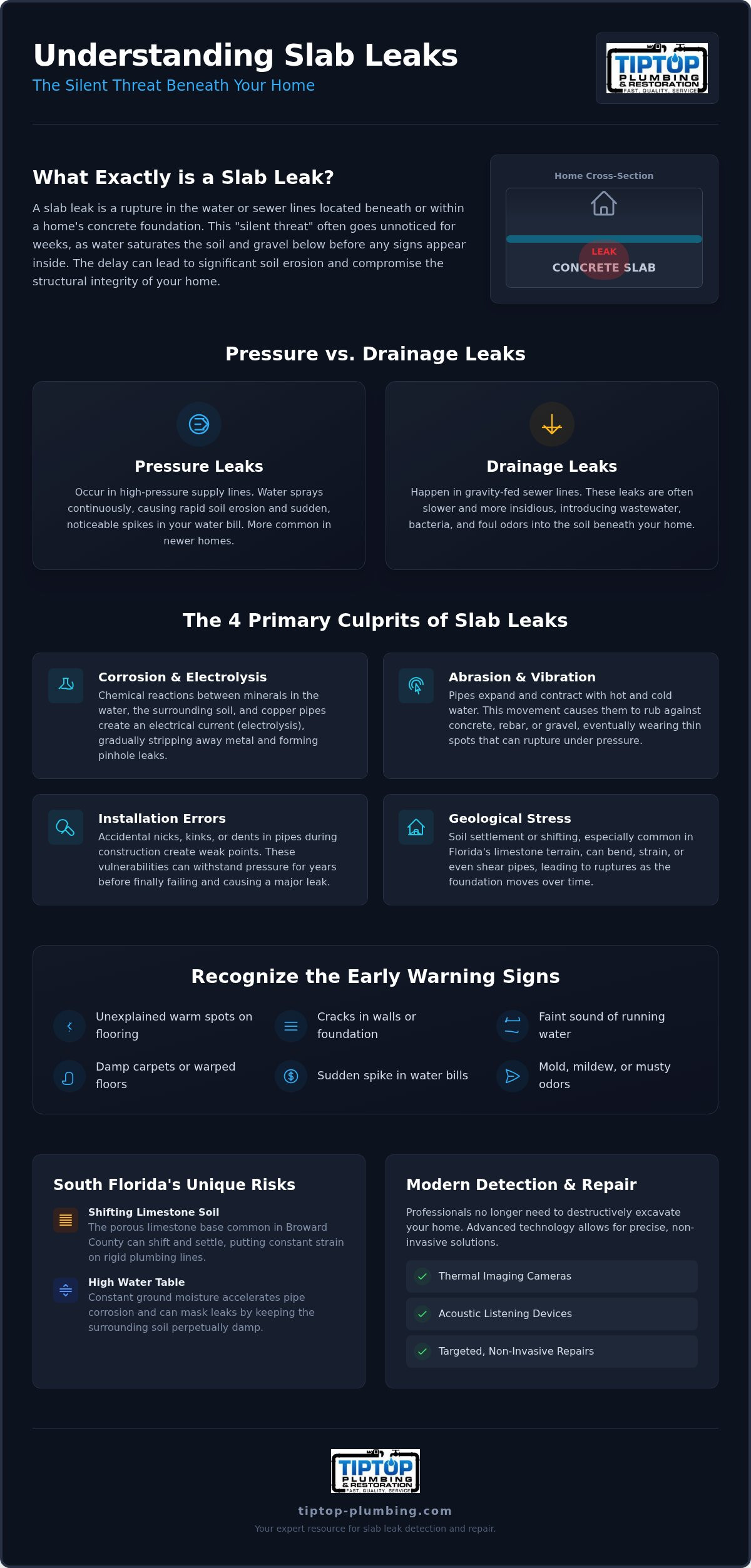
A slab leak occurs when the water or sewer lines running beneath or within your home’s concrete foundation rupture. It is a critical plumbing failure that threatens both structural integrity and indoor air quality. Unlike a leaking faucet, these failures happen out of sight, making them a “silent threat” that can persist for weeks before you see a single drop of water. Because the pipes are encased in or buried under heavy concrete, the water often travels outward into the surrounding soil or through the gravel bed before it ever surfaces inside your living space. By the time you notice a damp carpet or a warm spot on the tile, the ground beneath your home may already be saturated. This delay is a major part of what causes a slab leak to be so destructive; the longer the water flows unchecked, the higher the risk of soil erosion and foundation settlement.
Pressure Leaks vs. Drainage Leaks
Supply lines are under constant high pressure. When these fail, they spray water continuously, leading to rapid soil displacement and sudden spikes in your utility bills. These pressure leaks are increasingly common in newer Florida builds where high-velocity water flow can stress pipe joints. Conversely, drainage leaks involve sewer lines that rely on gravity. These are often more insidious because they leak slowly and intermittently. They carry the added burden of health risks, as wastewater can introduce bacteria and foul odors into the soil directly beneath your home. Both types require immediate attention to prevent the subsoil from washing away, which can lead to cracked walls and uneven floors.
The Anatomy of a Florida Home Foundation
In Broward County, most homes utilize monolithic slabs. This means the foundation is poured as a single, continuous piece of concrete. Your plumbing is often embedded directly within this slab or buried in the dirt just below it. To prevent ground moisture from entering the home, builders install a thick plastic vapor barrier. While this protects your floors from dampness, it can also trap water from a slab leak against the underside of your foundation, hiding the problem until mold begins to grow. Understanding the local soil and construction style is essential for accurate diagnostics. If you suspect an issue, professional leak detection services Broward County can pinpoint the rupture without tearing up your entire floor. Chemical reactions like Pitting corrosion on copper pipes often play a role in these failures, especially when pipes react with the minerals in the local water supply. This chemical breakdown is a primary factor in what causes a slab leak to develop in older copper systems.
The 4 Primary Culprits: What Causes a Slab Leak to Form?
Identifying exactly what causes a slab leak requires looking at the invisible forces acting on your home’s infrastructure. While concrete foundations are designed for stability, the environment surrounding your pipes is surprisingly volatile. Most failures stem from a combination of mechanical stress and chemical reactions that occur over several years. Understanding these triggers is essential for any homeowner who wants to protect their property from the ground up.
Sometimes the problem begins long before you move in. During the initial construction phase, a plumber might accidentally nick a pipe with a tool or create a sharp kink while laying the line in the trenches. While the pipe holds pressure initially, that localized stress point becomes a structural vulnerability. After a decade of constant water flow and pressure fluctuations, that minor imperfection finally develops into a full-scale rupture. This delayed reaction is why even relatively young homes can suffer from foundation pipe failure.
Corrosion and the “Electrolysis” Effect
Florida’s unique water chemistry is a primary driver of pipe degradation. The minerals present in our local water supply can react aggressively with metal, leading to a process called electrolysis. This occurs when a small electrical current passes between the soil and the pipe, effectively stripping away the metal at a microscopic level. For many local residents, copper pipe leak repair in Broward County becomes necessary because these chemical reactions create tiny pinholes that eventually merge into significant leaks. Older copper systems are particularly vulnerable to this type of electrochemical warfare, as the metal thins out over decades of exposure to the surrounding earth.
Abrasion and Thermal Expansion
Mechanical wear is another common factor in what causes a slab leak to develop. When you turn on your hot water, the pipes physically expand due to the increase in temperature. When the water cools, they contract. If a pipe is encased too tightly in concrete without proper insulation or sleeves, it will rub against the rough aggregate every time you take a shower or run the dishwasher. This constant friction acts like sandpaper, slowly grinding down the pipe wall until it is thin enough to burst. This often manifests as “hot spots” on your floor, where the escaping thermal energy radiates through the tile or laminate.
Finally, the physical movement of the earth plays a significant role. Florida’s limestone and sandy soil can shift dramatically during heavy rain seasons. This ground movement exerts hydrostatic pressure against the pipes, forcing them to bend or crack under the weight of the shifting slab. If you suspect your foundation is under this kind of stress, you can schedule a professional inspection to assess the current state of your plumbing before a minor drip becomes a structural catastrophe.
Florida-Specific Factors: Why Broward County Homes Are at Risk
National plumbing guides often overlook the unique geological challenges of South Florida. In Broward County, the ground beneath your home isn’t just dirt; it’s a complex mix of porous limestone and shifting sandy soil. During our intense summer rain seasons, this terrain undergoes significant volume changes. When the soil becomes saturated, it expands and exerts immense pressure on the concrete slab. Conversely, during dry spells, the soil shrinks and leaves voids beneath the foundation. This constant movement is a primary driver of what causes a slab leak, as the pipes are forced to flex beyond their structural limits.
Older communities like Plantation and Miramar face an additional hurdle known as the “Cast Iron legacy.” Many homes built before the mid-1970s utilized cast iron for their drainage lines. While durable against some pressures, cast iron is highly susceptible to the humid, salty air and high water table of our coastal environment. Over time, these pipes corrode from the outside in, leading to collapses that compromise the entire foundation. Understanding these local nuances is what distinguishes a general repair from a long-term solution that accounts for the specific environment of your neighborhood.
The Impact of the Florida Water Table
Our high water table creates a scenario where underground pipes are often submerged in groundwater. This environment accelerates the degradation of metal components and increases hydrostatic pressure. When a pipe develops even a microscopic fissure, the surrounding external pressure can force silt and sand into the line, widening the gap. This cycle of drought and deluge frequently leads to foundation settling, which can snap rigid supply lines. Because these issues often lead to significant flooding beneath the floor, water damage restoration Fort Lauderdale is a common necessity alongside the initial plumbing fix.
Hard Water and Pipe Integrity
Water chemistry varies significantly across the county. In areas like Weston and Davie, the municipal water supply often contains high levels of calcium and magnesium. These minerals create internal scaling, which narrows the diameter of your pipes and increases internal pressure. This added stress contributes to what causes a slab leak by wearing down the pipe walls from the inside out. As a veteran plumber Weston FL homeowners trust, we’ve seen how local water treatment processes can interact with different pipe materials. Whether you have copper, PEX, or CPVC, the chemical balance of your water plays a decisive role in the longevity of your home’s foundation plumbing.
Warning Signs and the Dangers of Delayed Repair
Detecting a slab leak early is the difference between a controlled repair and a structural disaster. While identifying what causes a slab leak is important for prevention, recognizing the warning signs is critical for immediate damage control. Because the failure occurs beneath the foundation, the symptoms are often subtle at first. One of the most common indicators is a sudden, unexplained spike in your water bill. According to the U.S. Environmental Protection Agency, household leaks are responsible for nearly 1 trillion gallons of wasted water across the country annually. If your usage hasn’t changed but your costs have climbed, a subterranean rupture is likely the culprit.
Physical changes in your home’s interior provide more immediate clues. You might notice unexplained warm spots on your tile or laminate flooring, which usually indicates a hot water supply line failure. In some cases, you can actually hear the sound of rushing water behind walls or under the floor even when every tap in the house is tightly closed. As the leak progresses, you may see visible cracks forming in your baseboards, flooring materials, or the foundation itself. These aren’t just cosmetic issues. They’re evidence of the ground shifting beneath your feet.
The Structural Threat to Your Foundation
The water escaping from a pipe doesn’t just sit there. It actively erodes the supporting soil under your slab, creating voids that lead to a phenomenon known as “heaving.” This occurs when the foundation shifts or lifts due to the pressure of saturated soil, potentially leading to a total foundation collapse if left active. The 2026 Insurance Information Institute data shows that water damage and freezing incidents account for nearly 28% of all homeowner insurance losses. To mitigate these risks, securing emergency plumber Weston FL services is vital to stop the flow before the structural damage becomes irreversible.
The Mold Factor: A Florida Homeowner’s Nightmare
In our humid climate, a slab leak provides the perfect moisture source for mold to thrive under floorboards and behind drywall. Research from the EPA confirms that mold can begin to grow within 24 to 48 hours of materials being exposed to water. This makes professional mold testing essential after any sub-floor leak is identified. Merely fixing the pipe isn’t enough; “dry out” services and water remediation are just as important to ensure your indoor air quality remains safe. Understanding what causes a slab leak is only half the battle. Addressing the secondary environmental impact is what saves your home from long-term health hazards.
Professional Slab Leak Detection and Repair Solutions
Modern slab leak detection has evolved far beyond the destructive “jackhammer and hope” methods of the past. When our team investigates what causes a slab leak in your specific home, we prioritize non-invasive diagnostics that preserve your flooring and foundation. By using high-frequency sonic equipment, we “listen” through several inches of concrete and rebar to pinpoint the exact vibration of escaping water. This precision allows us to identify the rupture site within a few inches, which minimizes the disruption to your daily life and your property’s structural integrity. We don’t start digging until we’ve confirmed the location with technical certainty.
How We Find Leaks Without Tearing Up Your Home
We utilize a suite of advanced tools to map the failure before any tools touch your floor. For hot water lines, thermal imaging cameras allow us to see heat plumes radiating through the slab, providing a visual guide to the leak’s location. On the drainage side, our advanced sewer camera inspections provide a real-time view of the pipe’s interior, identifying cracks or root intrusions that are common in older Broward County systems. These methods ensure that we aren’t just guessing; we’re working with concrete data to protect your investment.
- Electronic Sonic Detection: Amplifies the sound of pressurized water escaping to find pinhole leaks in supply lines.
- Thermal Imaging: Detects temperature anomalies in the foundation caused by hot water line ruptures.
- Sewer Camera Inspections: High-definition video probes that identify structural failures in gravity-fed drain lines.
Choosing the Right Repair Method
Once the leak is identified, the next step is determining the most sustainable fix. A spot repair involves a surgical cut through the slab to fix a single section of pipe. This is often the most efficient choice for a localized failure caused by a specific installation nick. However, if the failure was triggered by widespread corrosion or electrolysis, bypassing the slab entirely through pipe rerouting is often the safer long-term investment. By running new lines through the walls or attic, we eliminate the risk of future foundation failures in that specific line. For homeowners with aging systems, exploring repiping services in Broward County can provide permanent peace of mind.
In specific scenarios, we also utilize tunneling. This involves digging a small access point from the exterior of the home to reach the pipe from underneath. This method allows us to perform high-quality repairs without ever breaking through your interior tile or hardwood. Our approach follows a strict “triage” logic: we stop the immediate disaster, identify the root of what causes a slab leak, and then implement a solution that ensures the problem doesn’t return. Because we handle both the plumbing repair and the subsequent water remediation, you receive a seamless transition from crisis to restoration.
Protect Your Home From Foundation Failure
From the shifting limestone soil of South Florida to the chemical warfare of electrolysis, understanding what causes a slab leak is the first step in defending your property. These silent threats don’t just waste water; they actively erode the ground beneath your feet and invite mold into your home’s structure. By recognizing the warning signs early and utilizing non-invasive detection technology, you can stop a minor drip before it evolves into a foundation catastrophe.
Tip Top Plumbing & Restoration provides a complete triage approach to these high-stakes crises. We pair a 24/7 emergency response with the specialized knowledge of certified water damage restoration experts. Serving all of Broward County, our team is dedicated to precise repairs and thorough dry-out services that ensure your indoor air quality remains safe. We treat your home with the meticulous care required to provide long-term stability and professional peace of mind.
You don’t have to face a structural plumbing emergency without a reliable guide. Our experts are ready to restore your home’s integrity and protect your family’s investment with permanent, high-quality solutions.
Frequently Asked Questions
How do I know if my slab leak is from a water line or a sewer line?
You can distinguish between the two by monitoring your water meter and checking for specific symptoms. In Sunrise and Southwest Ranches, checking your meter for rapid movement while taps are closed usually indicates a pressurized supply line leak. Sewer line leaks are gravity-fed and often manifest as foul odors, foundation cracks, or localized mold growth without impacting your water usage statistics or immediate meter readings.
Will my homeowners insurance cover the cost of a slab leak repair?
Homeowners insurance typically covers the cost of “sudden and accidental” water damage, but they often exclude gradual leaks caused by wear and tear. While the policy might pay for the “tear out” and restoration of your flooring, the actual pipe repair is frequently considered a maintenance issue. With a 10% denial rate for these claims, we recommend documenting the damage immediately to support your restoration coverage.
Is a slab leak considered a plumbing emergency?
Yes, a slab leak is a high-priority plumbing emergency because it actively compromises your home’s structural integrity. Beyond the risk of foundation settlement and soil erosion, moisture introduces a significant threat of mold growth within 24 to 48 hours. The Insurance Information Institute reports that water damage accounted for nearly 28% of all homeowner losses in 2022, making immediate professional intervention necessary in communities like Pembroke Pines and Davie.
How long does it typically take to detect and fix a slab leak?
Most slab leaks can be detected and repaired within one to two days, depending on the complexity of the rupture. Non-invasive electronic detection usually takes a few hours, while the actual repair or rerouting process typically spans a full workday. However, the subsequent water remediation and dry-out phase may take several additional days to ensure your foundation and flooring are completely moisture-free and safe from mold.
Can I still live in my house while a slab leak is being repaired?
Most homeowners can remain in their residence during the repair process, although you should expect your water service to be temporarily shut off. If the repair requires significant slab penetration or tunneling, there will be some noise and dust, but our “no-shortcuts” approach focuses on maintaining a clean workspace. If the leak has caused extensive mold or structural issues, we will provide an assessment of whether temporary relocation is safer.
What happens if I ignore a slab leak for too long?
Ignoring the problem leads to severe consequences, including foundation heaving, cracked walls, and permanent structural instability. The escaping water erodes the subsoil, creating massive voids that can eventually result in a partial foundation collapse. Additionally, the long-term moisture exposure guarantees extensive mold growth and astronomical water bills. Addressing what causes a slab leak early is the only way to avoid these catastrophic secondary damages and the associated restoration expenses.
Are certain types of pipes more prone to slab leaks in Florida?
Copper pipes are particularly susceptible to slab leaks in South Florida due to electrolysis and chemical reactions with the local soil minerals. These electrochemical processes are a primary factor in what causes a slab leak within older residential foundations. Homes in Plantation and Miramar also face risks with aging cast iron drainage lines. While modern PEX and CPVC are more resistant to corrosion, they can still fail if improperly installed.
How can I prevent slab leaks in my Broward County home?
Preventing slab leaks in Broward County requires a focus on water quality and pressure management. We recommend installing a water softener to mitigate the mineral buildup common in Weston and Davie, which reduces internal pipe stress. Maintaining a consistent water pressure through a pressure-reducing valve also prevents the mechanical friction that often leads to foundation pipe failures. Regular professional inspections remain the most effective way to identify vulnerabilities before they escalate.
Disclaimer
The information provided in this article is for general educational and informational purposes only and should not be considered professional plumbing, restoration, mold remediation, or legal advice. Every plumbing system, property, and situation is unique, and the recommendations discussed may not apply to your specific circumstances.
While Tip Top Plumbing & Restoration strives to provide accurate and up-to-date information, we make no warranties regarding the completeness, accuracy, or reliability of the content. Any actions you take based on this information are at your own risk.
Plumbing repairs, water damage restoration, and mold remediation should be performed by qualified professionals and in accordance with applicable local building codes and regulations. If you are experiencing a plumbing emergency, water leak, or property damage, contact a licensed professional for an on-site evaluation.
Tip Top Plumbing & Restoration is licensed and insured to provide plumbing and restoration services throughout Broward County, Florida.