

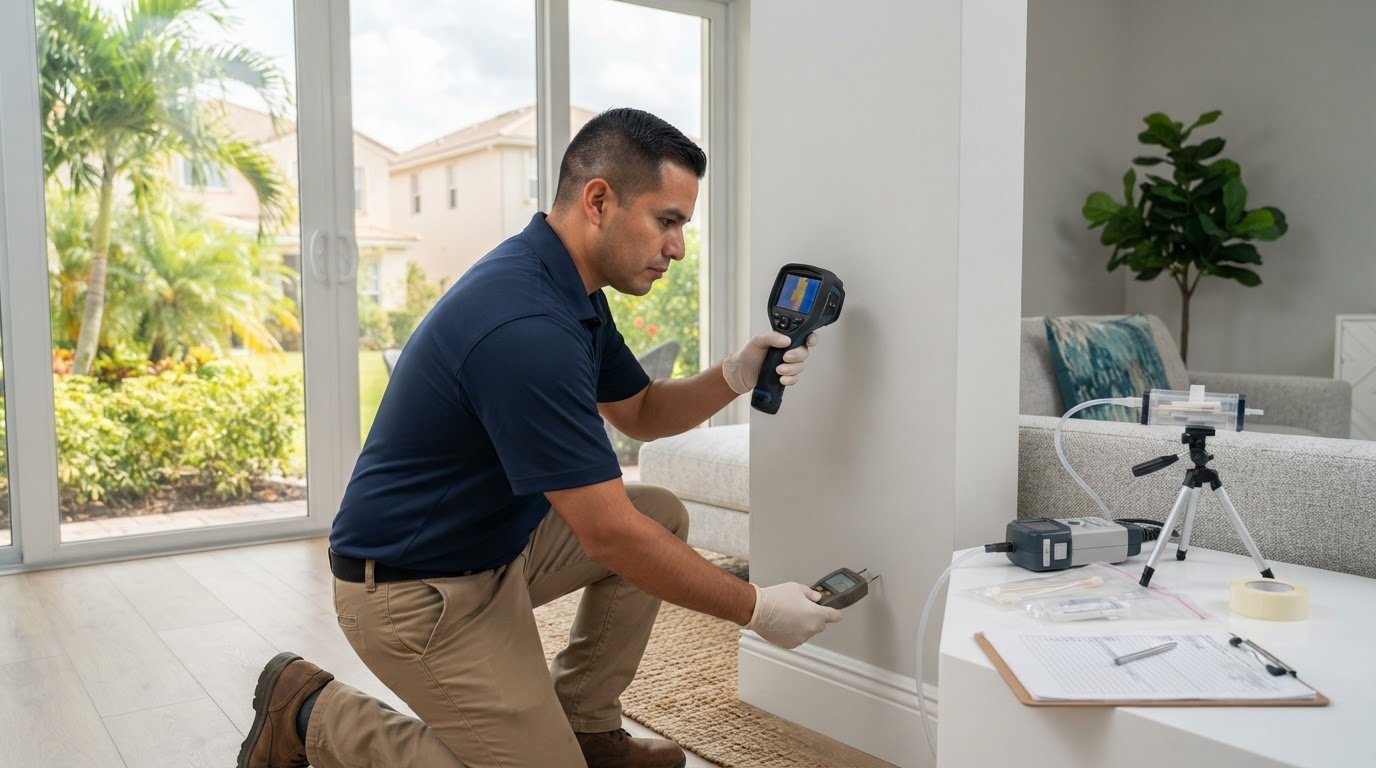
Capturing airborne spores in a test cassette won’t protect your property if you fail to find the water feeding them first. Definitive mold testing diagnoses the hidden moisture source before analyzing indoor air samples. If you recently discovered a plumbing drip, an air conditioning overflow, or a persistent musty smell behind your baseboards, you’re likely wondering whether you need professional mold testing Broward County specialists provide, and how the diagnostic process actually unfolds.
It’s completely natural to feel overwhelmed by the thought of toxic colonies spreading unseen behind drywall or under tile flooring. Confusing lab sheets filled with Latin species names and raw spore counts rarely offer comfort, especially when your family’s respiratory health and property value hang in the balance.
You don’t have to navigate this uncertainty alone. You’ll discover how certified assessments pinpoint concealed leaks, how independent lab data translates into real-world safety, and how a precise testing protocol protects your investment during remediation or insurance claims. Here is your clear roadmap to securing a healthy, dry home.
Key Takeaways
- Learn why professional mold testing Broward County homeowners rely on must pair non-invasive leak detection with air sampling to isolate hidden dampness.
- Understand how diagnostic tools like infrared thermography and electronic moisture meters uncover trapped water before colonies spread behind drywall or cabinetry.
- Discover the technical flaws of over-the-counter DIY settle plates and why volumetric air sampling is vital for accurate indoor air quality data.
- Find out how to decode complex laboratory spore reports by comparing indoor concentrations against outdoor baseline controls and identifying critical marker species.
- Verify Florida licensing requirements and conflict-of-interest statutes to ensure your assessment provider delivers an objective, actionable protocol.
Understanding Mold Testing in Broward County: Environmental Risks & Triggers
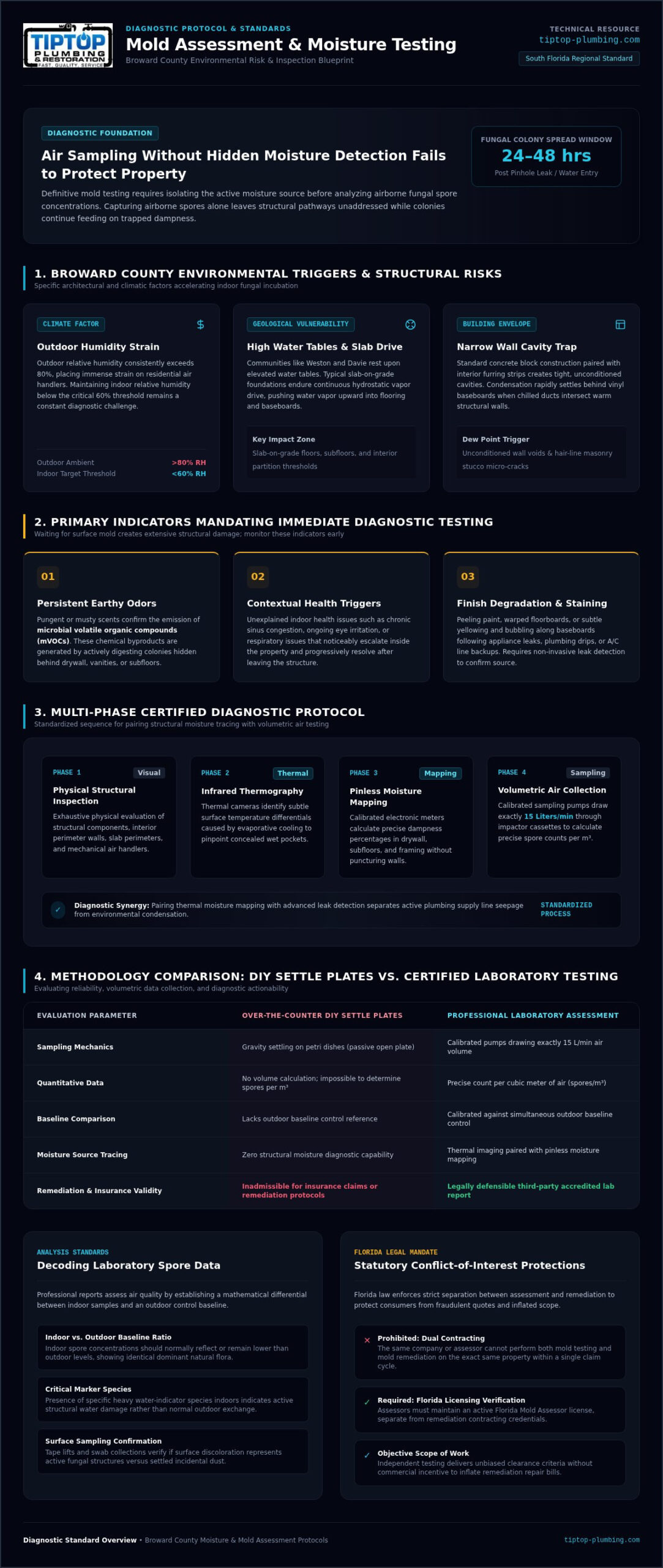
Professional mold testing is a specialized diagnostic process combining visual structural assessment, electronic moisture mapping, and quantitative laboratory analysis of air and surface samples to measure indoor fungal activity. In South Florida, intense year-round humidity and torrential afternoon rainstorms create an aggressive breeding ground for fungal colonies. Western Broward communities such as Weston and Davie sit atop high water tables, leaving typical slab-on-grade foundations susceptible to hydrostatic vapor drive. Standard concrete block construction with interior furring strips also forms narrow wall cavities that readily trap moisture. When hidden pinhole plumbing leaks occur, colonies can spread behind drywall within 24 to 48 hours. Scheduling certified mold testing Broward County property owners rely on establishes clear baseline conditions after a water intrusion, ensuring full diagnostic clarity before remediation begins.
South Florida Climate Factors and Indoor Humidity
Keeping indoor relative humidity strictly below 60% presents a daily challenge in Broward County. When outdoor humidity exceeds 80%, residential air handlers face severe mechanical strain. Chilled ductwork running through unconditioned cavities causes warm air to hit its dew point rapidly, prompting condensation behind vinyl baseboards and within insulation. During severe tropical storms, wind-driven rain penetrates hairline stucco cracks, saturating exterior masonry. Documented research on indoor mold species and behavior shows that persistent humidity alone can activate dormant spores, turning structural wall cavities into active fungal incubators.
Primary Warning Signs Requiring Immediate Investigation
Waiting for dark patches to appear on finished surfaces is a costly mistake. Fungal growth usually develops out of sight long before breaking through paint or trim. Watch for these critical warning indicators:
- Persistent earthy odors: A pungent, musty scent indicates microbial volatile organic compounds (mVOCs) released by active colonies concealed behind walls, vanities, or ceilings.
- Unexplained indoor health issues: Chronic sinus pressure, eye irritation, or respiratory issues that worsen inside the home and resolve when leaving.
- Water staining and discolored finishes: Peeling paint, warped flooring, or yellow stains along baseboards after an appliance or pipe failure. Pairing diagnostic air testing with non-invasive leak detection quickly confirms whether hidden structural components harbor active contamination.
The Professional Inspection Protocol: How Certified Testing Works
A rigorous investigation follows a methodical diagnostic pathway rather than guesswork. Certified inspectors begin with an exhaustive physical assessment, inspecting structural components, perimeter walls, and air handling equipment. However, visual evaluation only scratches the surface. Definitive mold testing Broward County properties require relies on precision instruments that uncover active moisture pathways hidden far behind interior finishes.
Non-Invasive Moisture Mapping & Thermal Imaging
Thermal imaging cameras detect subtle surface temperature differentials caused by evaporative cooling, immediately flagging wet pockets within ceiling assemblies and wall cavities. Once thermal anomalies are spotted, technicians deploy calibrated pinless moisture meters to measure actual dampness percentages inside gypsum board, subfloors, and wood framing without punching holes in your walls. This non-destructive moisture mapping establishes the exact perimeter of water travel. Pairing this analysis with advanced leak detection services ensures you find whether a slow supply line seepage or slab compromise sparked the issue in the first place.
Air Sampling and Surface Collection Methods
To evaluate indoor air quality, inspectors use high-volume sampling pumps calibrated to draw 15 liters of air per minute through specialized impactor cassettes. These cassettes trap airborne particulates across a designated time window, providing a quantifiable snapshot of fungal activity per cubic meter of air. Technicians also gather surface tape lifts or swab samples directly from suspect discoloration to identify the exact fungal genera colonizing the substrate.
Crucially, an outdoor baseline sample is collected at the same time under identical weather conditions. Because outdoor air naturally carries mold, evaluating indoor samples alongside an exterior control aligns directly with EPA guidelines on mold testing and sampling. If you suspect an unresolved leak is releasing hidden airborne contaminants, you can readily schedule an on-site property evaluation to secure definitive proof before damage escalates.
DIY Home Test Kits vs. Professional Laboratory Assessment
Picking up an over-the-counter mold test kit from a big-box hardware store might feel like a fast, economical shortcut. In reality, these retail kits often cause unnecessary panic while providing zero actionable data. South Florida air naturally carries ambient fungal spores at all times. Leaving an open petri dish filled with nutrient agar on a counter guarantees that background spores will land and grow within days. Studies show that DIY settle plates produce misleading results in up to 80% to 90% of residential uses. For true peace of mind, professional mold testing Broward County homeowners invest in relies on calibrated suction mechanics and certified environmental laboratories rather than passive petri dishes.
The Flaws of Gravity-Based Agar Dishes
Retail settle plates rely entirely on gravity. They capture only what happens to drop onto the agar, possessing no calibrated pump to calculate volumetric airflow. Heavy outdoor spores drop quickly onto the plate, while dangerous indoor varieties remain suspended in your breathing zone. Without a simultaneous outdoor baseline sample, a moldy dish cannot tell you whether the indoor spore count is abnormal or simply reflects routine air exchange through an open patio door.
Accredited Lab Analysis and Chain of Custody
Legitimate environmental testing demands strict scientific controls. Professional assessments send samples to independent laboratories accredited by the American Industrial Hygiene Association (AIHA) or ISO/IEC standards under strict chain-of-custody protocols. Trained microbiologists conduct direct microscopic examination and optical analysis, calculating exact spore concentrations per cubic meter of air.
Insurance adjusters and underwriters reject DIY kits immediately because uncalibrated dishes lack verifiable chain of custody. Documented testing adhering to Florida DBPR mold assessor licensing requirements provides defensible evidence that protects your financial interests. Whether negotiating an insurance claim or closing a property sale in Pembroke Pines or Weston, accredited laboratory reports establish legally recognized proof of your home’s structural and microbial condition.
Interpreting Your Lab Report: Spore Types, Counts, and Next Steps
Reviewing an environmental laboratory analysis can feel like deciphering a foreign language. The central principle of aerobiology is straightforward. A healthy indoor fungal ecology should statistically mirror or remain noticeably lower than outdoor background levels. South Florida air carries significant ambient mold, so laboratories evaluate indoor spore traps against an outdoor control collected during the exact same inspection. When indoor air reveals a heavy concentration of a single genus or indoor levels exceed outdoor benchmarks by three times, active fungal amplification is occurring. Certified mold testing Broward County specialists conduct cuts through confusing data sheets, transforming raw particle counts into clear, actionable property insights.
Common Indoor Fungi Genera Found in Broward
Accredited lab reports distinguish between harmless background spores and hazardous toxigenic markers. Common molds such as Cladosporium drift into homes through open doors and foot traffic, usually matching exterior baseline levels. In contrast, heavy marker species like Stachybotrys chartarum and Chaetomium thrive on saturated cellulose building materials. These toxigenic varieties produce microscopic mycotoxins linked to severe respiratory inflammation. Because their spores are dense and sticky, they don’t aerosolize easily unless actively disturbed. Detecting even twenty to fifty spores per cubic meter indoors flags chronic, hidden water damage. Meanwhile, Aspergillus and Penicillium species produce lightweight spores that aerosolize effortlessly, frequently dominating living spaces following untreated plumbing leaks.
Moving from Testing to Remediation and Recovery
A reliable testing report serves as an objective scope of work for subsequent property recovery. Moisture control comes first. Rushing into selective demolition without proper structural drying simply spreads airborne contaminants across unaffected living areas. Technicians must first isolate the moisture intrusion, repair compromised piping, and deploy commercial dehumidifiers to stabilize saturated wall studs and subfloors. Post-remediation clearance verification confirms whether professional remediation successfully restored a normal fungal ecology. Following water intrusion events, integrating diagnostic testing with comprehensive water damage restoration in Fort Lauderdale provides property owners with verifiable documentation to settle insurance claims and verify that their indoor living space is clean.
Selecting a Qualified Assessment Provider in Broward County
Hiring the right diagnostic professional protects your family’s health and ensures your property restoration proceeds on solid legal and structural ground. Navigating local directories can be tricky, as general handymen often attempt to market themselves as environmental specialists. Legitimate mold testing Broward County property owners depend on requires specialized equipment, strict compliance with state regulatory statutes, and an expert grasp of South Florida building dynamics.
Florida Licensing and Regulatory Standards
Florida enforces stringent statutory oversight to safeguard consumers from unqualified operators. Under Chapter 468 of the Florida Statutes, anyone conducting mold assessment must hold an active Mold-Related Services Assessor (MRSA) license issued by the Florida Department of Business and Professional Regulation (DBPR). You can readily verify an assessor’s credentials, active status, and disciplinary history directly through the DBPR licensing portal before allowing them on site. State law also mandates that licensed assessors carry at least $1,000,000 in general liability insurance coverage alongside errors, omissions, and pollution liability protection. Never settle for an uninsured technician or an uncertified report, as insurance providers routinely reject documentation from unlicensed sources.
The Value of Integrated Diagnostic Expertise
An environmental test is only as reliable as the root-cause diagnosis behind it. Air samples show you what is suspended in your living space, but they cannot tell you where a concealed leak began. Working with professionals who understand both aerobiology and complex plumbing infrastructure provides a distinct advantage. Before taking air samples, a skilled technician can identify the structural anomalies that drive fungal amplification, whether it’s a hidden pinhole copper leak or hairline joint failure.
When sudden pipe failures or drain backups strike, fast action is essential. Swift water extraction and structural drying stop fungal spores from germinating in the first place, containing structural damage before extensive remediation becomes necessary. Property owners seeking reliable local support can partner with Tip Top Plumbing & Restoration to pair advanced diagnostic leak detection, precision moisture mapping, and dedicated dry out services across Broward County communities including Plantation, Davie, and beyond.
Take Control of Your Indoor Air Quality Today
Concealed moisture never resolves on its own, and unaddressed dampness quickly compromises your entire living environment. Professional assessment delivers objective clarity, replacing anxious guesswork with concrete data. Combining non-invasive thermal imaging and electronic moisture mapping with accredited lab analysis allows you to pinpoint the moisture source fueling spore proliferation and halt structural decay before it spreads.
Scheduling reliable mold testing Broward County specialists provide gives you the defensible evidence needed to navigate insurance claims with complete confidence. You gain a verifiable baseline of your indoor environment alongside an actionable protocol designed for South Florida construction.
Restoring clean air and structural stability to your property is entirely within reach. Taking decisive action today safeguards your home’s value and ensures your family breathes clean, healthy air tomorrow.
Frequently Asked Questions
Is mold testing always necessary if mold is already visible?
Yes, testing is often essential even if surface growth is visible because it determines the full spread of airborne contamination and identifies specific fungal species. Visual inspection cannot tell you whether invisible spores have circulated into adjoining rooms or settled inside porous furnishings. In South Florida real estate transactions and insurance claims, independent laboratory documentation establishes the formal baseline needed to write a legally valid remediation protocol and verify post-cleanup safety.
Can a plumbing leak cause toxic mold inside wall cavities?
Yes, hidden plumbing leaks are a leading catalyst for toxic mold growth inside residential wall cavities. Pressurized supply lines or drain seepage saturate drywall cellulose and structural framing within hours. In humid climates across Davie and Plantation, dark, unventilated cavities provide ideal incubation conditions for toxigenic strains like Stachybotrys. Comprehensive leak detection paired with professional mold testing Broward County technicians provide pinpoints the moisture breach before spores compromise neighboring living areas.
How much time does it take to receive lab test results?
Standard turnaround time for independent laboratory mold analysis is typically between 24 and 48 hours after sample collection. Once an assessor gathers air cassettes or surface tape lifts, samples travel directly to an accredited environmental microbiology laboratory under strict chain of custody. Microbiologists perform direct optical microscopy to count and classify spores. Expedited processing is often available when urgent health concerns or time-sensitive property transactions demand immediate answers.
What happens if testing reveals elevated toxic black mold?
Discovering elevated marker species like Stachybotrys requires establishing immediate physical containment and developing an engineered remediation protocol. The testing report outlines the exact scope of affected materials that must be safely removed or treated under negative air pressure with HEPA filtration. Property owners should avoid disturbing the growth themselves, as agitated spores quickly contaminate unaffected rooms. Once structural drying and remediation conclude, independent clearance testing ensures spore concentrations return to normal baseline levels.
Does homeowners insurance cover professional mold testing in Florida?
Homeowners insurance frequently covers professional mold testing if the contamination stems directly from a sudden, covered water loss. Insurers generally approve diagnostic assessments following abrupt pipe bursts or accidental appliance overflows in Weston and Pembroke Pines. Coverage is typically denied if mold resulted from long-term maintenance neglect or chronic roof leaks. Property owners should review their specific policy limits, as many Florida carriers cap mold remediation and diagnostic testing benefits under standard policy endorsements.
Can mold spread throughout my home through the air conditioning ducts?
Yes, forced-air ventilation systems can rapidly distribute microscopic spores from an isolated leak across an entire residence. When an active colony releases spores near a return vent or inside damp wall cavities, the central air handler pulls those particulates into the ductwork. The system then circulates them into every connected room. Professional air sampling evaluates cross-contamination between living areas, confirming whether airborne amplification remains localized or has compromised the entire building envelope. To optimize humidity regulation and prevent condensation issues within your cooling system, discover BulletProof Air for guidance on ideal indoor Florida settings.
How do inspectors determine the difference between old and active mold?
Inspectors distinguish between historical staining and active mold growth by pairing laboratory analysis with electronic moisture readings. Inactive mold colonies sit on dry building materials, while active fungal colonies require sustained moisture to grow and release fresh spores. Assessors utilize calibrated pinless moisture meters and infrared thermal imaging to verify whether the underlying substrate remains wet. Air sampling also reveals whether the colony actively sheds spores into the living environment, distinguishing recent amplification from past water intrusion.
Disclaimer
The information provided in this article is for general educational and informational purposes only and should not be considered professional plumbing, restoration, mold remediation, or legal advice. Every plumbing system, property, and situation is unique, and the recommendations discussed may not apply to your specific circumstances.
While Tip Top Plumbing & Restoration strives to provide accurate and up-to-date information, we make no warranties regarding the completeness, accuracy, or reliability of the content. Any actions you take based on this information are at your own risk.
Plumbing repairs, water damage restoration, and mold remediation should be performed by qualified professionals and in accordance with applicable local building codes and regulations. If you are experiencing a plumbing emergency, water leak, or property damage, contact a licensed professional for an on-site evaluation.
Tip Top Plumbing & Restoration is licensed and insured to provide plumbing and restoration services throughout Broward County, Florida.