

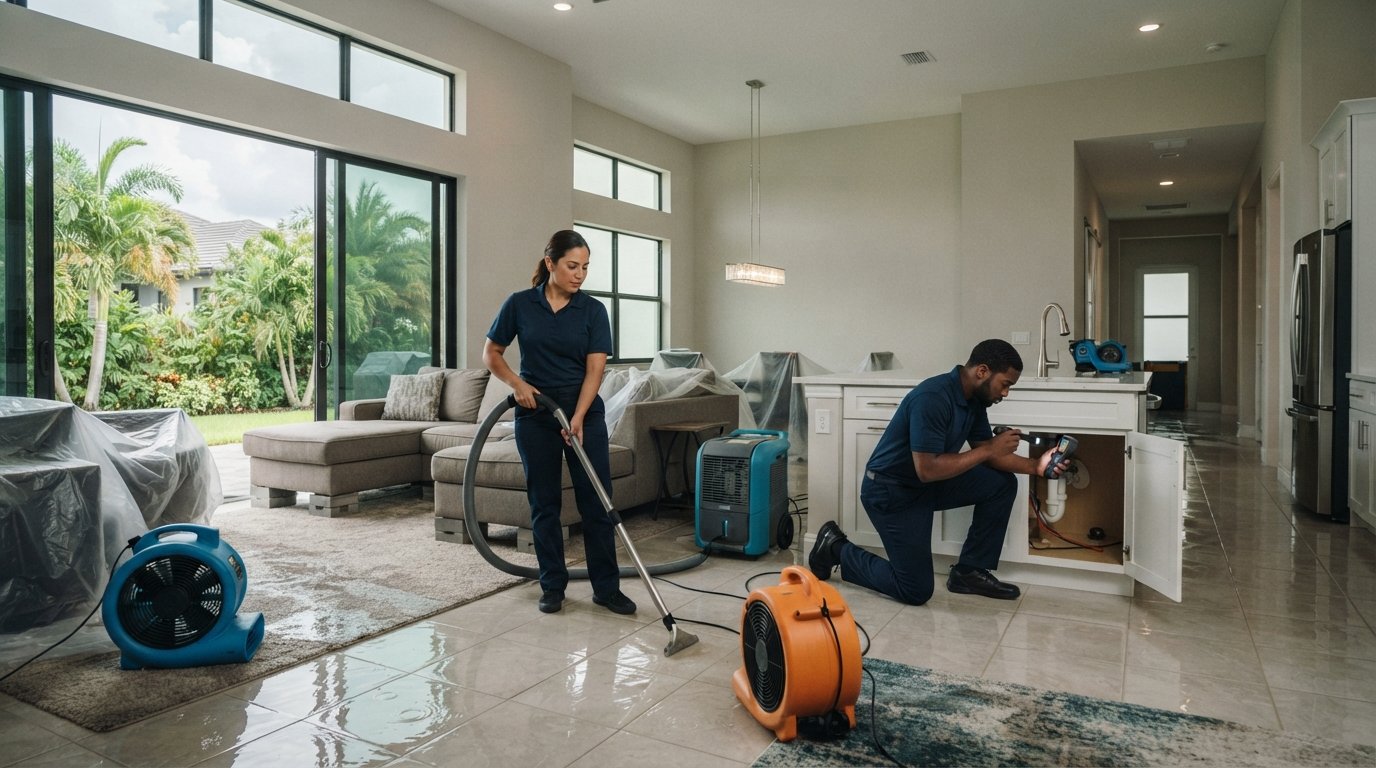
Drying wet floors won’t save your property if the broken plumbing line feeding the disaster remains active inside your walls. When water rapidly spreads across your baseboards, the panic is immediate. South Florida’s oppressive humidity gives you a razor-thin window, allowing toxic mold to colonize wet drywall within 24 to 48 hours. When disaster strikes, securing immediate water damage restoration Davie FL residents can trust requires stopping the plumbing failure at its origin, not just vacuuming surface puddles.
You shouldn’t have to battle trapped dampness, musty odors, or complicated insurance paperwork while worrying whether the underlying leak was truly resolved. Discover how rapid, professional water damage restoration in Davie protects your home, foundation, and air quality against devastating South Florida moisture. We will explore the critical steps of industrial water extraction, precision moisture mapping, source pipe repair, and the documentation required to bring your living space back to pristine condition.
Key Takeaways
- Understand how South Florida’s ambient humidity accelerates capillary action, pulling water deep into porous drywall and baseboards within hours.
- Discover the five-stage scientific drying protocol and how advanced thermal imaging pinpoints trapped moisture pockets behind finished walls.
- Learn why successful water damage restoration Davie FL homeowners rely on must pair structural dry-out with precision plumbing leak detection at the source.
- See how relying on store-bought fans leaves foundation subfloors soaked, creating ideal conditions for hidden rot and toxic mold.
- Master the critical emergency safety steps to execute immediately, including managing electrical hazards while professional technicians are en route.
Emergency Water Damage in Davie FL: Why Immediate Action Matters
Standing water in South Florida is an active structural threat, not a passive cleanup task. Professional water damage restoration goes far beyond mopping floors; it requires stabilizing indoor relative humidity, establishing controlled air pressure, and halting deep moisture migration. In Davie, local environmental dynamics make immediate mitigation critical. Porous building assemblies like drywall, baseboards, and structural sill plates absorb pooling water through capillary action, pulling moisture upward like a continuous wick. Standard retail shop vacuums lack the extraction pressure to pull liquid from subfloor layers or structural concrete, leaving behind dangerous saturation pockets.
The First 24 to 48 Hours: Stopping the Clock on Mold Growth
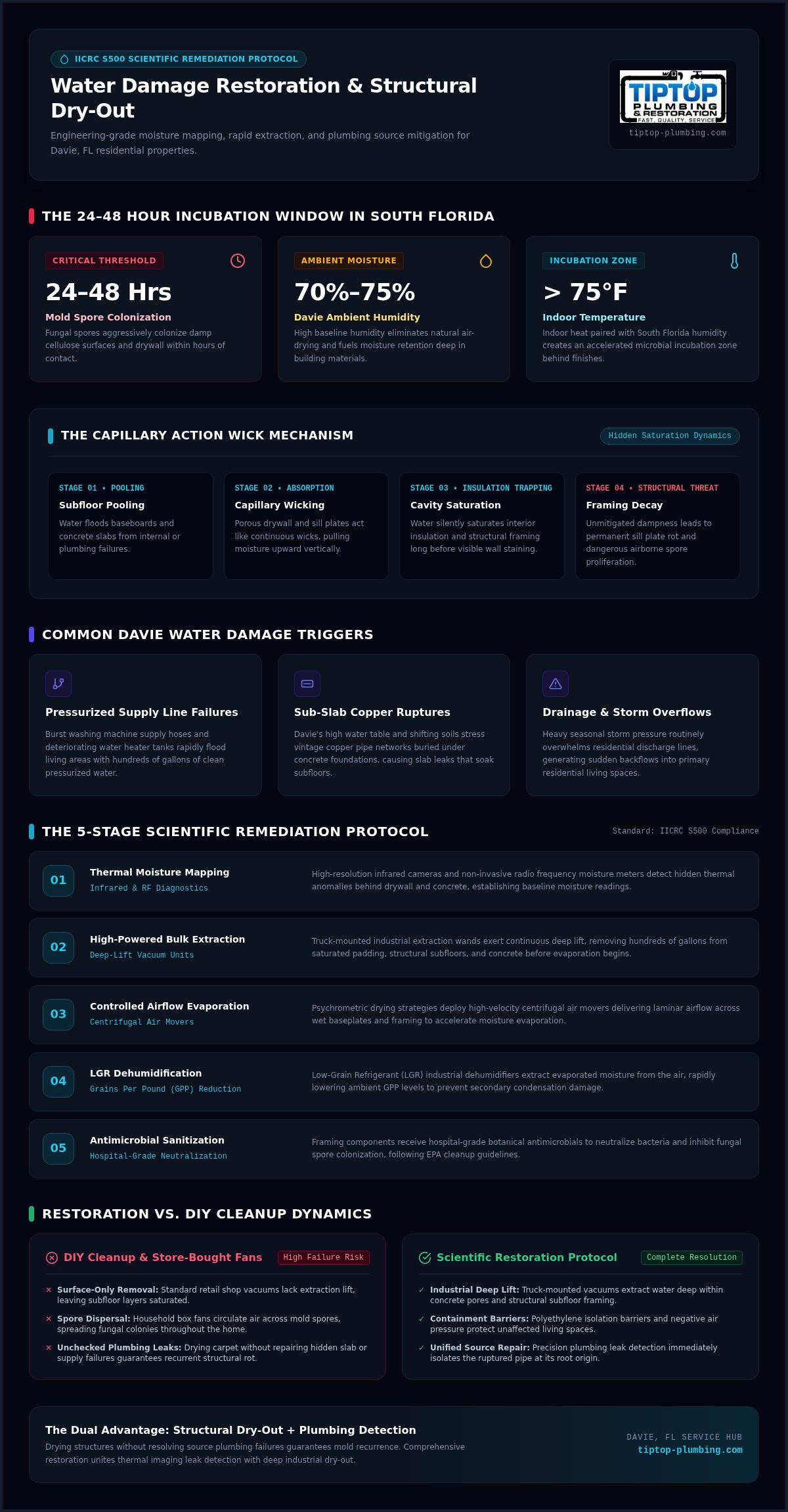
Every minute counts once moisture enters your home. Indoor temperatures exceeding 75 degrees Fahrenheit combine with South Florida’s typical 70% to 75% ambient humidity to create an aggressive incubation zone. Fungal spores colonize damp cellulose surfaces within 24 to 48 hours. Water silently travels past wall finishes, saturating interior insulation and dark sill plates long before surface staining appears. Effective water damage restoration Davie FL specialists deploy includes setting immediate containment barriers to preserve uncontaminated rooms, scrubbing indoor air, and protecting your household’s respiratory health.
Common Water Damage Triggers Across Davie Properties
Davie homes face distinct geographical and structural plumbing challenges that national mitigation franchises routinely overlook:
- Pressurized Supply Failures: Burst washing machine supply hoses and deteriorating water heater tanks rapidly flood living areas with hundreds of gallons of clean water.
- Sub-Slab Copper Ruptures: Davie’s high water table and shifting soils stress vintage copper pipe networks buried under concrete foundations, causing slab leaks that silently soak subfloors. Working with a dedicated plumber in Davie, FL ensures the broken pipe is located alongside structural extraction.
- Drainage and Storm Overflows: Heavy seasonal storm pressure often overwhelms residential discharge lines, sending backflows into primary living spaces.
Leaving saturated subfloors unaddressed while simply drying the visible carpet invites hidden microbial decay. Immediate, professional extraction stops this progression before structural framing suffers permanent rot.
The 5-Stage Scientific Water Restoration and Dry-Out Process
Remediating structural flooding demands an empirical approach dictated by the IICRC S500 standard, not guesswork. Water damage restoration Davie FL properties require follows a methodical five-stage protocol that coordinates thermal mapping, mechanical water removal, structural drying, and sanitization. Skipping scientific steps leaves moisture trapped inside wall cavities, guaranteeing long-term building degradation.
Phase 1 & 2: Thermal Moisture Mapping and High-Powered Bulk Extraction
Technicians begin by deploying high-resolution infrared cameras alongside non-invasive radio frequency moisture meters. This hardware detects hidden thermal anomalies behind drywall and concrete, establishing definitive baseline moisture readings before physical disruption begins. Containment zones using heavy polyethylene sheeting are erected immediately, preventing spore migration into unaffected living spaces. Next, heavy-duty truck-mounted vacuum units extract bulk liquid from flooring materials. Standard household shop vacuums pull only surface dampness, while industrial extraction wands exert continuous deep lift, removing hundreds of gallons from saturated padding and subfloors before evaporation even starts.
Phase 3 & 4: Controlled Evaporation, Dehumidification, and Antimicrobial Sanitization
Once bulk water is removed, the drying strategy shifts to psychrometrics, the science of drying air and structures. Centrifugal air movers direct laminar airflow across wet baseplates, accelerating evaporation. Low-Grain Refrigerant (LGR) dehumidifiers then capture this airborne water, driving down grains per pound (GPP) of ambient moisture far faster than standard residential units. Framing components receive hospital-grade botanical antimicrobials to neutralize bacteria and inhibit spores, aligning with safe containment standards like the EPA mold cleanup guide. Similar precision protocols govern water damage dry out Weston FL procedures, where maintaining correct vapor pressure differentials ensures building assemblies dry thoroughly from within.
Phase 5: Daily Moisture Logging and Structural Clearance
Mitigation ends only when quantitative data proves the structure has returned to its dry standard. Technicians conduct daily psychrometric logging, recording relative humidity, ambient temperature, and wood moisture equivalent (WME) percentages across affected framing members. Structural wood must reach a stable moisture content below 16% to eliminate fungal growth hazards. Detailed moisture logs and drying verification records are compiled directly for insurance adjusters, certifying that wall assemblies have stabilized. If your property is currently holding standing water, reserve your emergency inspection through the Tip Top online booking portal to initiate swift extraction.
Restoration vs. DIY Cleanup: Why Hidden Moisture Destroys Foundations
Reaching for bath towels and box fans during a flood creates an illusion of recovery. While the surface feels dry within hours, water remains trapped inside wall cavities and structural framing. Proper water damage restoration Davie FL properties require technical extraction equipment designed to pull trapped water out of dense structural assemblies before materials cup, warp, or rot.
| Restoration Metric | DIY Cleanup (Fans & Shop Vacs) | Professional Mitigation (IICRC Standards) |
|---|---|---|
| Depth of Extraction | Surface level only; leaves subfloors soaked | Weighted sub-surface extraction wands |
| Moisture Tracking | Visual inspection and surface touch | Non-destructive infrared cameras and penetrating pins |
| Humidity Control | Circulates humid room air, feeding spores | Commercial LGR dehumidifiers removing deep ambient vapor |
| Cavity Drying | Requires massive drywall demolition | Targeted positive/negative air pressure injection systems |
The Anatomy of Hidden Water: Under Slabs, Flooring, and Cabinetry
Water always follows gravity to the lowest structural boundary. Modern luxury vinyl tile (LVT) and glued-down engineered wood act as vapor barriers, trapping moisture underneath against the concrete foundation. Porous concrete slabs absorb this trapped volume, triggering mineral efflorescence, adhesive failure, and loose tiles. Under kitchen and bathroom base cabinets, stagnant pockets fester completely undetected. Certified technicians utilize specialized high-pressure floor mat systems and wall-cavity injection units to draw moisture straight through the assemblies without gutting expensive cabinetry.
Homeowner Insurance Realities and Claim Denials in Florida
Amateur cleanups frequently jeopardize insurance coverage. Under Florida law (Fla. Stat. §627.70132), policyholders face strict claim notice windows, and carriers demand clear evidence of proactive mitigation. If you fail to adhere to established protocols, such as those outlined in the EPA guidelines on flood cleanup, adjusters can deny subsequent mold claims by citing continuous neglect. Comprehensive contractor moisture maps, psychrometric records, and thermal imagery provide the exact audit trail needed to prove you took prompt action to protect your home and satisfy policy conditions.
The Dual Advantage: Uniting Plumbing Leak Detection with Restoration
Setting up industrial drying blowers over an active, undetected plumbing failure is an exercise in futility. When water intrusion originates from a pressurized line hidden inside a wall or subfloor, running dehumidifiers without fixing the break merely manages symptoms while structural rot spreads. Most national mitigation franchises focus solely on extraction, forcing homeowners to call independent plumbers to isolate the leak. This fragmented approach causes dangerous dispatch delays, duplicate diagnostic fees, and contradictory insurance reports. Seamless water damage restoration Davie FL homeowners depend on begins by shutting down the active leak before extracting a single drop.
Stopping the Intrusion: From Pinholes to Hidden Slab Leaks
Locating a pressurized breach beneath a concrete slab requires pinpoint acoustic technology rather than destructive exploration. Technicians utilize frequency-filtered ground microphones and helium tracer gas testing to trace hairline fractures inside subterranean pipes. Utilizing advanced professional leak detection services isolates the failure point without trenching across your entire living room. In established Davie neighborhoods, aged copper lines often suffer from aggressive pinhole pitting caused by water chemistry and shifting sandy soils. Once technicians isolate the copper rupture, targeted pipe repairs or surgical reroutes stop the flow, allowing drying equipment to operate against a stabilized structure.
Post-Mitigation Safety: Certified Mold Testing and Clearance
Extracting liquid and repairing the pipe resolves the immediate crisis, but verifying indoor environmental safety requires empirical biological testing. Active mold colonies release volatile organic compounds and microscopic mycotoxins that persist even after structural wood looks dry. Professional post-mitigation protocol incorporates calibrated air cassette sampling and surface swab testing. These laboratory-analyzed samples measure ambient spore counts against outdoor baseline levels, differentiating between harmless background dust and elevated indoor mold amplification. Securing a clean clearance certificate provides verifiable legal proof that your indoor living space is biologically sound.
Emergency Water Remediation in Davie: Actionable Steps and Local Support
Taking immediate, deliberate steps during a water crisis minimizes permanent structural damage and protects personal safety. Standing water in a residence presents severe electrical and biological hazards that must be managed before remediation teams arrive. For homeowners across Broward County, securing timely water damage restoration Davie FL specialists deliver requires executing a decisive triage sequence to stabilize the property and build clear insurance documentation.
Immediate Safety Checklist While Technicians Are En Route
Protecting your household and property begins with three critical containment measures:
- Cut the Flow at the Main Valve: Locate your primary water shut-off valve, typically found near the street meter box or exterior exterior hose bib, and turn it clockwise until fully closed to stop incoming pressure immediately.
- Eliminate Shock Hazards: Never step into standing water if electrical outlets, submerged power strips, or floor-level appliances are submerged. Shut off power to affected living areas directly at the main electrical breaker panel first.
- Isolate Porous Furnishings: Place heavy aluminum foil squares or plastic wrap beneath the legs of wooden tables, couches, and cabinets. Pin draperies up to curtain rods to prevent moisture from wicking upward into fabrics.
- Document the Initial Water Line: Record high-resolution photos and wide-angle videos capturing standing water levels, wet drywall margins, and impacted personal possessions before moving any major items.
Securing Rapid Dispatch and Peace of Mind Across Broward
Navigating home recovery requires an agile team that understands local foundation designs, high water tables, and Broward insurance documentation requirements. Technicians serving the Davie service area deploy high-volume extraction equipment directly to your driveway, stabilizing humidity within the critical 24- to 48-hour mold threshold. Homeowners receive transparent communication throughout the entire project lifecycle, from initial moisture profiling to final dry-out sign-off.
Stopping water spread preserves your family’s living environment and protects long-term real estate equity. If a sudden plumbing failure or localized flooding has compromised your floors, don’t wait for moisture to climb your walls. Book your emergency water restoration service immediately to dispatch certified extraction equipment straight to your door.
Take Decisive Action to Restore Your Property Today
Recovering from indoor flooding requires far more than surface suction and open windows. Lasting water damage restoration Davie FL properties require pairs acute leak detection with scientific structural drying. By deploying dual-certified emergency plumbing and professional structural drying technicians, you stop the underlying plumbing failure and trapped dampness in a single coordinated response. Advanced non-invasive thermal imaging and moisture mapping technology locate hidden saturation beneath slabs and wall cavities before rot sets in. Comprehensive insurance claim assistance with detailed psychrometric drying logs ensures your policy coverage remains protected every step of the way.
You don’t have to handle complex plumbing repairs and high-stakes structural drying on your own. Taking immediate action stabilizes your property, shields your family from hazardous airborne microbes, and completely restores your peace of mind.
Frequently Asked Questions
How quickly does mold begin growing after water damage occurs in a Davie home?
Mold typically begins colonizing wet indoor materials within 24 to 48 hours. South Florida’s climate, characterized by steady ambient humidity above 70%, significantly accelerates fungal incubation. Porous components like sheetrock backing, wood studs, and carpet padding provide immediate nourishment for airborne spores. Prompt bulk extraction and commercial dehumidification during this critical window prevent microscopic spores from spreading into extensive microbial colonies.
Will my homeowners insurance policy cover water damage restoration in Davie FL?
Most standard Florida homeowners insurance policies cover sudden and accidental discharge, such as burst pressurized supply pipes or appliance ruptures. Coverage typically excludes long-term neglected leaks or external floodwater without an active flood insurance rider. Securing professional water damage restoration Davie FL specialists deliver ensures you receive detailed moisture maps, thermal photos, and psychrometric logs that provide verifiable documentation for your adjuster.
Can I use standard box fans and dehumidifiers to dry out my flooded floor?
Standard household fans and retail dehumidifiers lack the mechanical capacity to dry saturated structures. Box fans merely blow humid air across wet flooring, evaporating superficial drops while driving moisture deeper into baseplates, subflooring, and concrete slabs. Professional mitigation requires low-grain refrigerant dehumidifiers and high-velocity air movers working in tandem to pull trapped vapor out of dense structural assemblies.
What is the difference between water mitigation and water damage restoration?
Water mitigation focuses on immediate damage control: isolating the plumbing failure, extracting bulk standing water, removing unsalvageable porous components, and fully drying structural framing. Restoration is the subsequent phase where technicians rebuild the property. This includes replacing drywall, laying fresh flooring, repainting, and returning the home to its pre-loss condition once structural moisture logs prove complete drying.
How do technicians detect water hidden behind walls and underneath tiled floors?
Restoration technicians use non-destructive diagnostic instruments, primarily high-resolution thermal imaging cameras and dual-depth moisture meters. Thermal imaging detects temperature differentials caused by active evaporation behind finished walls. Radio-frequency pinless meters and penetrating resistance probes then assess exact moisture content within wood studs, subfloors, and concrete without causing unnecessary cosmetic damage to intact surfaces.
Do I need to leave my house during the industrial water dry-out process?
You can usually remain in your home if damage is confined to an isolated room that can be sealed behind containment barriers. If large living spaces require heavy fleets of industrial dehumidifiers, the resulting equipment heat and continuous noise can be uncomfortable. If standing water contains category two or three contaminants, temporarily vacating protects your household’s respiratory health.
What should I do immediately after discovering a burst pipe or flooded room?
Shut off your property’s main water supply valve immediately to cut incoming water volume, then turn off the electrical breakers controlling the flooded space. Never step into standing water if electrical outlets or appliances are submerged. Take comprehensive photo and video evidence for your insurance company, then call a certified team equipped to handle both emergency plumbing repair and structural dry-out.
Disclaimer
The information provided in this article is for general educational and informational purposes only and should not be considered professional plumbing, restoration, mold remediation, or legal advice. Every plumbing system, property, and situation is unique, and the recommendations discussed may not apply to your specific circumstances.
While Tip Top Plumbing & Restoration strives to provide accurate and up-to-date information, we make no warranties regarding the completeness, accuracy, or reliability of the content. Any actions you take based on this information are at your own risk.
Plumbing repairs, water damage restoration, and mold remediation should be performed by qualified professionals and in accordance with applicable local building codes and regulations. If you are experiencing a plumbing emergency, water leak, or property damage, contact a licensed professional for an on-site evaluation.
Tip Top Plumbing & Restoration is licensed and insured to provide plumbing and restoration services throughout Broward County, Florida.