

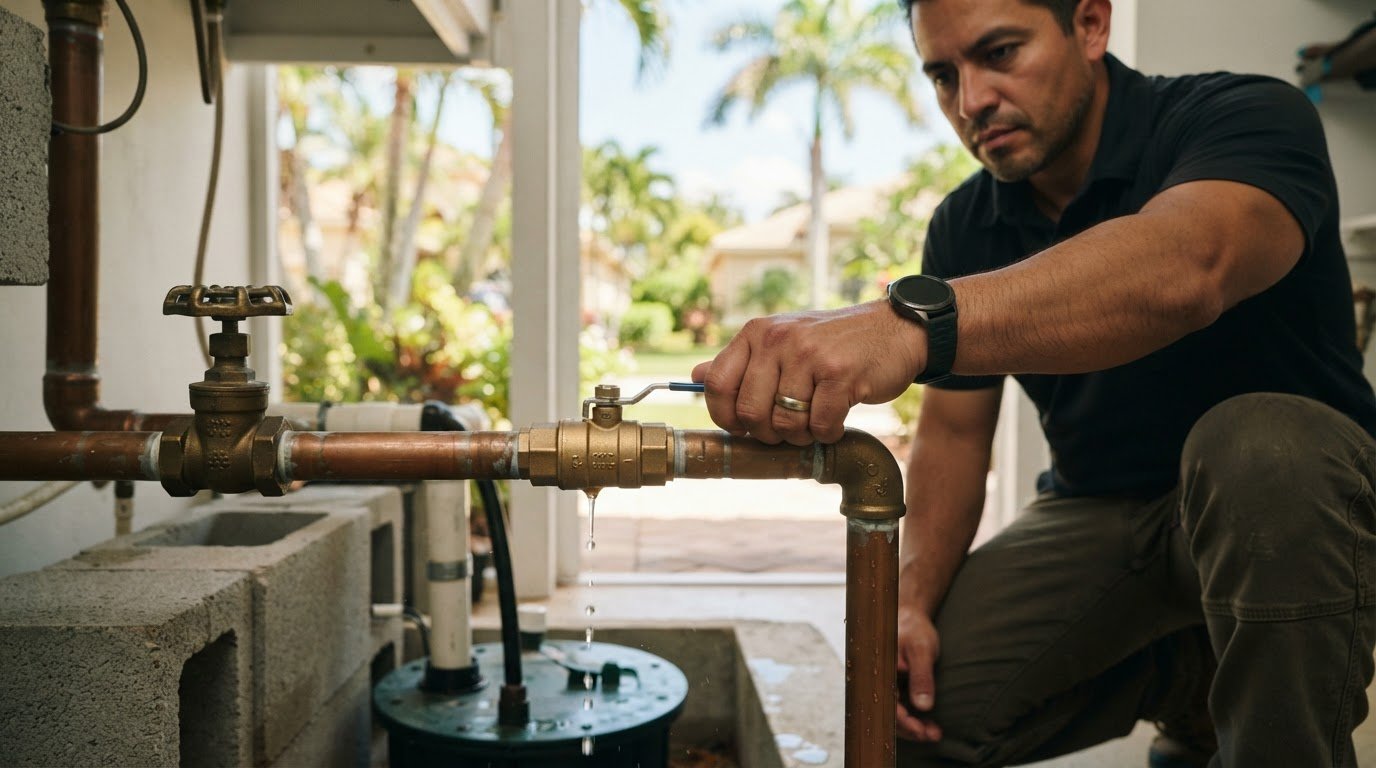
One quick turn can help keep a plumbing leak from soaking your home. Knowing where your main water shut off valve is before an emergency can save time when a pipe bursts or a fixture starts leaking. But the water meter and the valve that controls water entering your house aren’t necessarily the same thing, and an old, rusty handle can make a stressful moment feel even riskier.
It’s understandable to hesitate before touching plumbing that looks worn. This guide explains where to look, how to operate common valve types safely, and what to do if a valve is stuck or damaged.
You’ll learn how to distinguish your home’s shut-off valve from the utility meter and what to do if the handle won’t move. Don’t force a resistant valve. For homeowners in Broward County, shutting off the water is an important first step during a plumbing emergency. Leak detection and plumbing repairs can help address the cause, while water remediation and dry-out services can address resulting water damage.
Key Takeaways
- Trace the incoming water line and check common Broward County locations to narrow down where your home’s main water shut off valve may be.
- Recognize the difference between a quarter-turn ball valve and a wheel-handle gate valve so you can operate the right type correctly.
- Respond to a stiff or leaking valve without forcing aging plumbing and making the problem worse.
- Use simple maintenance checks to spot valve problems before an emergency makes them harder to manage.
- After shutting off the water, relieve remaining pressure and assess what cleanup or repair steps may still be needed.
What Is a Main Water Shut Off Valve and Why Is It Critical?
The main water shut-off valve controls the water supply entering your home. If a pipe breaks or a leak suddenly worsens, closing this valve can stop the incoming flow while you arrange repairs.
This is different from a local shut-off valve, such as the small valves beneath a sink or behind a toilet. A local valve controls water to one fixture; the main valve cuts off water to most or all of the home’s plumbing. The general purpose of a stopcock is to control liquid or gas flow, as explained in Stopcock – Wikipedia. Knowing which valve does what helps you act without wasting time testing fixture valves during a larger leak.
Make sure everyone in your household knows the main valve’s location and how to recognize it. The person who first notices a leak may not be the person who usually handles home maintenance. Show household members the route, keep the area clear, and explain that a stiff or corroded handle should not be forced. In Broward County homes with slab-on-grade construction, a fast shutoff can help stop continued water flow while the source is assessed.
The Cost of a Delayed Response
A burst pipe can release water continuously. The flow rate depends on factors such as pipe size and water pressure, so there isn’t one reliable figure for every home. The practical point is that water keeps entering until the flow is stopped. Standing water can also create conditions that support mold growth, a particular concern in Florida’s humid climate. A working shut-off helps control the situation while leak detection helps identify where water is escaping.
Closing the valve is a useful first step in plumbing triage, not a repair by itself. It can limit active flow and give Tip Top Plumbing & Restoration a starting point for investigating the leak. If the valve won’t close or the source remains unclear, the company’s leak detection service can help locate the problem and guide the next repair.
Utility Meter vs. House Shut-Off
The water meter is commonly housed in a box near the curb or property line and may have a utility lock or seal. Don’t tamper with a locked meter assembly. Instead, locate the homeowner’s valve inside or near the house, where it can be reached quickly without special access. If you’re unsure which component belongs to the utility, contact the local water utility for guidance about its equipment.
An accessible house valve matters because reaching a curbside box may take longer, especially in poor weather or when the area is obstructed. Once you find your valve, make sure household members can reach it and understand its purpose. If it appears damaged, leaks around the handle, or won’t operate, have Tip Top Plumbing & Restoration assess it rather than relying on it in an emergency.
Finding Your Main Water Shut Off Valve: Common Locations
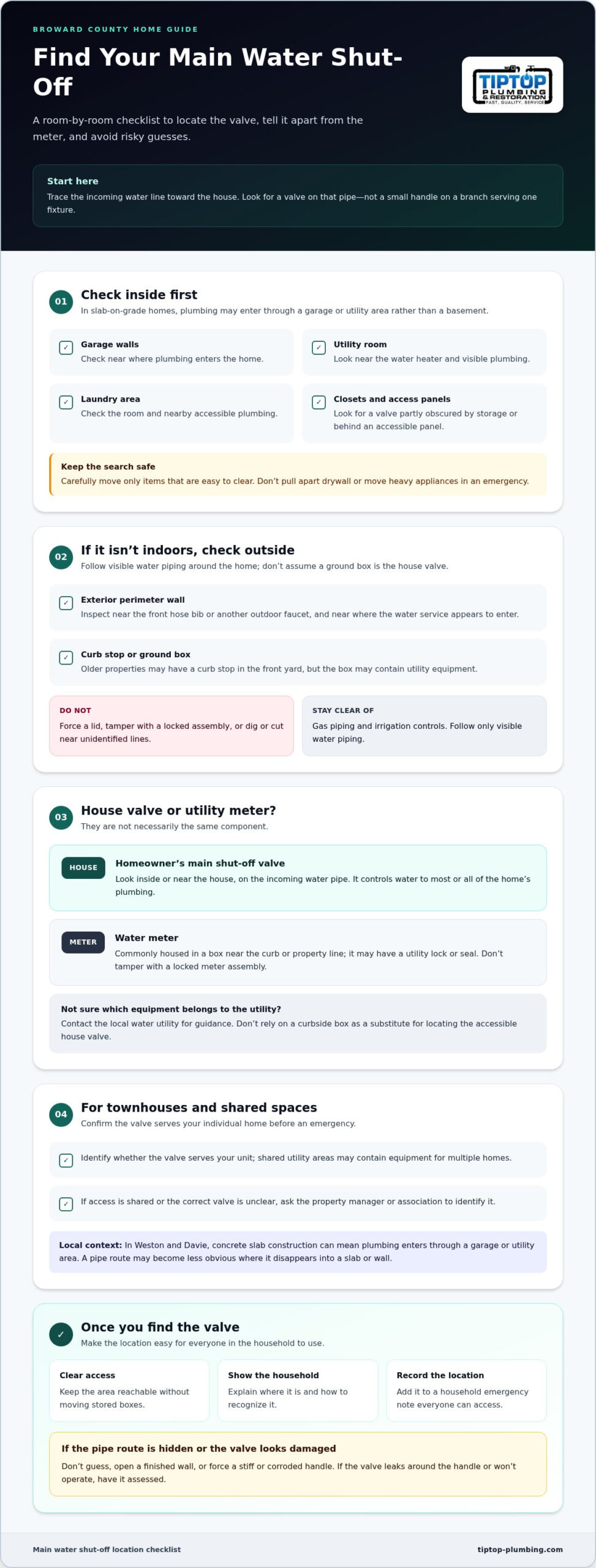
Start at the point where the water service enters your property, then follow the visible plumbing toward the house. If you know where the meter is, use it as a reference point, but don’t assume the shut-off is inside its box. The homeowner’s valve may be indoors or mounted on an exterior wall. Look for a valve on the incoming water pipe, rather than a small handle on a branch serving one fixture.
In Broward County, construction details matter. Homes in Weston and Davie often sit on concrete slabs, so plumbing may enter through a garage or utility area rather than a basement. The pipe route can be less obvious when it disappears into a slab or wall. Search methodically, and make a note of the location once you find the valve.
Interior Locations: Garages and Utility Rooms
Check garage walls and utility rooms first, especially near the water heater or where plumbing enters the home. Also look in laundry rooms and nearby closets, including behind an access panel. The valve may be partly obscured by storage, but don’t pull apart drywall or move heavy appliances in an emergency. Carefully clear movable items. If the pipe is concealed, Tip Top Plumbing & Restoration can help trace plumbing and assess access.
Exterior Locations: Perimeter Walls and Ground Boxes
If you don’t find an interior valve, inspect the exterior wall near the front hose bib or another outdoor faucet. Older Broward County properties may also have a curb stop in the front yard, but a ground box can contain utility equipment, so don’t force a lid or tamper with a locked assembly. Avoid digging or cutting near unidentified lines. Follow only visible water piping, and keep clear of gas piping and irrigation controls.
Use this checklist to make the search manageable, especially in a multistory home or townhouse in Miramar or Pembroke Pines:
- Check the garage, utility room, laundry area, and accessible plumbing closets.
- Look along the exterior perimeter near hose bibs and where the water service appears to enter.
- In a townhouse, identify whether the valve serves your individual unit; shared utility areas may contain equipment for multiple homes.
- If access is shared or the valve remains unclear, ask the property manager or association to identify the correct shut-off before an emergency.
Once you locate it, clear the area and show other household members how to recognize the valve. If the incoming line disappears beneath the slab or the valve is hidden behind a finished wall, avoid guessing or opening the structure yourself. Tip Top Plumbing & Restoration provides plumbing services and leak detection to help investigate unclear pipe routes and hidden plumbing problems. Schedule plumbing help if you need assistance.
Record the location in a place everyone can access, such as a household emergency note. The main water shut off valve should be reachable without moving stored boxes or searching through unfamiliar utility spaces. Keep its path clear, and revisit the location if renovations change the room layout. For homeowners who need assistance with general home maintenance or keeping utility areas accessible, services such as americanhandymanknox.com can help with routine household repairs and upkeep.
Identifying Valve Types and How to Operate Them
Before turning anything, identify the handle and the pipe it controls. Main water valves commonly have either a short lever or a round wheel, and the operating motion differs. Move carefully: an old valve can be stiff because of wear or corrosion, and extra force may damage the valve or nearby piping. If the handle looks fragile or the pipe shifts when you touch it, stop and get professional help.
Ball Valves: The Modern Standard
A ball valve usually has a straight lever and closes with a quarter-turn, which makes it quick to operate during an emergency. The valve is off when its handle sits perpendicular to the pipe. When the handle lines up parallel with the pipe, the valve is generally open. Turn the lever steadily until it reaches its natural stop. Don’t push past it or use a tool for extra leverage.
This visual cue makes it easier to check the valve’s position quickly. If it won’t move smoothly or doesn’t reach the closed position, don’t assume the water is off. A damaged or seized valve needs assessment, particularly if movement causes the pipe or fittings to twist.
Gate Valves: Maintenance and Risks
A gate valve typically has a round wheel handle. On most standard gate valves, turning clockwise closes the valve and turning counterclockwise opens it, the familiar “righty-tighty” rule. Older valves in homes around Southwest Ranches and Plantation may be stiff or worn, but age and condition vary by property. A crunchy feel, unusual resistance, or visible corrosion is a reason to stop rather than apply more force.
Inside, a gate valve raises or lowers a barrier to control flow. Wear can prevent it from sealing fully, even if the wheel turns. Forcing a stuck handle may damage the stem, leaving the valve unable to shut off the water. If the main water shut off valve won’t operate as expected, Tip Top Plumbing & Restoration can inspect the valve and surrounding piping and determine whether repair or replacement is needed.
Use these checks before operating a valve:
- Look at the handle style. A lever usually indicates a quarter-turn ball valve; a wheel usually indicates a gate valve.
- Follow the pipe. Compare the lever’s direction with the pipe to understand whether a ball valve is open or closed.
- Move gently. Don’t force a handle that is stuck, crunchy, corroded, or causing the pipe to move.
- Check for markings. Follow any open and closed labels on the valve, since configurations can vary.
Show other household members how to operate the valve so they don’t waste time or strain an aging handle during a leak. If a valve feels unreliable, arrange an assessment before an emergency. A stuck handle can point to plumbing issues that need diagnosis. For property owners seeking professional assistance outside the region, Prodigy Mechanical provides full-service plumbing support to address valve maintenance and system reliability.
Maintenance: What to Do If the Valve Is Stuck or Leaking
A valve that works today may seize after sitting untouched for years. As a preventive check, inspect it twice a year and gently operate it only if the handle moves freely. Stop if it resists, grinds, or causes the pipe to shift. The purpose of exercising a valve is to reveal trouble while there’s no active leak, not to force it through resistance.
Careful Steps for a Stiff or Leaking Valve
If the handle is only mildly stiff, clear the area and look for corrosion, moisture, or movement at the pipe joints. A small amount of penetrating oil may be applied to the exterior metal stem only if the product label allows that use. Keep it away from drinking-water openings and follow the product directions. Don’t strike the pipe or valve body to loosen the handle. If it still won’t move easily, stop.
A small leak around the handle may come from the packing nut, which compresses material around the valve stem. If the nut is visibly loose and the valve and pipe are sound, a slight tightening with the correct wrench may reduce the seep. Don’t crank it down. If the leak continues, worsens, or comes from a joint or the pipe itself, leave the valve alone and arrange an assessment with Tip Top Plumbing & Restoration.
When DIY Stops Being Safe
Forcing a stuck valve can transfer torque to connected piping. That may crack a weakened joint or damage a pipe concealed in a wall or beneath a concrete slab, creating a larger leak or a difficult-to-find slab leak. Older copper piping and fittings can be more vulnerable when corrosion or previous wear has weakened them, though the actual condition needs assessment. If the valve twists with the pipe, the stem bends, water begins to spray, or resistance feels “crunchy,” stop immediately. Tip Top Plumbing & Restoration’s emergency plumbing service in Broward County can address a valve failure and help limit further damage.
Automatic Shut-Off Systems
Some automatic leak-detection systems use sensors to detect water and trigger a shut-off device on the supply line. They can add a layer of protection while you’re away, but they aren’t a guarantee against flooding and don’t replace a working manual valve or prompt repairs. Tip Top Plumbing & Restoration provides leak detection to help locate hidden plumbing problems. Professional leak detection services can help identify the source when a leak is hidden. If you’re considering an automatic device, consider how it would fit your plumbing setup and how it would be maintained.
Don’t wait for an emergency to discover that a handle is seized or leaking. A stuck main water shut off valve may point to wear elsewhere in the plumbing, so have it assessed rather than applying more force.
Emergency Triage: You’ve Shut Off the Water, Now What?
Closing the main valve stops new water from entering, but it doesn’t remove water already in the pipes or the home. If it’s safe to do so, open a faucet at the lowest level of the house to release pressure and drain some remaining water. Keep away from wet areas near electrical outlets or appliances. If water is near electrical equipment, don’t enter the area. Prioritize safety and get qualified help.
Stopping the flow is only the first part of the response. Water may have soaked flooring, cabinets, insulation, or wall cavities, even if the visible puddle seems small. In Broward County’s humid climate, damp materials can remain wet after surface water is gone, so arrange an assessment and begin appropriate drying promptly. There’s no reliable universal 24-hour cutoff that makes a home safe from moisture damage; the important step is to avoid unnecessary delay.
Identify the Source Before Restoring Water
Keep the water off if a pipe has burst, a leak is hidden, or the valve’s condition is uncertain. Don’t turn it back on simply to see whether the leak returns. Tip Top Plumbing & Restoration can assess the plumbing, locate the source, and determine when it’s safe to restore water. The company’s emergency plumbing service in Broward County can help move the response from stopping the flow to diagnosing the failure.
Not every break is visible. Water may be escaping behind a wall or beneath a slab, so damp spots, unexplained water sounds, or a drop in pressure can provide clues without pinpointing the leak. Professional leak detection can help locate hidden problems while limiting unnecessary disruption. If inspection reveals widespread corrosion or repeated failures, Tip Top Plumbing & Restoration can explain whether a larger repair, such as repiping, should be considered.
Repair, Dry-Out, and Mold Prevention
Once the plumbing issue is controlled, restoration work addresses the water that has already spread. A small leak behind a wall can leave concealed materials wet, so drying only the visible surface may not be enough. Water remediation and dry-out services can assess affected areas and use appropriate drying equipment, including commercial dehumidifiers, to remove moisture from the space. Professional mold testing can also help evaluate concerns after water exposure.
Tip Top Plumbing & Restoration provides plumbing response, water remediation, and restoration services to address both the source of a leak and its effects on the property. Don’t restart the water until the cause is understood and the repair is ready to be tested. That measured handoff helps reduce the chance of another leak undoing the drying work.
Contact Tip Top Plumbing & Restoration for help with a burst pipe
Make Your Emergency Plan Before You Need It
Knowing where your main water shut off valve is gives you a practical first move when a leak threatens your home. Make that knowledge part of your household’s emergency plan: keep the route clear, show others how to reach it, and arrange an inspection if the valve sticks, leaks, or appears worn. A dependable response also means addressing both the plumbing fault and any water damage left behind.
If a leak is active or the valve won’t work, don’t force it. Tip Top Plumbing & Restoration provides emergency plumbing and water remediation in Broward County, including Weston, Miramar, Pembroke Pines, Davie, Sunrise, Southwest Ranches, Cooper City, and Plantation. Get help assessing the plumbing problem and the next steps for protecting your home.
If you have an active leak or a valve that won’t operate, request emergency plumbing help from Tip Top Plumbing & Restoration.
Frequently Asked Questions
Can I use a wrench to turn a stuck water shut-off valve?
No, don’t use a wrench to force a stuck valve. Extra leverage can bend the handle, break the valve stem, or twist the pipe and create a larger leak. If the valve won’t move with gentle hand pressure, stop and keep the area clear. Tip Top Plumbing & Restoration can assess whether the valve has failed and how to shut off the water safely without damaging connected plumbing.
Is the main water shut-off valve the same as the water meter?
No. The meter records water use, while the main water shut off valve controls water entering the home. They may be near one another, but a meter box can contain utility equipment that shouldn’t be disturbed. If water is leaking from the meter area rather than inside the home, avoid touching locked equipment and contact the water utility for direction. For a house-side leak, arrange plumbing help from Tip Top Plumbing & Restoration.
What happens if my main water shut-off valve breaks in the ‘on’ position?
If the valve can’t close, water may keep flowing through the home’s plumbing until another shutoff is used. Don’t try to dismantle or force the broken handle. If water is actively escaping, move away from electrical hazards and contact Tip Top Plumbing & Restoration for emergency plumbing help. The water utility may be able to advise about service-side shutoff options, but don’t tamper with a locked meter assembly.
How do I know if my shut-off valve is a ball valve or a gate valve?
Look at the operating handle: a lever commonly indicates a ball valve, while a round wheel commonly indicates a gate valve. Some installations use other valve designs, so treat the handle as a clue rather than proof. Check for labels or markings on the valve body, and don’t test an unfamiliar or corroded valve by forcing it. Tip Top Plumbing & Restoration can identify it during a plumbing assessment.
Should I turn off my main water valve when I go on vacation?
For an extended trip, shutting off the home’s water may reduce the chance of an unattended plumbing leak, but consider what depends on the supply first. Check appliance instructions, especially for refrigerators with water dispensers or ice makers, and consider whether irrigation uses the same supply. If you’re unsure how shutting off water affects equipment in your home, have the setup reviewed before leaving.
My shut-off valve is leaking from the handle. Do I need a new one?
Not necessarily. Moisture at the handle may come from the stem area, while water from the valve body or a pipe connection can indicate a different fault. Dry the area and observe where the moisture returns, but don’t keep operating a valve that leaks or worsens when touched. Tip Top Plumbing & Restoration can identify the source and determine whether a repair is suitable or replacement is needed.
Where is the shut-off valve usually located in a Florida home with a slab foundation?
In slab-foundation homes, check accessible plumbing areas such as the garage, utility space, or wall near where the water service enters. There may be no basement to search, and the pipe route can disappear into a wall or slab. Across Weston, Miramar, Pembroke Pines, Davie, Sunrise, Southwest Ranches, Cooper City, and Plantation, layouts vary by home, so avoid opening walls based on a guess.
Does insurance cover replacing a faulty main water shut-off valve?
Coverage depends on your specific policy and the circumstances. A policy may treat the cost of repairing or replacing a worn valve differently from damage caused by a sudden leak, and exclusions or maintenance requirements may apply. Photograph the valve and any resulting damage, keep records of repairs, and contact your insurer to understand your coverage before assuming the replacement or cleanup will be paid.
Disclaimer
The information provided in this article is for general educational and informational purposes only and should not be considered professional plumbing, restoration, mold remediation, or legal advice. Every plumbing system, property, and situation is unique, and the recommendations discussed may not apply to your specific circumstances.
While Tip Top Plumbing & Restoration strives to provide accurate and up-to-date information, we make no warranties regarding the completeness, accuracy, or reliability of the content. Any actions you take based on this information are at your own risk.
Plumbing repairs, water damage restoration, and mold remediation should be performed by qualified professionals and in accordance with applicable local building codes and regulations. If you are experiencing a plumbing emergency, water leak, or property damage, contact a licensed professional for an on-site evaluation.
Tip Top Plumbing & Restoration is licensed and insured to provide plumbing and restoration services throughout Broward County, Florida.