

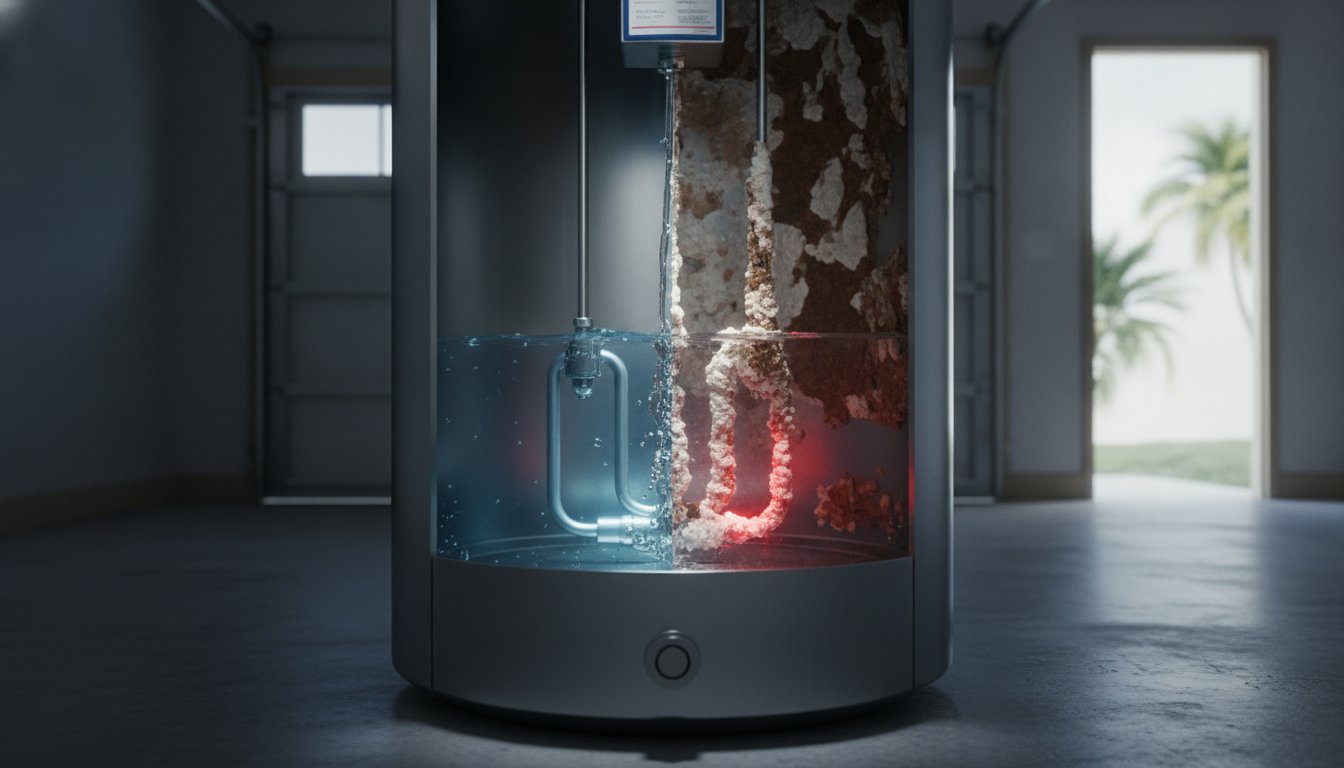
Imagine waking up in Broward County, turning on the shower, and hearing a violent popping sound from the garage followed by a sudden blast of cold water. You aren’t alone. Thousands of homeowners across the Sunshine State face this exact crisis every year because they underestimate the aggressive nature of our local supply. The reality is that hard water water heater damage Florida homeowners face is often a silent, internal erosion that eats away at your appliance long before it finally quits. While our water is safe to drink, the high mineral content from the Floridan Aquifer acts like liquid sandpaper on your heater’s internal components.
It’s frustrating to watch your utility bills climb while your hot water pressure disappears, especially when you’ve done everything else right to maintain your home. We understand the stress of a failing system. This guide will show you exactly how Florida’s unique mineral concentrations, which often exceed 15 grains per gallon in cities like West Palm Beach and Boca Raton, lead to catastrophic failures. You’ll learn how to identify the specific warning signs of terminal damage and the professional maintenance steps required to protect your investment. We’ll provide the clarity you need to stop the damage and find a reliable local expert to keep your water running hot.
Key Takeaways
- Understand why Florida’s limestone-rich aquifers create extreme mineral levels that aggressively degrade your heater’s internal components.
- Identify the specific mechanics of hard water water heater damage Florida homes face, including how limescale creates an insulating barrier that leads to tank fatigue.
- Learn to recognize warning signs like “kettling” noises or cloudy water before they escalate into a catastrophic tank failure.
- Discover why a professional annual flush and timely anode rod replacement are the most effective ways to prevent premature system failure.
- Master the “10-year rule” to help you decide whether a repair is viable or if a full replacement is necessary to protect your property.
The Hidden Impact of Florida’s Hard Water on Your Water Heater
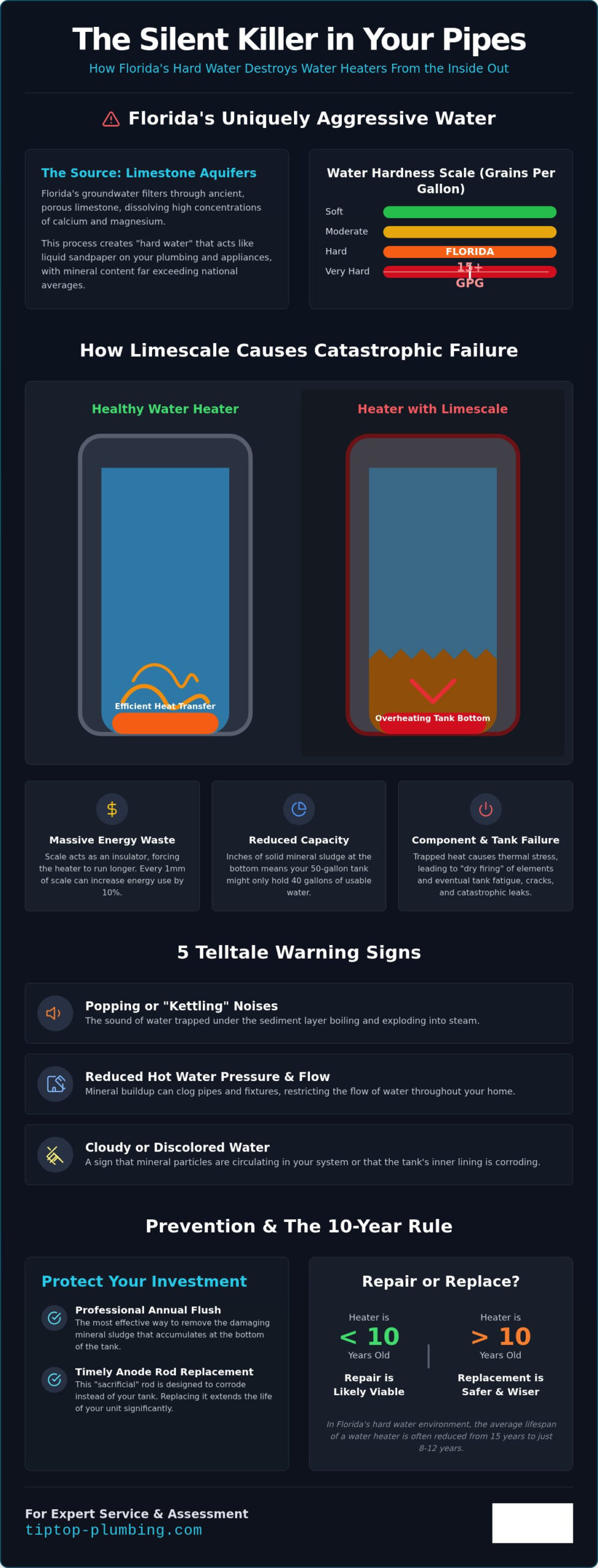
Florida’s unique geology is the primary culprit behind your plumbing frustrations. Our state sits atop the Floridan and Biscayne aquifers, which are composed primarily of ancient, porous limestone. As groundwater filters through this rock, it dissolves high concentrations of calcium and magnesium, creating what experts call Hard water. In Broward County, these mineral levels are exceptionally aggressive, frequently testing at 15 grains per gallon or higher. This is nearly double the threshold for what the USGS classifies as “very hard” water, making our local supply some of the most taxing in the country.
When this mineral-heavy water enters your home, it carries a hidden threat that remains invisible in its cold state. The problem begins the moment your water heater activates. As the temperature rises, these dissolved minerals undergo a chemical change and precipitate out of the liquid. They transform into solid rock that settles at the bottom of your tank or clings to the heating elements. This process is the root cause of hard water water heater damage Florida residents experience. Because this happens inside a sealed steel tank, the destruction remains a silent killer until a major component finally gives way.
Why Florida Water is Uniquely Aggressive
The Biscayne Aquifer provides much of the water for South Florida, and its high concentration of dissolved calcium carbonate is particularly punishing. Our climate exacerbates the issue. Because Florida stays warm year-round, incoming groundwater is already at a higher base temperature, and your water heater works tirelessly to maintain its set point. This constant thermal activity accelerates the rate at which minerals solidify. To be precise, hard water damage is the accumulation of solid calcium scale on internal heater surfaces. This scale creates a thick, stony crust that standard national maintenance schedules simply don’t account for, leaving Florida homeowners at a higher risk for sudden failure.
The Cost of Ignored Minerals
Ignoring these deposits is a recipe for financial loss and household stress. Limescale is an incredibly poor conductor of heat, acting as an unintended layer of insulation between the burner and the water it’s trying to reach. This forces your unit to run longer and consume more energy to achieve the same results, leading to a noticeable spike in your monthly utility bills. While a unit in a soft-water state might easily last 15 years, the aggressive mineral content in our region often limits an appliance’s lifespan to just 8 to 12 years. If you’re noticing a drop in efficiency or a lack of hot water, contacting a plumber Weston FL for a water quality assessment can help you determine the current state of your system before a total breakdown occurs. Even for those outside of Florida, maintaining your heating system is vital; for instance, those in West Sussex can learn more about WellPlumbed to find dedicated local experts for their plumbing needs.
How Limescale Buildup Destroys Your Water Heater from the Inside Out
The “Insulation Effect” is perhaps the most immediate mechanical threat to your system’s efficiency. As minerals precipitate, they form a stony crust known as limescale that coats the internal surfaces of your tank. This layer acts as a physical barrier. While your water heater is designed to transfer heat directly from the burner or electric element to the water, scale forces the heat to penetrate a layer of solid rock first. This inefficiency isn’t just a minor nuisance. Every millimeter of scale can increase energy consumption by up to 10%, causing your utility bills to climb while your water stays lukewarm.
This cumulative destruction is the core of hard water water heater damage Florida residents experience. Beyond energy loss, sediment takes up physical space inside the tank. If you have several inches of mineral sludge at the bottom, your 50-gallon tank might only hold 40 gallons of actual water. For electric models, the situation is even more dire. Scale often encases the lower heating element entirely. This leads to “dry firing,” where the element overheats because it’s no longer in direct contact with the water that normally keeps it cool. The result is a snapped element and a sudden loss of hot water.
The Science of Sediment and Thermal Hot Spots
The physics of a scaled-up tank are punishing. According to the U.S. Geological Survey, water hardness is a significant factor in how appliances age. In a water heater, the steel tank expands and contracts as it heats and cools. However, the rigid scale buildup cannot move with the metal. This creates immense structural stress, leading to localized “hot spots” on the tank floor. These hot spots cause the protective glass lining to crack, exposing the raw steel underneath to rapid corrosion and eventual tank failure. You might hear this process happening as “kettling,” a series of pops and rumbles caused by water trapped beneath the scale reaching a boiling point.
Component Failure: Anodes and T&P Valves
Hard water also targets your heater’s primary safety and defense systems. Your sacrificial anode rod is designed to corrode so your tank doesn’t, but the aggressive mineral content in Broward County exhausts these rods twice as fast as the national average. Once the rod is gone, the minerals begin eating the tank itself. Even more dangerous is the impact on the Temperature and Pressure (T&P) relief valve. Scale can clog this vital safety device, preventing it from opening if the tank overpressurizes. Ensuring these components remain clear is a critical part of Water Heater Repair Broward County services. If you notice your heater struggling or making unusual noises, it’s wise to request a professional system evaluation before a minor leak becomes a major flood.
Telltale Signs of Hard Water Damage in Your Florida Water Heater
Recognizing the symptoms of mineral accumulation before they lead to a burst tank is essential for every Broward County homeowner. While the internal erosion is often invisible, your system will eventually provide external clues that it is under significant stress. Ignoring these early warnings often results in a higher repair bill or a premature total system failure. In many cases, hard water water heater damage Florida residents experience manifests through distinct sounds and changes in water quality that indicate the tank is reaching its functional limit.
Audible Warnings You Shouldn’t Ignore
If you hear popping, rumbling, or a sound similar to a boiling tea kettle during a heating cycle, your tank is suffering from a phenomenon called “kettling.” This occurs when water becomes trapped beneath a thick layer of sediment at the bottom of the tank. As the burner heats the metal, that trapped water turns to steam and “pops” through the mineral crust to escape. These rumbles in the night are a sign of imminent element failure, as the heating components are forced to work through a solid barrier of rock. This constant overheating not only wastes energy but also significantly shortens its lifespan by stressing the tank’s structural integrity. Hearing strange noises? Book a professional diagnostic now to catch the issue before it escalates.
Physical and Visual Indicators
Beyond the noise, you should watch for changes in the water itself. Cloudy or “milky” water coming from your hot taps is often a sign of calcium suspension, where the mineral buildup has become so severe that it is sloughing off into the water stream. You might also find white, grainy particles clogging the aerators on your faucets or showerheads. Check the exterior of your heater as well. Visible white, crusty buildup, known as efflorescence, around pipe connections and valves is a clear indicator that hard water is leaking through seals and evaporating, leaving its mineral footprint behind. If you see these signs, it may also indicate hidden leaks that require expert leak detection services Broward County to prevent water damage to your flooring or walls. Slow recovery times, where the heater takes an unusually long time to warm up after a single shower, further confirm that sediment has displaced your tank’s rated capacity.
Prevention and Maintenance: Extending Heater Life in Broward County
While the aggressive mineral content in our local supply is a constant threat, proactive maintenance can significantly mitigate the risk of premature failure. You don’t have to accept a shortened appliance lifespan as an inevitable Florida tax. By implementing a methodical preservation strategy, you can combat the hard water water heater damage Florida homeowners typically face. The most critical step is managing the sediment that naturally accumulates at the base of your tank before it hardens into a permanent, rock-like barrier.
One of the simplest yet most overlooked adjustments is your heater’s thermostat. We recommend keeping your unit set to 120°F. Higher temperatures accelerate the chemical reaction that causes calcium and magnesium to precipitate out of the water. By lowering the heat slightly, you slow the rate of scale formation without sacrificing household comfort. Additionally, you must prioritize the sacrificial anode rod. This magnesium or aluminum component is designed to attract corrosive elements, protecting the steel tank by dissolving first. In our high-mineral environment, these rods often expire within two to three years. Replacing a rod is a minor expense that can prevent the need for a total system replacement.
The Professional Flush vs. DIY
Many homeowners attempt to drain their tanks using only gravity, but this is rarely effective against heavy Florida sediment. The mineral chunks in our region are often too large or heavy to be swept out by a simple garden hose connection. A professional “power flush” utilizes high-pressure water to agitate and remove the solidified sludge that gravity leaves behind. We frequently see DIY attempts result in stripped drain valves or incomplete removal, which only delays the inevitable failure. Whether you are in Davie FL or Plantation FL, a thorough, expert cleaning is the only way to ensure your tank is actually clear of debris.
Long-term Protection Strategies
For permanent relief, a whole-house water softener is the gold standard for long-term protection. By removing minerals before they ever reach your heater, you eliminate the source of the problem entirely. This is especially vital if your local grain count exceeds 15 GPG. If your system has already suffered extensive internal corrosion that has spread to your plumbing lines, you might need to consider Repiping Services Broward County to restore flow and pressure throughout your home. Even modern tankless units require specific maintenance; while they don’t store sediment, their heat exchangers are highly susceptible to scale and require a specialized chemical descale every 12 months to maintain their efficiency and warranty coverage.
Professional Repair and Replacement: Protecting Your Home from Catastrophic Failure
When your system reaches a certain level of decay, you must decide whether to invest in another repair or move toward a full replacement. In Florida, we follow a strict 10-year rule. While heaters in other states might last 15 years or more, the aggressive mineral content in our local supply means any unit over a decade old is living on borrowed time. If you are already experiencing the symptoms of hard water water heater damage Florida homeowners often see, such as persistent leaks or a complete loss of efficiency, a replacement is usually the most financially responsible path. Investing in new parts for a tank that is structurally compromised by a decade of scale is a short-term fix for a long-term problem.
A burst tank is the ultimate nightmare for any property owner. This happens when the internal corrosion we’ve detailed finally breaches the steel shell. Because sediment creates hotspots that weaken the metal, the tank can fail suddenly and release 40 to 50 gallons of water into your home in minutes. This isn’t just a plumbing issue; it’s a property disaster that leads to warped flooring, ruined drywall, and mold growth. Upgrading to a high-efficiency or tankless model in 2026 is a smart move, as newer units are designed to meet the 9th Edition of the Florida Building Code’s strict energy standards while offering better resistance to mineral buildup.
Emergency Response for Failed Heaters
If you discover water pooling at the base of your heater, you must act immediately. Turn off the cold water supply valve and the circuit breaker to prevent further damage. Most plumbers will simply swap the unit and leave you to deal with the wet mess. Tip Top Plumbing & Restoration offers a dual-expertise approach that sets us apart. We don’t just fix the plumbing; we handle the entire water remediation process. If your tank has already failed, our Emergency Plumber Weston FL team provides rapid response to stop the leak and perform a professional dry-out, ensuring your home is protected from secondary water damage.
The Tip Top Advantage in Broward County
We pride ourselves on being the Reliable Local Authority for Broward County homeowners. Our team is meticulous, clean, and transparent about every step of the process. We don’t believe in shortcuts. Whether we are performing hydro jetting to clear scale-clogged lines or conducting mold testing after a leak, we apply the same disciplined professional standards to every job. Our goal is to provide you with a permanent solution and total peace of mind. We understand the specific challenges of our local environment and we have the tools to solve them decisively.
Don’t wait for a flood to tell you your heater is failing. Schedule your water heater inspection today to ensure your home stays dry and your water stays hot.
Secure Your Home’s Future Against Florida’s Aggressive Water
Florida’s unique geology makes hard water water heater damage Florida an unavoidable reality for homeowners who ignore regular maintenance. We’ve seen how mineral buildup acts as a silent killer, driving up energy costs and causing structural fatigue that leads to catastrophic tank bursts. Prioritizing professional power flushes and timely anode rod replacements can extend your system’s life and protect your property from sudden, floor-warping floods. Don’t let sediment steal your comfort.
Tip Top Plumbing & Restoration provides expert emergency plumbing and restoration services throughout Weston, Miramar, and all of Broward County. Our team utilizes advanced leak detection technology to identify issues before they become crises, acting as your reliable local authority in property protection. We’re ready to stabilize your home and ensure your hot water remains consistent and efficient.
You don’t have to wait for a cold shower or a flooded garage to take action. Reach out today to keep your home comfortable and your water running hot.
Common Questions About Florida Water Heater Maintenance
Is hard water damage to a water heater covered by warranty?
Most manufacturers don’t cover hard water water heater damage Florida units sustain under their standard warranties because they classify mineral buildup as a lack of routine maintenance. If a tank fails due to sediment accumulation or scale-related overheating, the manufacturer typically denies the claim. You should review your specific warranty documents; however, keeping service records of annual professional flushes is the best way to prove you’ve met your maintenance obligations.
How often should I flush my water heater in Florida?
You should schedule a professional flush every six to twelve months due to the extreme mineral content in Broward County’s water. While national guidelines often suggest once a year, homes in cities like Weston and Miramar frequently deal with water exceeding 15 grains of hardness. This high concentration causes sediment to accumulate much faster than average. Frequent maintenance prevents that sediment from hardening into a solid mass that eventually destroys the tank.
What are the white flakes in my hot water?
The white, grainy flakes in your hot water are solid pieces of calcium carbonate that have precipitated out of the water and broken off from the internal surfaces of your heater. As the water heats up, these minerals solidify and form a crust on the tank walls and heating elements. Eventually, thermal expansion causes these pieces to flake off and enter your plumbing system, where they can clog aerators.
Can a water softener fix a water heater that is already damaged?
A water softener cannot reverse existing physical damage or remove thick layers of solidified scale already present inside your tank. While installing a softener is an excellent way to prevent future hard water water heater damage Florida systems face, it won’t repair a cracked glass lining or fix an element already encased in rock. If your heater is already showing signs of failure, have it professionally inspected before investing in a system.
Why is my water heater making a loud rumbling noise?
Loud rumbling or popping sounds are typically caused by a phenomenon called kettling, which occurs when water becomes trapped beneath a thick layer of sediment at the bottom of the tank. As the burner heats the metal, the trapped water boils and turns into steam bubbles that violently pop through the mineral crust. This noise is a clear warning that your heater is struggling with significant buildup and is at risk.
How long do water heaters typically last in Broward County?
Water heaters in Broward County typically last between eight and twelve years, which is shorter than the national average of fifteen or more years. The aggressive nature of the local water supply, combined with coastal salt air, accelerates the corrosion process. If your unit is approaching the ten-year mark in a city like Pembroke Pines or Davie, it’s wise to plan for a replacement before a catastrophic failure occurs. Similarly, if you’re located in North Georgia and want to stay ahead of potential issues, you can check out Stuart the Plumber, LLC for expert maintenance and advice.
If you never flush your heater, the accumulated sediment will eventually displace a significant portion of your hot water capacity and create an insulating barrier that forces the unit to work harder. This leads to rising energy bills and constant overheating of the tank’s lower section. Over time, the stress causes the protective internal lining to crack, allowing the raw steel to rust and eventually leading to a sudden leak.
Can hard water cause my water heater to leak from the bottom?
Hard water is a leading cause of bottom-tank leaks because it creates localized hotspots where the heat cannot escape through the sediment layer. These hotspots cause the tank’s steel to expand and contract unevenly, which eventually cracks the protective glass lining. Once the lining is compromised, the water begins to corrode the steel shell from the inside out. By the time you see water pooling, it’s too late.
Disclaimer
The information provided in this article is for general educational and informational purposes only and should not be considered professional plumbing, restoration, mold remediation, or legal advice. Every plumbing system, property, and situation is unique, and the recommendations discussed may not apply to your specific circumstances.
While Tip Top Plumbing & Restoration strives to provide accurate and up-to-date information, we make no warranties regarding the completeness, accuracy, or reliability of the content. Any actions you take based on this information are at your own risk.
Plumbing repairs, water damage restoration, and mold remediation should be performed by qualified professionals and in accordance with applicable local building codes and regulations. If you are experiencing a plumbing emergency, water leak, or property damage, contact a licensed professional for an on-site evaluation.
Tip Top Plumbing & Restoration is licensed and insured to provide plumbing and restoration services throughout Broward County, Florida.