

What if that weak trickle in your morning shower isn’t just a nuisance, but an early warning signal from your home’s foundation? You’ve likely tried cleaning the showerhead only to find the flow remains frustratingly thin. It’s exhausting to watch your appliances take forever to fill; it’s even more stressful wondering if a hidden pipe is currently failing behind your drywall. Understanding the most common low water pressure causes is the first step toward protecting your property from the structural risks of undetected leaks.
We agree that a reliable plumbing system is the backbone of a functional home, especially with Broward County’s aging housing stock and the recent July 2026 water conservation orders. This guide identifies the hidden culprits behind your weak water flow and teaches you exactly when to tackle a fix yourself or call in an expert. We provide a clear diagnostic plan to restore your pressure and ensure your pipe integrity remains solid, giving you back the peace of mind you deserve.
Key Takeaways
- Differentiate between PSI (force) and GPM (volume) to pinpoint whether your problem is a systemic pressure drop or a localized flow restriction.
- Uncover the primary low water pressure causes in Broward County, ranging from South Florida’s mineral-heavy hard water to the “plumbing cholesterol” found in older galvanized pipes.
- Check your home’s Pressure Reducing Valve (PRV) and main shutoff points to rule out mechanical failures or simple, overlooked valve obstructions.
- Learn how to perform a timed bucket test to establish a clear diagnostic baseline before deciding to tackle a repair or call for professional help.
- Understand the critical connection between a sudden loss of pressure and underground slab leaks that require advanced electronic detection to prevent structural damage.
Identifying Low Water Pressure vs. Low Flow in Your Home
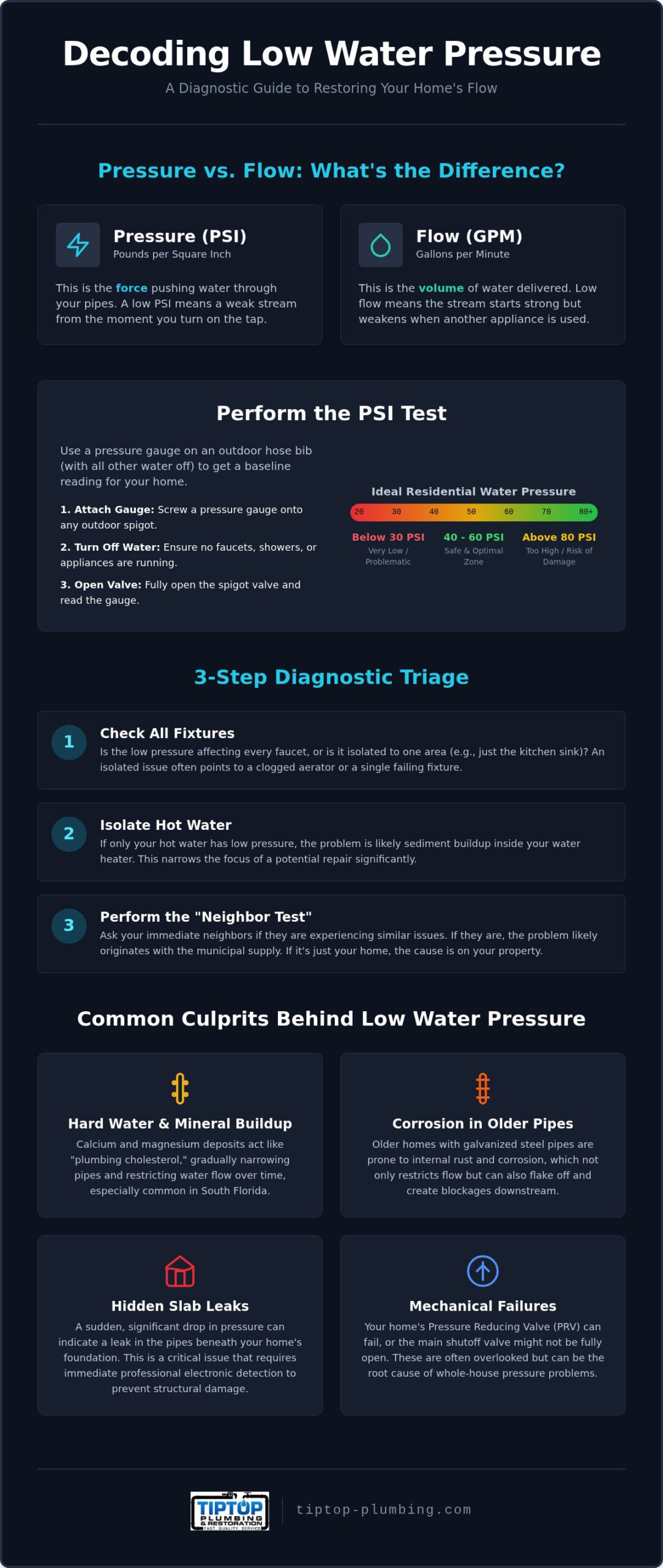
Before you can fix the problem, you have to define it correctly. Many homeowners confuse low water pressure with low flow, but they are distinct mechanical issues that require different solutions. Water pressure, measured in pounds per square inch (PSI), is the force pushing water through your pipes. Flow, measured in gallons per minute (GPM), is the actual volume of water delivered. If your shower feels like a weak mist from the moment you turn it on, you likely have a pressure issue. If the stream starts strong but drops the moment someone flushes a toilet or starts the dishwasher, you are dealing with a flow restriction. Understanding these low water pressure causes is the first step in our diagnostic triage.
Broward County’s exceptionally flat geography plays a significant role in how you receive water. Unlike hilly regions that benefit from gravity-fed systems, our local municipal water relies heavily on massive pump stations to maintain force across the grid. Any local infrastructure strain or a malfunction at a city pump station can immediately impact your home’s intake. This makes it vital to determine if the issue is a systemic failure or something happening within your own property lines.
The PSI Test: What is Normal for Florida Homes?
You don’t need a professional degree to get a baseline reading of your home’s health. Purchase a standard pressure gauge from a local hardware store for about $10 and screw it onto your outdoor hose bib. Ensure all indoor faucets and appliances are turned off before opening the valve to get an accurate static reading. For most Florida residences, the “Safe Zone” is between 40 and 60 PSI. If your reading drops below 30 PSI, your appliances will struggle to function. Dishwashers and washing machines require specific force to trigger intake valves; without it, cycles take longer and cleaning performance suffers significantly.
Determining if the Problem is Localized or Whole-House
Start your diagnostic plan by checking every fixture in the house. If the weak stream is limited to the kitchen sink, the culprit is likely a clogged aerator or a failing cartridge. However, if every faucet in the house is underperforming, the low water pressure causes are likely located at the main supply line or the municipal connection. Check your hot water specifically. If only the hot side is weak, sediment buildup inside your water heater is the probable cause, narrowing your repair focus to that single appliance.
Finally, perform the “Neighbor Test.” A quick text to the person next door can confirm if the issue is your private line or a city-wide main break. If the problem is unique to your property, it’s time to investigate deeper for potential leaks or pipe failures that could be diverting water before it reaches your faucets. This methodical approach ensures you aren’t wasting money on broad repairs when a specific, localized fix is all that’s required.
Internal Plumbing Issues: Clogs, Corrosion, and Slab Leaks
South Florida’s water is notoriously hard. This isn’t just about soap scum on your shower door. It’s about calcium and magnesium deposits that act like plumbing cholesterol. Over decades, these minerals fuse to the interior walls of your pipes, narrowing the passage for water to travel. This restriction is one of the most persistent low water pressure causes in our region. A pinhole leak in a copper pipe can cause a 15% pressure drop before you see a puddle. This invisible loss of force often leaves homeowners scratching their heads while their structural integrity is slowly compromised.
Hard Water and Sediment Accumulation
Calcium and magnesium deposits don’t just stay in your main lines; they often settle in the bottom of your water heater, forming a thick layer of sediment that acts as an insulator. This buildup forces the unit to work harder and eventually sends flakes of scale through your hot water lines. These flakes then clog faucet aerators and showerheads, leading to a frustrating drop in performance. Identifying these low water pressure causes early can save you from a full system failure. Regularly maintaining your system is the best way to prevent these technical failures from escalating into expensive repairs.
The Danger of Slab Leaks in South Florida
Homes in Weston and Miramar are particularly susceptible to slab leaks due to the way our local soil shifts and settles. A slab leak occurs when a pipe beneath your concrete foundation fails, allowing water to escape into the ground. Because the water is under pressure, even a small breach can significantly reduce the PSI available at your fixtures. You might notice warm spots on your tile floor or hear the faint sound of running water when all taps are closed. If you suspect an underground failure, scheduling a professional leak detection service is the only way to confirm the location without destructive digging.
Aging Infrastructure: Cast Iron and Galvanized Steel
Many Broward County homes built before 1980 still rely on galvanized steel or cast iron plumbing. Galvanized pipes are prone to internal corrosion that creates “scaling,” where the interior of the pipe becomes rough and obstructed. This scaling doesn’t just reduce flow; it creates friction that kills water pressure. Cast iron pipes present a different risk, as they tend to corrode from the inside out, leading to structural collapses that can completely block water delivery. If your home is reaching the 40 or 50-year mark, these materials are likely reaching the end of their viable lifespan.
If you are noticing a sudden, unexplained drop in force, you can schedule a professional inspection to identify the exact culprit before it causes significant property damage.
Mechanical Failures and External Factors Affecting Your PSI
While internal pipe corrosion is a gradual decline, mechanical failures often result in a sudden, jarring loss of force. Your home’s plumbing system relies on a series of valves and regulators to maintain a steady flow. If these components fail or are mismanaged, the resulting drop in pressure can feel like an overnight disaster. Identifying these mechanical low water pressure causes requires a methodical look at your home’s entry points and the surrounding municipal environment.
Troubleshooting the Pressure Reducing Valve (PRV)
Most modern homes in Broward County feature a Pressure Reducing Valve. This bell-shaped brass component is usually located near your main shut-off valve where the water line enters the house. Its job is to step down the high pressure from city mains to a safe residential level. When a PRV fails, it often defaults to a restricted position, choking off your supply. You might hear vibrating pipes or “water hammer” sounds when fixtures are turned off. Don’t attempt to adjust the PRV bolt without a pressure gauge attached. The Florida Building Code mandates that residential static pressure must not exceed 80 PSI. Over-tightening this valve can lead to ruptured pipes and blown appliance seals.
The Main Shut-Off and Meter Valves
Sometimes the solution is as simple as a valve that isn’t fully open. Check your main house valve to ensure it’s turned completely counter-clockwise. This is a common oversight after recent plumbing repairs or during a move-in. There is also a “street side” valve located inside the meter box near the sidewalk. If you’ve recently had a city technician out for a meter reading or repair, they may have left the valve partially closed. If your house-side valve is fully open but the flow remains weak, contact your city utility department to verify the meter valve’s position.
External factors in growing Broward neighborhoods also play a role. As more residents move into areas like Davie or Pembroke Pines, the increased demand on municipal mains can lead to temporary pressure drops. Additionally, shared supply lines in some older developments mean your neighbor’s high-volume irrigation system could be siphoning off your force. With the mandatory water conservation orders effective July 2026, being aware of when your neighbors irrigate can help you time your own high-demand activities. Scheduling your laundry or showers outside of peak irrigation hours can provide a temporary boost while you investigate more permanent low water pressure causes.
DIY Triage: How to Troubleshoot Low Water Pressure Safely
Identifying the specific low water pressure causes in your home requires a methodical triage process that starts at the fixture and works back to the main line. Don’t jump to the conclusion that you need a full repipe until you’ve ruled out simple mechanical obstructions. By following a step-by-step diagnostic plan, you can determine if the problem is a five-minute fix or a complex issue that requires professional intervention.
Step 1: Clean and Inspect Your Fixtures
Begin by unscrewing the aerators from your faucets and soaking them in white vinegar for at least thirty minutes. This acidity dissolves the calcium and magnesium deposits common in South Florida’s hard water. You should also perform a timed bucket test to calculate your current flow rate. Place a 5-gallon bucket under a bathtub spout and time how long it takes to fill. If it takes longer than 60 seconds, your flow rate is below 5 gallons per minute (GPM), which indicates a significant restriction in your plumbing system.
Step 2: The Water Meter Leak Test
Locate your water meter, usually found in a concrete box near the sidewalk or property line. Ensure all faucets, irrigation systems, and appliances are turned off. Look for a small red or blue triangle, often called the “leak indicator,” on the face of the meter. If this triangle is spinning even slightly while no water is being used, you have an active leak. For slower, “silent” leaks, record the meter reading and wait two hours without using any water. If the numbers have changed when you return, you’re losing water somewhere in your system, likely through a failing valve or an underground pipe.
Step 3: Check the Hot Water Supply
Compare the pressure of your cold water versus your hot water at several different fixtures. If the cold water has plenty of force but the hot water is barely a trickle, the low water pressure causes are likely located within your water heater. Sediment buildup at the bottom of the tank can block the outlet pipe, or the shut-off valve on the cold-water intake may be partially closed or corroded. If you find that a leak is causing your pressure loss, you may need a professional for Copper Pipe Leak Repair in Broward County to restore your home’s integrity.
Professional Solutions: When to Call Tip Top Plumbing & Restoration
While DIY triage can resolve minor fixture clogs, many low water pressure causes are hidden deep within your home’s infrastructure. These complex issues require more than just a wrench and a bucket. When your initial troubleshooting fails to restore force, it’s time to bring in professional-grade technology. We provide the precise diagnostic data needed to make informed decisions about your property. Our team approaches every pressure drop as a potential emergency, ensuring we identify the root cause before it leads to a catastrophic pipe failure or extensive water damage. If you are located outside of Florida and need similar high-quality drainage and gas fitting expertise, you can discover CQR Plumbing for professional support in the Yeppoon and Rockhampton regions.
Precision Leak Detection and Camera Inspections
We utilize advanced electronic leak detection and thermal imaging to see through solid concrete and drywall. These tools allow us to pinpoint the exact location of a slab leak or a pinhole breach without the need for exploratory demolition of your floors. If mineral buildup is the suspected culprit, our high-definition sewer camera inspections provide a real-time view inside your lines. We map out the internal “plumbing cholesterol” and corrosion levels, giving you a clear visual report of your system’s health. This level of precision is essential for homeowners who need an Emergency Plumber in Broward County to stop active losses immediately.
Comprehensive Restoration and Remediation
Tip Top Plumbing & Restoration offers a unique advantage because we handle both the mechanical fix and the resulting environmental impact. If a hidden leak is among the low water pressure causes in your home, the plumbing repair is only half the battle. Excess moisture trapped in your foundation or walls can lead to rapid mold growth and structural rot. We provide professional dry-out services and mold testing as part of our “no-shortcuts” approach to restoration. We don’t just swap out a pipe; we ensure your entire living environment is returned to a safe, dry, and healthy state.
Residents in Weston, Davie, and Pembroke Pines trust us because we understand the specific challenges of South Florida’s aging housing stock and hard water environment. We act as a stabilizing force during stressful household crises, providing transparent communication and methodical solutions that last. Our technicians are trained to treat your home with the same discipline and care they would their own, prioritizing permanence over temporary patches. You deserve the peace of mind that comes from knowing your plumbing is in the hands of a seasoned local authority. For those managing properties in the UK, We are a trusted plumbing & heating company providing reliable, high-quality services across London and Kent.
Secure Your Home’s Flow and Foundation
Your home’s water pressure is more than a matter of comfort; it’s a vital indicator of your entire plumbing system’s health. By understanding the most common low water pressure causes, you can differentiate between a simple clogged aerator and a high-stakes slab leak that threatens your foundation. We’ve explored how South Florida’s hard water and aging infrastructure create unique challenges that require precise, expert-led diagnostics to resolve permanently.
Tip Top Plumbing & Restoration acts as your stabilizing force in any household crisis. We specialize in expert leak detection and slab leak repair, ensuring we find the problem without unnecessary damage to your property. Our team provides 24/7 emergency service in Broward County, backed by certified mold testing and water remediation to handle the cleanup if a leak has already occurred. You don’t have to settle for a weak shower or the fear of hidden structural damage.
Take the first step toward a more reliable home today. We’re ready to restore your peace of mind with thorough, professional service that puts your family’s safety first.
Frequently Asked Questions
Why did my water pressure suddenly drop in the whole house?
Sudden whole-house drops usually stem from a failed Pressure Reducing Valve (PRV), a partially closed main shut-off valve, or a municipal main break. If you’ve ruled out city-wide issues by checking with neighbors, the PRV is the primary suspect. This valve often defaults to a restricted position when the internal spring fails. This mechanical failure requires an immediate professional inspection to prevent further strain on your home’s plumbing joints and appliances.
Is low water pressure a sign of a pipe leak?
Yes, a sudden or persistent drop in force is a common indicator of a significant breach, such as an underground slab leak. When water escapes through a hole in a copper or PEX pipe, it bleeds off the pressure meant for your fixtures. If you hear the faint sound of running water while all taps are off, you likely have a hidden leak that requires electronic detection to locate.
Can a bad water heater cause low water pressure?
A water heater is a frequent culprit if the pressure loss is limited specifically to your hot water lines. Over time, South Florida’s hard water causes calcium and sediment to accumulate at the bottom of the tank, eventually blocking the outlet valve. This restriction chokes the flow of hot water throughout the home. This issue necessitates a professional tank flush or valve replacement to restore normal force to your showers and sinks.
How do I increase the water pressure in my shower?
Start by cleaning the showerhead with white vinegar to dissolve mineral deposits that obstruct the nozzles. If the issue persists, check if the fixture has a “low-flow” restrictor installed, which is common in newer high-efficiency models. If every shower in the house feels weak, the problem is likely systemic, involving the PRV or main supply line rather than a single fixture. You should perform a bucket test to confirm your GPM before making adjustments.
Does Broward County have naturally low water pressure?
Broward County municipal water is generally delivered at high pressure, but local demand and aging infrastructure can cause fluctuations. Because our geography is flat, the city relies on pump stations rather than gravity. During peak irrigation hours, especially under the July 2026 conservation orders, you may notice a temporary dip in force as the local grid struggles to meet the increased volume requirements. This is usually temporary and resolves once irrigation cycles end.
Will a new pressure regulator fix my low water pressure?
A new Pressure Reducing Valve (PRV) will fix your issue only if the existing valve has failed or was improperly adjusted. If your low water pressure causes are actually related to corroded galvanized pipes or a hidden slab leak, replacing the regulator won’t help. We recommend testing your PSI with a gauge before replacing hardware. This ensures you aren’t ignoring a more serious underlying problem that could lead to water damage.
What is the difference between low pressure and low flow?
Pressure (PSI) refers to the force of the water, while flow (GPM) refers to the volume being delivered. If the water has no “sting” from the moment you open the tap, you have a pressure problem. If the water starts strong but trickles down when a second faucet is turned on, you have a flow restriction. This is often caused by narrowed pipes, mineral buildup, or a partially closed valve somewhere in the system.
How much does it cost to fix low water pressure in Florida?
The cost of a repair depends entirely on the diagnostic findings, as a simple valve adjustment is far less complex than a whole-house repipe. While cleaning aerators is a cost-effective DIY task, professional leak detection or replacing a failed regulator involves technical expertise and specialized equipment. We prioritize long-term viability in our repairs, ensuring you receive a “no-shortcuts” solution that protects your property value and prevents future restoration needs.
Disclaimer
The information provided in this article is for general educational and informational purposes only and should not be considered professional plumbing, restoration, mold remediation, or legal advice. Every plumbing system, property, and situation is unique, and the recommendations discussed may not apply to your specific circumstances.
While Tip Top Plumbing & Restoration strives to provide accurate and up-to-date information, we make no warranties regarding the completeness, accuracy, or reliability of the content. Any actions you take based on this information are at your own risk.
Plumbing repairs, water damage restoration, and mold remediation should be performed by qualified professionals and in accordance with applicable local building codes and regulations. If you are experiencing a plumbing emergency, water leak, or property damage, contact a licensed professional for an on-site evaluation.
Tip Top Plumbing & Restoration is licensed and insured to provide plumbing and restoration services throughout Broward County, Florida.