

You hear the sound of rushing water behind your drywall, and within minutes, a small leak becomes a torrent that threatens your living room. Knowing exactly what to do when a pipe bursts is the difference between a minor repair and a total property restoration. Most Florida homeowners feel a sudden wave of panic because they aren’t sure where their main water shut off valve is located or how to stop the deluge before it ruins their flooring. Every second the water flows, the risk of structural damage and expensive repairs grows.
It’s completely normal to feel anxious about the potential for mold growth and the high costs associated with water damage. We recognize that in our humid environment, a plumbing crisis is a race against time; mold can begin to colonize damp surfaces in as little as 24 to 48 hours. This guide provides the exact steps you need to locate your shut off valve immediately and regain control of the situation. You will learn how to secure your property, manage the initial cleanup, and navigate the critical dry out process to ensure your home remains safe and dry.
Key Takeaways
- Locate your main water shut-off valve quickly using our guide to common Broward County home layouts to stop flooding in its tracks.
- Identify early warning signs like hissing sounds or “hot spots” on your floor before a minor leak becomes a major disaster.
- Learn exactly what to do when a pipe bursts to beat the “48-hour rule” and prevent rapid mold colonization in the Florida heat.
- Understand the importance of professional leak detection and dry-out certificates for protecting your home’s resale value and insurance claims.
Immediate Triage: How to Locate and Use Your Main Water Shut Off Valve
The sound of rushing water inside a wall is a countdown to property damage. Every minute that passes allows gallons of water to saturate your drywall, seep under your baseboards; and ruin your flooring. When you are faced with this crisis, knowing exactly what to do when a pipe bursts starts with one specific action: cutting off the supply. The primary mechanism for this is the main water shut off valve, which acts as the gatekeeper for every drop entering your property. Stopping the flow immediately is the only way to prevent a manageable repair from turning into a five-figure restoration project.
Finding the Valve in Florida Homes
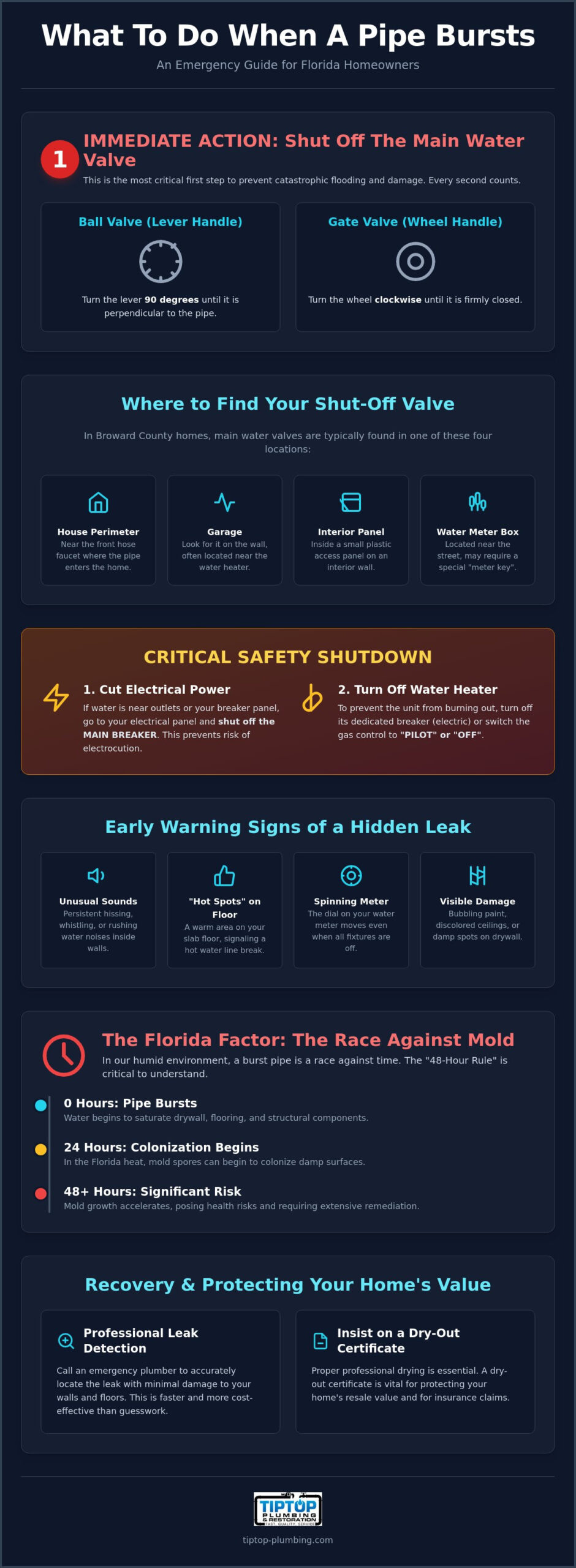
In Broward County, residential layouts often place these valves in predictable spots, though they can be hidden by landscaping or storage. If you are in a single-family home in Weston or Miramar, your first stop should be the perimeter of your house. Look for the front hose bib, which is your outdoor faucet; the main valve is frequently located on the same pipe where it enters the structure. If it isn’t there, check the garage near the water heater or inside a small plastic panel on an interior wall.
If you cannot find an interior or exterior wall valve, head toward the street. Most Florida homes have a water meter box buried near the sidewalk or property line. This is a plastic or concrete rectangular lid, often labeled “Water.” You may need a “meter key” or a pair of pliers to turn the valve inside this box. Because these boxes often collect dirt or debris, you might have to dig slightly to uncover the handle.
Step-by-Step Shutdown Instructions
Once you locate the valve, the method for closing it depends on the hardware installed in your home. You will likely encounter one of two styles:
- Ball Valves: These feature a straight lever handle. To shut off the water, turn the lever 90 degrees until it is perpendicular to the pipe. When the handle is “across” the pipe, the flow is stopped.
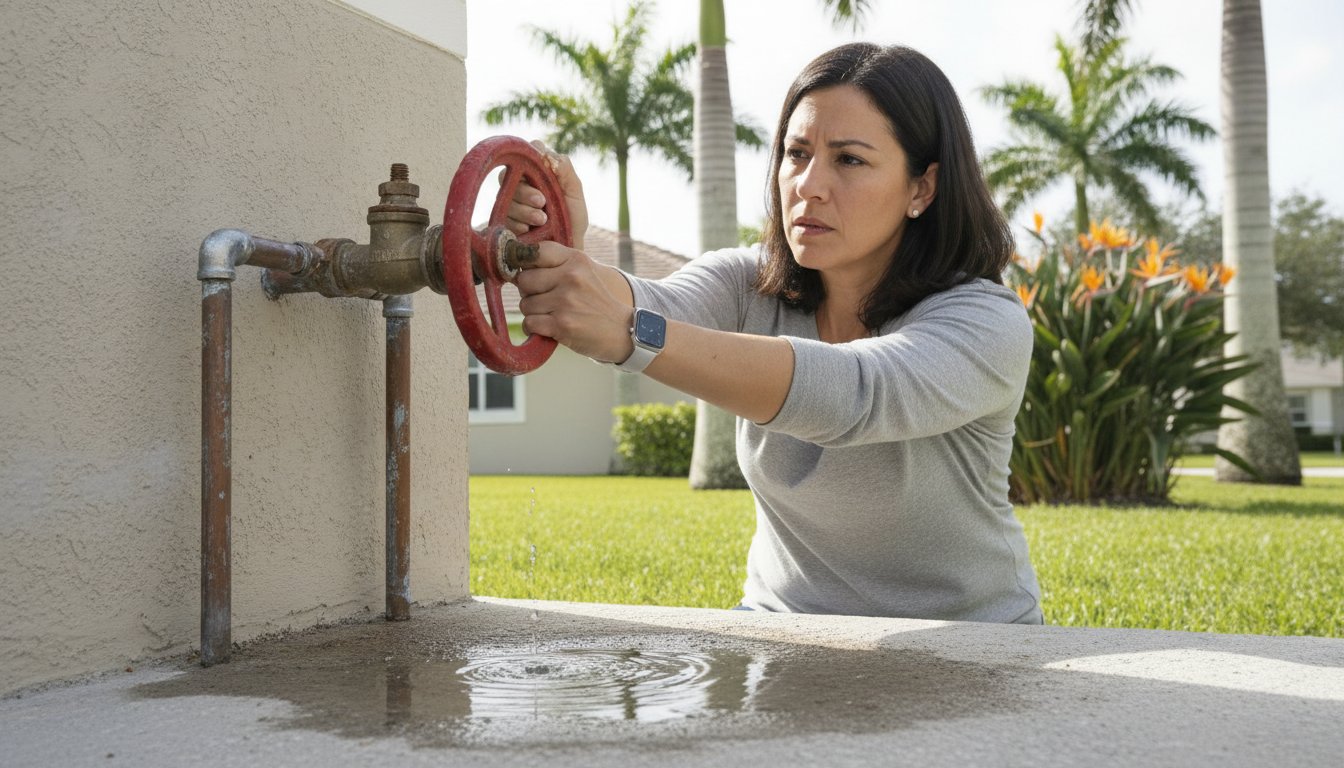
- Gate Valves: These look like a circular wheel or a faucet handle. To close a traditional gate valve, turn the circular handle clockwise until you feel firm resistance.
After the valve is closed, you must relieve the remaining pressure in the system. Go to the lowest point in your home, usually an outdoor hose bib or a laundry room sink, and open the faucet completely. This allows the water already in the pipes to drain out safely rather than continuing to leak through the burst section.
Critical Safety and Appliance Checks
A critical part of what to do when a pipe bursts involves protecting your appliances and your safety. If the leak is near an electrical outlet, a light fixture, or your breaker panel, do not touch the water. Go to your electrical panel and shut off the main breaker to eliminate the risk of electrocution. Additionally, you must turn off your water heater. If the main supply is cut and the tank drains while the heating elements are still active, the unit can suffer permanent damage or even catch fire. For electric heaters, flip the dedicated breaker; for gas units, turn the dial to the “Pilot” or “Off” setting. If your unit was exposed to flooding or sustained damage during the event, prompt water heater repair in Plantation FL can prevent a secondary crisis from a leaking or compromised tank.
Signs of a Burst Pipe: How to Identify the Crisis Early
Not every burst pipe announces itself with a dramatic fountain of water. In many cases, the first indicators are auditory. You might hear a persistent hissing or whistling sound coming from inside a wall, even when no faucets are running. This is the sound of pressurized water escaping a small breach. If the break is larger, you will hear the unmistakable sound of rushing water. Recognizing these cues early is a vital part of what to do when a pipe bursts because it allows you to act before the structural integrity of your home is compromised.
Physical evidence often follows these sounds. You might notice a damp patch on a carpet or a sudden puddle in the middle of a hallway. In Florida, where many homes are built on concrete slabs, a “hot spot” on your floor is a major warning sign. This usually indicates a hot water line has ruptured beneath the slab, radiating heat through your tile or laminate. If you suspect a leak but can’t see it, perform a meter test. Ensure all water is off, then check your water meter. If the small dial or digital display is moving, you have an active leak that requires Professional Repair to locate and fix.
Visible Water Damage Patterns
Water damage presents in specific, identifiable patterns. Look for brownish discoloration on your ceilings or bubbling paint along your baseboards. These are signs that water is traveling along the framing of your house. A full burst will cause rapid saturation, while a pinhole leak might only create a small, persistent damp spot. However, even a small leak can lead to a catastrophic failure if left unaddressed. If you notice water seeping through floor grout, you are likely dealing with a slab leak, which requires specialized leak detection services to resolve without unnecessary demolition.
The Invisible Indicators
Sometimes, your home’s systems tell the story before you see a single drop. A sudden, unexplained drop in water pressure at every fixture is a red flag for a main line break. Your utility bill is another diagnostic tool. If your monthly costs spike without a change in usage, your pipes are likely leaking into the ground or under your foundation. Finally, trust your nose. The Florida heat turns trapped moisture into a breeding ground for bacteria and fungi very quickly. A musty, damp smell in a specific room often signals a hidden pipe failure that has already begun to affect your indoor air quality. Knowing what to do when a pipe bursts includes monitoring these subtle shifts to catch the problem before it escalates. For recurring drain backups or suspected underground pipe damage, a sewer camera inspection in Plantation FL can provide the visual proof needed to pinpoint failures without unnecessary digging.
The Florida Factor: Why Burst Pipes Lead to Rapid Mold Growth
In South Florida, the clock doesn’t just tick; it races. While homeowners in colder climates worry about frozen pipes, those in Broward County face a more aggressive enemy: humidity. Once you have successfully executed the steps of how to shut off the main water valve, your focus must immediately shift to moisture control. In our tropical climate, the “48-hour rule” is a hard reality. Mold spores are naturally present in our air, and they only require a consistent source of moisture to colonize a surface. If your home isn’t professionally dried within two days, you aren’t just looking at a plumbing repair; you’re facing a full-scale biohazard remediation.
The architectural design of homes in Weston and Miramar adds another layer of complexity. Most Florida properties utilize slab-on-grade construction, where pipes are buried directly in or beneath a concrete foundation. When a pipe bursts here, water doesn’t just sit on the floor; it gets trapped in the porous concrete and the sand bedding beneath it. This moisture then “wicks” upward into your drywall and baseboards long after the surface water has been mopped away. This hidden reservoir is why understanding what to do when a pipe bursts requires looking beyond the visible puddles. High ambient humidity prevents natural evaporation, meaning that “just putting a fan on it” will never reach the water trapped in your structural materials.
Secondary Damage Risks
Water damage is progressive. Within hours, wood cabinets made of particle board or MDF will begin to swell and delaminate, often requiring complete replacement. If water reaches your wall cavities, it can lead to electrical corrosion, creating long-term fire hazards that aren’t immediately apparent. Beyond property damage, the health risks are significant. Untreated mold can trigger respiratory distress and allergic reactions in families and pets, making a professional dry-out a matter of safety rather than just aesthetics. Statistics show that mold claims are a serious concern in our state, with an estimated 264,000 mold-related insurance claims filed in Florida in 2022 alone.
Professional Remediation vs. DIY Cleanup
Effective moisture removal in South Florida requires industrial-grade equipment. Standard household fans only move humid air around; they don’t remove it from the building’s core. Professional teams use high-capacity LGR dehumidifiers that can pull gallons of water from the air and structural materials every day. While the EPA suggests you can handle mold cleanup yourself if the affected area is less than 10 square feet, a burst pipe often saturates a much larger footprint. At Tip Top, our “Dry Out” protocol includes moisture mapping with infrared cameras to ensure no pockets of water remain behind your tiles or under your slab. Knowing what to do when a pipe bursts means choosing the right tools for the local environment.
Professional Repair: When to Call an Emergency Plumber
Once you have secured the main valve and stopped the immediate flood, the focus shifts toward a permanent restoration of your plumbing system. While it is tempting to reach for waterproof tape or a pipe clamp, these are never long-term solutions for a pressurized water line. A temporary patch might hold for an hour, but it often fails under the standard 40 to 60 PSI of a residential system, leading to a second, more destructive flood. Knowing what to do when a pipe bursts includes recognizing when a problem exceeds the limits of a home tool kit. Professional intervention ensures the repair meets local building codes and prevents future failures in the same line; for those in Central Florida, you can discover Alberto Pro Plumbing for expert residential and commercial support.
When our team arrives at a home in Weston or Pembroke Pines, we begin with a methodical diagnostic process to identify the exact cause of the breach. We don’t just fix the hole; we investigate why it happened. This is especially critical in older Florida homes where pipe degradation is often systemic rather than isolated. Whether you are dealing with a single burst or a series of pinhole leaks, we provide clear options ranging from surgical spot repairs to comprehensive system upgrades. Our goal is to stabilize your property and provide a solution that offers lasting peace of mind.
Advanced Leak Detection
We utilize non-invasive technology to find the source of the problem without tearing through your drywall or flooring unnecessarily. If the burst is hidden behind a wall or beneath a concrete slab, we employ acoustic listening devices that pick up the high-frequency vibrations of escaping water. Thermal imaging cameras also allow us to see temperature fluctuations caused by moisture plumes, pinpointing the leak with surgical precision. For drainage issues, we use high-definition sewer camera inspections to inspect the interior of your pipes for root intrusion, structural collapses, or severe corrosion that could lead to the next emergency.
Repiping as a Permanent Solution
For many Broward County homeowners, a burst pipe is a symptom of a larger issue with aging materials. Homes built several decades ago often rely on cast iron or polybutylene pipes, both of which are notorious for sudden, catastrophic failure. If your system is reaching the end of its viable lifespan, we may recommend Repiping Services Broward County to replace these vulnerable materials with modern PEX or copper. This upgrade not only eliminates the fear of future floods but also improves water quality and increases your home’s resale value. If you are tired of patching an unreliable system, contact Tip Top Plumbing & Restoration for a comprehensive evaluation of your home’s plumbing health.
Recovery and Prevention: Protecting Your Home After the Crisis
The water is off, the plumber is on-site, and the immediate panic has subsided. However, the recovery phase is just beginning. In the aftermath of a flood, your priority must shift toward protecting your financial interests and the long-term health of your property. For business owners, this mindset of financial recovery extends beyond property damage; you might also discover Trump Tariff Relief to explore potential IEEPA tariff refunds that could offset unexpected operational expenses. While you may be focused on the visible repairs, the legal and financial recovery depends on how well you documented the initial chaos. Every action you took as part of what to do when a pipe bursts should be cataloged to ensure your insurance claim is processed smoothly and your home’s value remains intact.
One of the most overlooked aspects of recovery is the “Dry Out” certificate. In South Florida, where humidity levels are high and mold growth is a constant threat, having professional documentation that your home was thoroughly dried is essential. If you decide to sell your home in Weston or Miramar years from now, a history of water damage without a certificate of professional remediation can derail a sale. We provide detailed reports that prove your home was restored to industry standards, offering future buyers the peace of mind that no hidden mold or structural rot exists behind the walls.
Navigating Insurance Claims
Most homeowners’ insurance policies cover water damage that is “sudden and accidental,” such as a pipe that bursts without warning. However, they often deny claims for “gradual” damage caused by long-term leaks or poor maintenance. This is why immediate action is so important. Most policies explicitly require you to “mitigate damage,” which includes shutting off the main valve and calling for professional help as soon as the leak is discovered. To support your claim, take clear photos and videos of the burst pipe, the standing water, and any damaged belongings before the cleanup begins. Our team works directly with adjusters, providing the technical reports and moisture mapping data needed to justify the full scope of your restoration claim.
Long-Term Prevention Strategies
Preventing the next crisis is far more cost-effective than reacting to one. For aging homes in Broward County, we recommend a proactive approach to plumbing health. This includes the installation of smart leak detectors. These devices monitor your water flow 24/7 and can automatically close your main water shut off valve the moment a burst is detected, stopping a flood even if you aren’t home. Additionally, regular maintenance like hydro jetting can clear out scale buildup and debris that increases internal pipe pressure, reducing the risk of a rupture. Homeowners should also be aware that an aging water heater is a common source of sudden flooding; scheduling routine water heater repair in Plantation FL can catch failing tanks and corroded connections before they become a full-scale emergency.
Don’t wait for a “hot spot” on your floor or a musty smell in your laundry room to tell you there’s a problem. Scheduling regular inspections allows us to use thermal imaging and acoustic tools to catch slab leaks in their infancy. By identifying vulnerable cast iron or polybutylene lines early, you can plan for a controlled repipe rather than facing an midnight emergency. Take control of your home’s safety and Schedule a preventative plumbing inspection with Tip Top today to ensure you never have to wonder what to do when a pipe bursts again.
Secure Your Property and Restore Your Peace of Mind
A plumbing emergency doesn’t have to result in the permanent loss of your home’s integrity or value. By identifying the signs of a leak early and knowing exactly what to do when a pipe bursts, you have already taken the most critical steps toward mitigation. Remember that stopping the water at the main valve is only the first half of the battle; in the South Florida heat, professional drying and mold testing are essential to prevent long-term health risks and structural decay. Trusting a local expert ensures that your repairs are permanent and your restoration is thorough.
Tip Top Plumbing & Restoration provides 24/7 emergency response throughout Weston, Miramar, and all of Broward County. Our team specializes in expert leak detection, slab leak repair, and certified water remediation to handle your crisis from the initial burst to the final dry out certificate. We are here to act as your reliable local authority through the complexities of property repair. Get Emergency Pipe Repair & Water Restoration Now and let us help you protect your home. You don’t have to face this disaster alone; we are ready to get to work and restore your safety.
Frequently Asked Questions
How do I find my main water shut off valve in a Florida home?
You can usually find your main water shut off valve by checking the front exterior wall near the hose bib or inside the garage near the water heater. In many Broward County neighborhoods, the valve is also located near the property line in a ground-level meter box. Knowing this location is the first step in what to do when a pipe bursts to prevent extensive flooding.
What is the most common cause of burst pipes in Broward County?
Corrosion of aging plumbing materials like cast iron or galvanized steel is the leading cause of pipe failure in South Florida. The high mineral content in our local water supply and the humid environment can weaken these pipes over time, leading to pinhole leaks or sudden ruptures. High water pressure from the municipal supply can also stress older joints and valves.
Will my homeowners insurance cover a burst pipe and water damage?
Standard Florida homeowners insurance typically covers water damage resulting from a sudden and accidental event like a burst pipe. However, most policies require you to take immediate action to mitigate further damage, such as turning off the water supply. Coverage may be denied if the damage is determined to be the result of long-term neglect or lack of maintenance.
How long do I have before mold starts growing after a pipe bursts?
Mold can begin to colonize damp building materials within 24 to 48 hours after exposure to moisture. In the high humidity of South Florida, this process can accelerate, making rapid dry-out services essential. If you aren’t sure what to do when a pipe bursts regarding moisture, professional water remediation should begin immediately to prevent a biohazard situation.
Can I stay in my house after a major pipe burst?
You can often remain in your home if the damage is localized and the water supply is restored quickly after repairs. However, if the burst occurred near electrical systems or if large areas of drywall and flooring are saturated, it may be safer to relocate temporarily. Professional mold testing is recommended if water has been standing for more than a day.
What is a slab leak and how do I know if I have one?
A slab leak is a rupture in the water lines located beneath your home’s concrete foundation. You might have one if you notice unexplained hot spots on your floor, a sudden spike in your water bill, or the sound of running water when all faucets are off. Because these leaks are hidden, they require specialized acoustic detection tools to locate.
How much does it cost to repair a burst pipe in South Florida?
The cost to repair a burst pipe in South Florida depends on several factors, including the location of the break and the materials needed for the fix. A simple repair in an open wall is generally less expensive than a slab leak repair that requires tunneling or floor removal. We provide transparent assessments based on the specific complexity and accessibility of your plumbing system’s failure.
What should I do if my main water shut off valve is stuck?
If your main water shut off valve is stuck, don’t try to force it with a heavy wrench, as this can snap the handle and worsen the leak. Instead, locate the water meter box near the street and use a meter key or pliers to turn off the city-side valve. If you can’t reach the street valve, contact an emergency plumber immediately to handle the shutdown safely.
Disclaimer
The information provided in this article is for general educational and informational purposes only and should not be considered professional plumbing, restoration, mold remediation, or legal advice. Every plumbing system, property, and situation is unique, and the recommendations discussed may not apply to your specific circumstances.
While Tip Top Plumbing & Restoration strives to provide accurate and up-to-date information, we make no warranties regarding the completeness, accuracy, or reliability of the content. Any actions you take based on this information are at your own risk.
Plumbing repairs, water damage restoration, and mold remediation should be performed by qualified professionals and in accordance with applicable local building codes and regulations. If you are experiencing a plumbing emergency, water leak, or property damage, contact a licensed professional for an on-site evaluation.
Tip Top Plumbing & Restoration is licensed and insured to provide plumbing and restoration services throughout Broward County, Florida.