

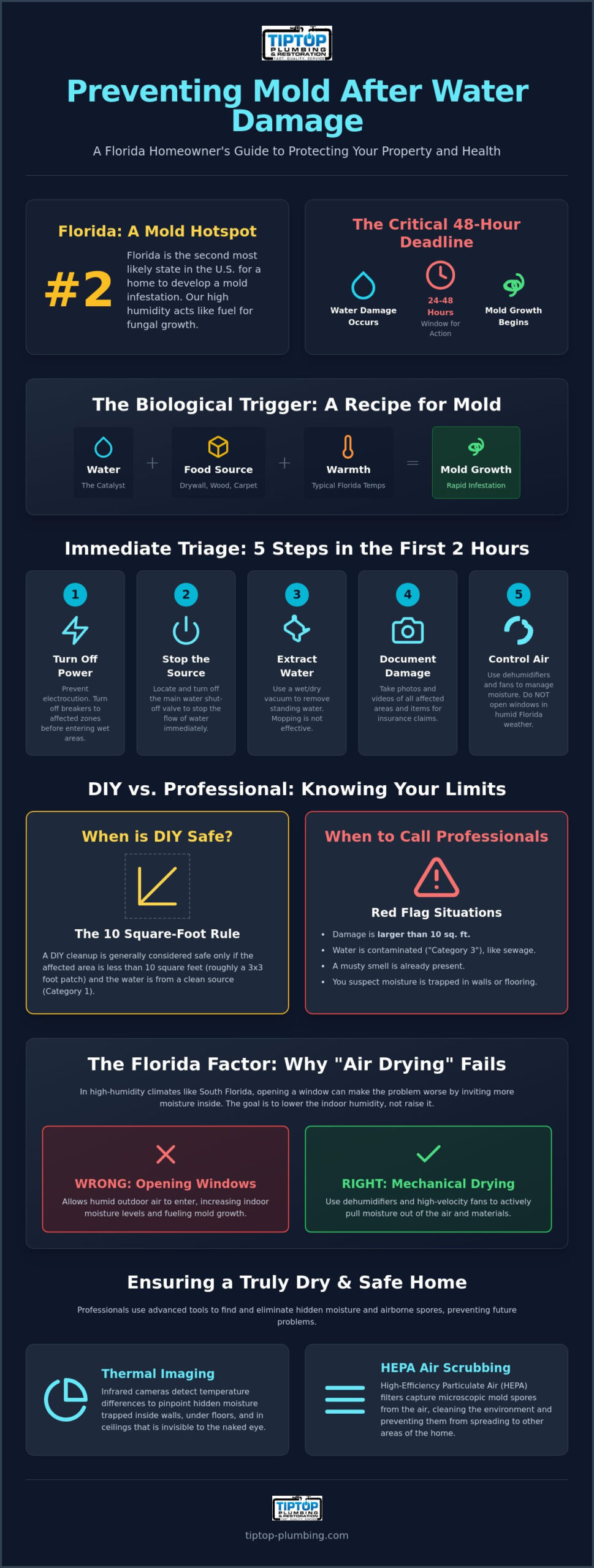
Florida is currently the second most likely state in the U.S. for a home to develop a mold infestation. When a leak occurs, the clock starts immediately because our high humidity acts like fuel for fungal growth. Knowing how to prevent mold after water damage is a race against a critical 48-hour deadline. If you’re currently staring at a damp wall and wondering if the moisture has already seeped behind your baseboards, you aren’t alone. It’s incredibly stressful to filter through conflicting advice about bleach or vinegar while worrying about your family’s long-term respiratory health.
We understand the urgency of protecting your property from secondary damage. This guide provides the exact, methodical steps required to stop mold in its tracks before it becomes a permanent problem. You’ll learn how to manage psychrometrics to control the air, understand the Florida legal threshold for professional remediation, and discover the tools used to validate that a space is truly dry. By following this professional approach, you can ensure your home remains a safe and healthy environment for years to come.
Key Takeaways
- Understand the critical 48-hour biological deadline and why speed is your primary defense against mold spore germination.
- Learn how to prevent mold after water damage by following a methodical 5-step triage plan within the first two hours of a leak.
- Discover why Florida’s high humidity makes “air drying” with open windows a mistake and how to control vapor pressure instead.
- Identify the 10-square-foot rule and “Category 3” water risks to know exactly when a DIY cleanup is safe versus when you need professional intervention.
- Explore how advanced tools like thermal imaging and HEPA air scrubbing provide the final validation that your home is truly dry and safe.
The 48-Hour Window: Why Speed is Your Only Defense
Mold spores are a natural part of our environment, existing invisibly in nearly every room of your home. However, they remain dormant until they encounter a specific catalyst. Water is that trigger. Once a leak or flood occurs, the biological clock begins ticking. Understanding what is indoor mold and how it spreads is vital for any homeowner facing a crisis. You have a narrow window of 24 to 48 hours before these spores begin to colonize and digest your property’s structural materials. In the humid climate of South Florida, this timeline often leans toward the shorter end of the spectrum.
Speed is your primary weapon. Learning how to prevent mold after water damage requires a dual focus: removing the liquid and stripping the moisture from the air. Stagnant, moisture-rich air is just as dangerous as the initial pool of water. Moisture doesn’t just sit on the floor; it evaporates into the air and increases the local humidity to levels that encourage rapid fungal blooms. When combined with our typical Florida heat, which frequently exceeds 80°F indoors when AC systems fail, the environment becomes a high-speed incubator for growth.
The Biological Trigger: Water + Food + Temperature
Mold doesn’t need much to thrive. Your home is essentially a massive “all-you-can-eat” buffet made of organic materials. Drywall, carpet padding, and plywood subfloors provide the cellulose that mold consumes for energy. In Broward County, the ambient temperature provides the perfect metabolic boost for these organisms. Within hours of a pipe burst or roof leak, these materials must be aggressively dried or, in some cases, completely discarded to stop the infestation from taking hold. If the material stays wet, the mold will continue to eat your home from the inside out.
The Invisible Threat: Secondary Damage
Visible puddles are only half the battle. As water evaporates, it creates “secondary damage” by re-absorbing into porous materials that were never even touched by the initial flood. This is why you might see wallpaper peeling or floorboards warping in a room adjacent to the leak. A surface might feel dry to the touch, but moisture often remains trapped inside wall cavities or under baseboards. To truly master how to prevent mold after water damage, you have to address this hidden dampness. Industry specialists like Simple Plumbing Inc point out that preventing these leaks at the source—such as through timely appliance maintenance—is the first line of defense. Without professional dry out services, this trapped moisture will fuel mold growth that you won’t see until the musty smell becomes undeniable.
Immediate Triage: 5 Steps to Take in the First 2 Hours
The first 120 minutes following a water intrusion are the most critical. You must act decisively to stabilize the environment and protect your property’s structural integrity. Safety is the immediate priority. Before you step into any standing water, turn off the electricity to the affected zones at the breaker box. This prevents electrocution risks and protects your home’s electrical system from short-circuiting. Once the area is safe, you can focus on how to prevent mold after water damage by cutting off the moisture supply at its origin.
Step 1 & 2: Power and Source Control
Locate your main water shut-off valve immediately to stop the flow. For many Florida homes, this is found near the water meter or where the main line enters the house. If you are struggling with Finding Your Main Water Shut Off Valve in a Crisis, remember that every second the water runs increases the risk of structural saturation. In cases of slab leaks or pipe bursts behind walls, you may need an emergency plumber to perform professional leak detection. Stopping the water is the only way to prevent the continuous re-soaking of your drywall and flooring.
Step 3 & 4: Extraction and Documentation
Extraction is far more effective than mopping. While a mop only moves water around, a wet/dry vacuum actually removes it from porous surfaces. Professional-grade extraction tools are even better, as they pull moisture from deep within carpet pads and subfloors. Before you begin the heavy lifting, document everything. Take high-resolution photos and videos of all affected areas, including baseboards, drywall, and personal belongings. This FEMA guide to mold after a flood emphasizes that documentation is your best friend when dealing with insurance adjusters. Do not discard any damaged items until they’ve been inspected; these are physical proof of your loss.
Step 5: Air Circulation Initiation
In Broward County, opening windows is usually a mistake. If the outdoor humidity is higher than 60%, you’re just inviting more moisture into the disaster zone. Instead, keep the house sealed and position floor fans to create a high-velocity vortex. This movement helps break the boundary layer of moisture on wet surfaces, speeding up evaporation. Don’t rely on your home’s AC unit to do the heavy lifting. Standard air conditioners are designed to maintain temperature, not to remove the massive gallons of water vapor generated by a flood. Mastering how to prevent mold after water damage requires more than just moving air; it requires controlling the environment. If you’re dealing with a significant leak, our water remediation experts can deploy industrial-strength dehumidifiers to pull gallons of water from the air every hour.
The Florida Factor: Why “Air Drying” Fails in Broward County
Many homeowners believe that opening windows and turning on ceiling fans is the natural way to dry out a room. In South Florida, this approach often invites a secondary disaster. Our local ambient humidity frequently exceeds 70%, which is well above the threshold required for fungal colonization. When you open your home to the outside air in Weston or Davie, you aren’t drying the structure; you’re actually importing more moisture. This saturated air prevents evaporation from occurring because the air is already holding as much water vapor as it can manage. This is a fundamental concept of vapor pressure. To effectively dry a building, the air must be thirstier than the materials it’s trying to dry.
Relying on standard household fans can also be a tactical error. While these fans move air, they don’t remove moisture. If mold spores have already begun to germinate within that 48-hour window, high-velocity household fans can simply loft those spores into the air, spreading them to unaffected rooms. Learning how to prevent mold after water damage requires a more scientific approach than just moving air. You need to create a controlled environment where the moisture is actively stripped from the atmosphere and the structural elements.
Managing Indoor Relative Humidity (RH)
The primary goal in any dry-out project is to drive the indoor relative humidity below 50%. According to the EPA mold and moisture guide, keeping humidity levels between 30% and 50% is the most effective way to stop mold growth. Achieving these low levels in a water-damaged Florida home requires industrial LGR (Low Grain Refrigerant) dehumidifiers. These machines are far more powerful than retail units; they’re designed to pull moisture from the air even when the humidity levels are already low. At Tip Top Plumbing & Restoration, we use precision hygrometers to monitor these levels daily, ensuring the environment remains hostile to mold.
The Porosity Problem
There is a persistent myth that bleach is the ultimate weapon against mold. While bleach is an excellent disinfectant for non-porous surfaces like tile or glass, it fails miserably on drywall, wood studs, and subflooring. The chemical structure of bleach prevents it from penetrating porous materials; it stays on the surface while the water content in the bleach actually soaks into the wood, feeding the mold roots (hyphae) below. For surface cleaning, a mixture of white vinegar or tea tree oil is often more effective as they can penetrate deeper. However, if you are dealing with contaminated water, cleaning is not an option. These materials must be professionally cut out and discarded to ensure your home remains safe.
DIY vs. Professional Restoration: Knowing Your Limits
Deciding whether to tackle a cleanup alone or call in experts is a choice that affects both your budget and your home’s long-term health. Understanding how to prevent mold after water damage starts with an honest assessment of the situation’s scale. In Florida, the Department of Business and Professional Regulation sets a clear threshold. If the affected area is larger than 10 square feet, the law requires a licensed professional to handle the assessment or remediation. This isn’t just about red tape. It’s about the fact that mold spores can easily cross-contaminate your entire house if they aren’t properly contained during the cleaning process. Licensed remediators in Florida must also carry a minimum of $1 million in general liability insurance, providing a layer of protection that a DIY project simply lacks.
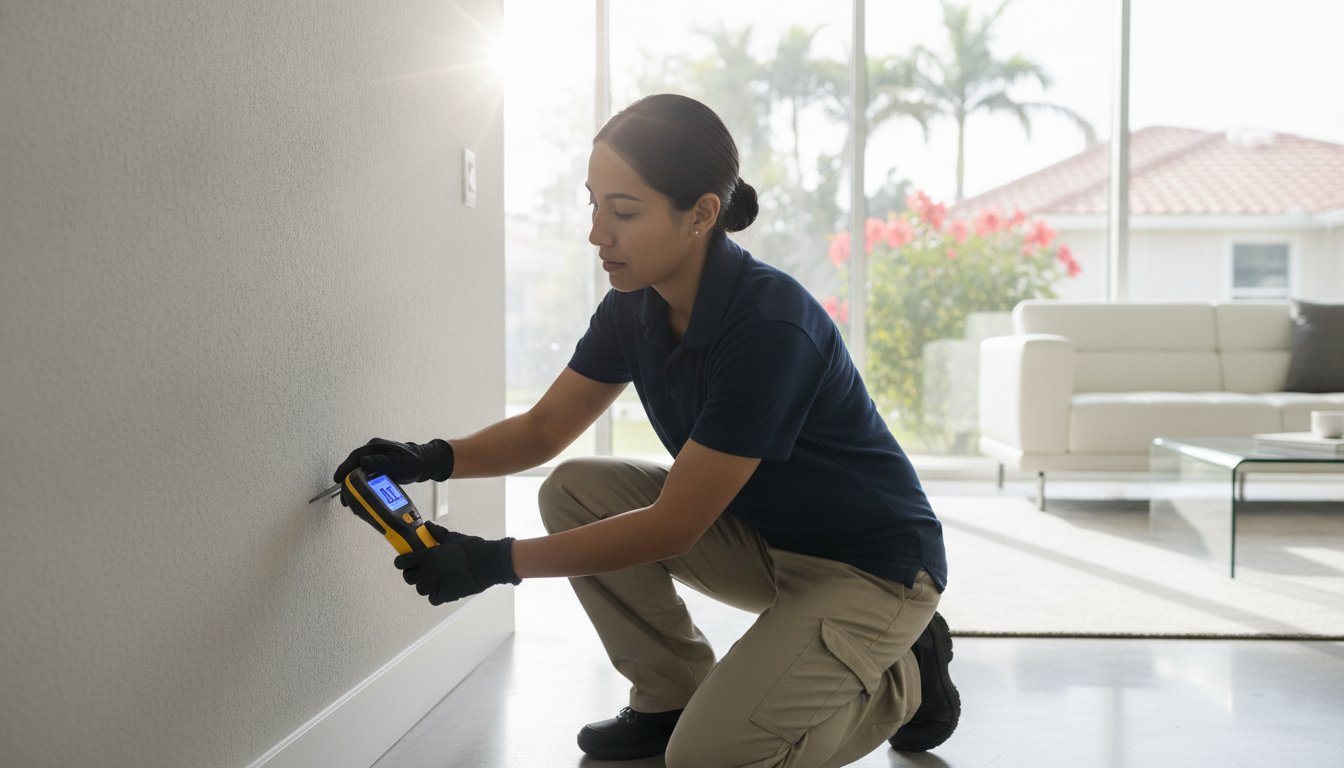
Beyond the size of the spill, the type of water matters even more. Category 3 water, often called black water, includes sewage backups or rising floodwaters from outdoors. This water is teeming with bacteria and pathogens that require specialized protective equipment and industrial-grade antimicrobials. You shouldn’t attempt to DIY a sewage cleanup. Even with clean water, such as a burst supply line, moisture often hides in places you can’t see. Professional moisture meters and thermal imaging cameras can detect dampness trapped deep inside wall cavities or under concrete slabs that your hands simply can’t feel.
When to Handle it Yourself
You can usually manage the situation if the source was clean water and the total area is under the 10-square-foot limit. Non-porous surfaces like ceramic tile, metal fixtures, or glass are easy to disinfect and dry. Minor window leaks that are caught immediately, before the water reaches the wall’s insulation, are also safe for a DIY approach. Just ensure you use a high-quality wet/dry vacuum and keep your dehumidifier running until the area is confirmed dry. If the material is porous, like drywall or carpet, and it has been wet for more than 48 hours, the safest bet is usually removal.
When to Call Tip Top Plumbing & Restoration
If a leak has been active for more than 24 hours, the risk of fungal colonization is extremely high. Water that has seeped under laminate, hardwood, or wall-to-wall carpeting requires professional extraction because these materials trap moisture against the subfloor. For homeowners in Miramar or Pembroke Pines, suspected slab leaks are a particular concern. These require precision leak detection and slab leak repair to stop the intrusion at the source and prevent a massive mold bloom beneath your feet. Professional intervention from Tip Top Plumbing & Restoration ensures that the structural elements of your home are truly dry, not just dry to the touch.
Professional Dry-Out and Mold Testing in Broward County
Professional dry-out services represent the final, decisive line of defense in protecting your property’s value. While the initial triage steps discussed earlier stop the immediate intrusion, the Tip Top Plumbing & Restoration structured remediation process ensures that hidden moisture is completely eradicated from the building’s envelope. We utilize industrial HEPA air scrubbers to cycle the room’s atmosphere, capturing microscopic spores before they have the opportunity to colonize on damp structural elements. This methodical approach is the most reliable way to understand how to prevent mold after water damage from becoming a chronic health issue for your family.
Advanced Diagnostics: Thermal Imaging
We don’t guess when it involves the safety of your home. Our technicians utilize high-resolution infrared cameras to identify thermal anomalies deep within your home’s structure. Because water-saturated materials are typically cooler than dry ones, these cameras reveal cold spots behind drywall or under flooring that are invisible to the naked eye. This non-invasive diagnostic tool allows us to target our drying equipment with surgical precision. By identifying the exact boundaries of the moisture, we often save homeowners from the cost and mess of unnecessary demolition. Tip Top Plumbing & Restoration uses this technology to verify that the “invisible” moisture is gone before we declare a job complete.
Certified Mold Testing and Clearance
Once the drying process is finished, professional mold testing provides the final validation you need for true peace of mind. We perform comprehensive air quality sampling and surface swabbing to ensure that spore counts have returned to safe, natural levels. Understanding how to prevent mold after water damage requires this scientific verification; without it, you are simply hoping the problem is resolved. After testing, we provide a “Certificate of Sanitization.” This document serves as vital proof for future home sales, demonstrating to potential buyers that any previous water incident was handled with professional integrity and full legal compliance.
Navigating insurance claims in Broward County requires a partner who understands the technical requirements of adjusters. Tip Top Plumbing & Restoration acts as your local authority in Miramar and Weston, providing the detailed moisture maps and drying logs necessary to justify your claim. Our team ensures that every step of the process, from the initial leak detection to the final clearance test, meets the highest professional standards. We believe in transparency and thoroughness, ensuring your home remains a stable, healthy environment for the long term.
Don’t let a leak become a health crisis. Schedule a Professional Dry-Out Assessment to ensure your property is truly protected.
Protect Your Home with Decisive Action
Florida’s unique environmental conditions don’t offer much room for error when a plumbing failure occurs. You’ve learned that the 48-hour window is a strict biological deadline and that managing indoor humidity is just as important as extracting standing liquid. By mastering the steps of how to prevent mold after water damage, you are now equipped to protect your family’s respiratory health and your property’s structural integrity.
You don’t have to navigate this high-stakes crisis alone. Our IICRC Certified Technicians provide an Emergency 24/7 Response for Water Remediation to homeowners throughout Weston, Miramar, and Davie. We utilize precision tools like thermal imaging and industrial dehumidifiers to ensure that every wall cavity and subfloor is truly dry. Get a Professional Water Damage Assessment & Dry-Out in Broward County to verify that your home is safe and mold-free. Taking decisive action now prevents a small leak from becoming a long-term burden. We are ready to help you restore your home to its original, healthy condition.
Frequently Asked Questions
How long does it take for mold to grow after a water leak in Florida?
Mold typically begins to colonize within a 24 to 48-hour window following a leak. In our humid Florida climate, this process often accelerates because high ambient moisture acts as a catalyst for fungal growth. If structural materials like drywall or wood remain saturated beyond this biological deadline, spores will begin to digest the organic matter. This is why immediate extraction is the most vital step in how to prevent mold after water damage.
Can I just use bleach to kill mold on my walls?
You should only use bleach on non-porous surfaces like tile, glass, or metal fixtures. On porous materials such as drywall or wood studs, bleach is ineffective because its chemical structure prevents it from penetrating deep enough to reach the mold’s root system. The water content in the bleach can actually soak into the material and feed the remaining roots. For these surfaces, professional removal or specialized antimicrobial treatments are the only reliable solutions.
Does home insurance cover mold prevention after a pipe burst?
Most homeowners insurance policies cover the cost of professional dry out services if the damage resulted from a sudden and accidental event, like a pipe burst. While many policies have specific limits or caps on mold remediation once growth occurs, they typically encourage proactive water mitigation to prevent larger losses. You should document the damage immediately and contact your provider to confirm the specific coverage details regarding your water remediation and professional drying.
What is the difference between water mitigation and mold remediation?
Water mitigation focuses on the immediate triage of the situation by stopping the leak and drying the structure to prevent future issues. Mold remediation is the reactive process of cleaning or removing existing fungal growth after it has already taken hold. Mitigation is a proactive strategy and the primary method for how to prevent mold after water damage. Remediation is only required once the 48-hour window has passed without successful drying.
Should I run my AC if I have water damage?
You should keep your air conditioning running to help regulate the indoor temperature, but don’t rely on it as your primary drying tool. Standard residential AC units are designed to maintain temperature, not to remove the massive gallons of water vapor generated by a flood out of the atmosphere. If the leak occurred within your HVAC system, running the unit could actually spread spores throughout the home; however, you can discover RMI Heating and Air Conditioning to perform a professional inspection and ensure your system is safe to operate. Always verify the source of the leak before relying on your climate control.
How can I tell if there is mold behind my baseboards without removing them?
You can identify hidden moisture using non-invasive tools like moisture meters or thermal imaging cameras. Physical signs often include a persistent musty odor, visible staining along the top of the trim, or baseboards that appear to be warping or pulling away from the wall. If a moisture meter indicates that the wall cavity behind the baseboard is still saturated, it’s highly likely that mold growth has already begun in that dark, stagnant space.
Is orange mold in the shower dangerous after a leak?
The orange growth often found in Florida bathrooms is usually a bacteria called Serratia marcescens rather than a true fungus. While it isn’t typically as dangerous as toxic black mold, it thrives in the same damp conditions and indicates that your bathroom’s moisture levels are too high. If you see this appearing after a leak, it serves as a warning sign that the area is not drying properly and requires more aggressive ventilation or professional dehumidification. Understanding the signs of water leak behind shower wall can help you determine whether this orange buildup points to a deeper plumbing issue that needs immediate attention.
What is the cost of professional mold testing in Broward County?
The cost of professional mold testing depends on the size of your property and the number of air or surface samples required for a conclusive result. In Broward County, testing involves laboratory analysis of these samples to provide a detailed report of spore counts and species identification. Because every situation is unique, you should contact a certified professional to receive a specific quote based on the square footage and the complexity of the affected area.
Disclaimer
The information provided in this article is for general educational and informational purposes only and should not be considered professional plumbing, restoration, mold remediation, or legal advice. Every plumbing system, property, and situation is unique, and the recommendations discussed may not apply to your specific circumstances.
While Tip Top Plumbing & Restoration strives to provide accurate and up-to-date information, we make no warranties regarding the completeness, accuracy, or reliability of the content. Any actions you take based on this information are at your own risk.
Plumbing repairs, water damage restoration, and mold remediation should be performed by qualified professionals and in accordance with applicable local building codes and regulations. If you are experiencing a plumbing emergency, water leak, or property damage, contact a licensed professional for an on-site evaluation.
Tip Top Plumbing & Restoration is licensed and insured to provide plumbing and restoration services throughout Broward County, Florida.