

The clock starts ticking the second water touches your floors; in our sweltering South Florida climate, you have a window of exactly 48 hours before mold begins to colonize your property. If you’ve recently dealt with a pipe burst or a heavy storm leak, you’re likely wondering exactly when to test for mold after water damage Broward County professionals recommend. Waiting even a few days too long can turn a simple dry-out into a full-scale environmental crisis hidden deep behind your drywall.
It’s completely normal to feel anxious when you smell that persistent musty odor or receive conflicting advice from insurance adjusters and contractors. You deserve definitive proof that your air quality is safe and that the underlying moisture source is actually gone. This guide will teach you how to navigate the latest 2026 Florida licensing requirements and choose a certified expert who prioritizes your family’s health. We will explore the critical timing for inspections, the legal protections that prevent conflicts of interest, and the documentation necessary to ensure your home remains a safe, healthy haven.
Key Takeaways
- Identify exactly when to test for mold after water damage Broward County professionals recommend, focusing on the critical 48-hour window before spores begin to compromise your home’s structure.
- Understand the difference between professional air quality diagnostics and unreliable DIY kits that often fail to account for Florida’s high ambient humidity.
- Learn how to verify a Florida MRSA license and why state law requires a strict separation between the company performing the test and the one handling the remediation.
- Discover why identifying the precise source of moisture through leak detection is the only way to ensure your property remains mold-free after the dry-out service is complete.
The 24-48 Hour Window: When to Test for Mold After Water Damage in Broward County
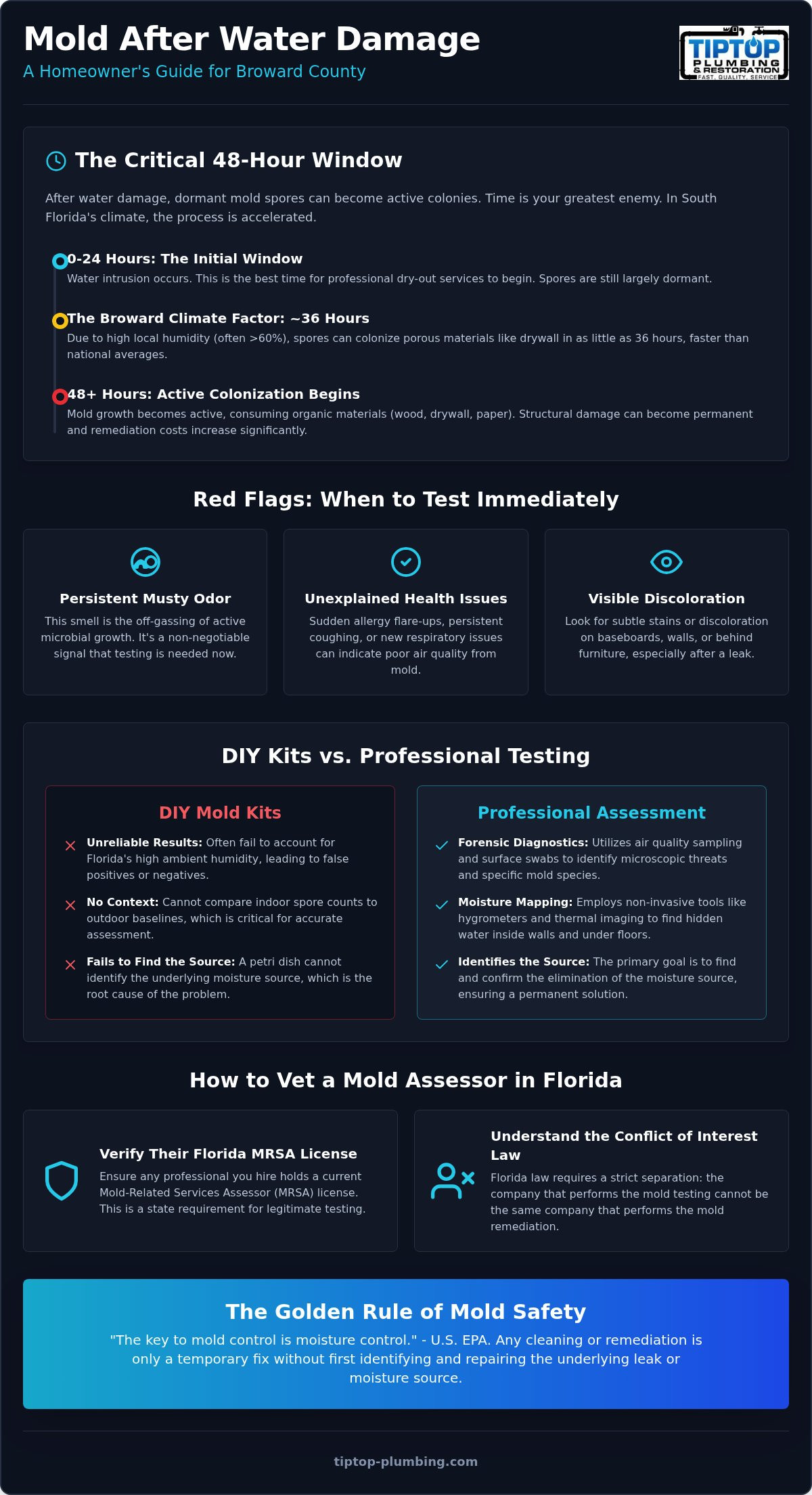
Professional mold testing is a forensic diagnostic assessment of your property’s air and surface quality. It moves beyond a simple visual inspection to identify microscopic threats that the naked eye cannot detect. When a pipe bursts or a heavy rain causes intrusion, understanding exactly when to test for mold after water damage Broward County homeowners face is the difference between a simple repair and a total home restoration. The first 48 hours are a critical biological threshold. During this narrow window, dormant spores transition into active colonies that begin to consume organic materials like wood, paper, and drywall. Once this process takes root, structural damage becomes permanent and significantly more expensive to remediate. If you notice a persistent, musty odor, consider it a non-negotiable signal that testing is required immediately. That smell is actually the off-gassing of active microbial growth, indicating that the colonization process is already well underway.
Why Florida Humidity Shortens Your Reaction Time
Broward’s unique environmental conditions act as a high-speed incubator for indoor air quality issues. While national guidelines often suggest a two-day window, our local indoor humidity levels, which frequently exceed 60%, allow spores to colonize porous drywall in as little as 36 hours. This “Broward Climate Factor” means that a standard dry-out service is rarely enough on its own. Moisture often remains trapped deep inside wall cavities or under floorboards, even when the surface feels dry to the touch. Professional verification is the only way to ensure that a hidden colony isn’t flourishing behind your walls. For a comprehensive overview of indoor mold and how it thrives in tropical environments, it’s clear that moisture control must be paired with precise air sampling to guarantee a healthy living space.
Signs You Need Immediate Testing in Weston or Miramar
Homeowners in Weston and Miramar should be vigilant for specific red flags that suggest an underlying problem. Look for subtle discoloration on baseboards or the back of furniture, particularly after a suspected leak has occurred. If your family starts experiencing unexplained respiratory issues, persistent coughing, or sudden allergy flare-ups, your home’s air quality is likely the culprit. Testing becomes an absolute priority if the water intrusion involved contaminated sources like a sewage backup or storm surge. We maintain a strong presence in these areas served to provide the rapid response necessary to document damage for insurance and, more importantly, to protect your family’s health. Determining when to test for mold after water damage Broward County experts recommend is simple: the moment you suspect moisture has lingered for more than a day, it’s time for a professional assessment. Homeowners in Weston specifically can benefit from understanding how professional mold testing in Weston FL acts as a diagnostic “MRI” for your home, uncovering hidden plumbing failures and slab leaks that fuel spore growth before they become catastrophic.
Professional Mold Assessment Methods: Beyond the Spore Count
Professional mold testing is far more than a simple petri dish left on a counter. It’s a forensic investigation designed to uncover hidden threats that standard visual inspections miss. When you are deciding when to test for mold after water damage Broward County experts recommend prioritizing a comprehensive approach that utilizes both air and surface analysis. Air quality sampling provides a snapshot of the invisible environment by comparing indoor spore counts to outdoor Florida baselines. Meanwhile, surface swabs and tape lifts allow technicians to identify specific species, such as Stachybotrys chartarum, commonly known as toxic black mold. While identifying the species is helpful, the most critical element of any assessment is identifying the moisture source. As the EPA emphasizes, the key to mold control is moisture control. Without stopping the water, any cleaning effort is only a temporary fix.
The Forensic Value of Moisture Mapping
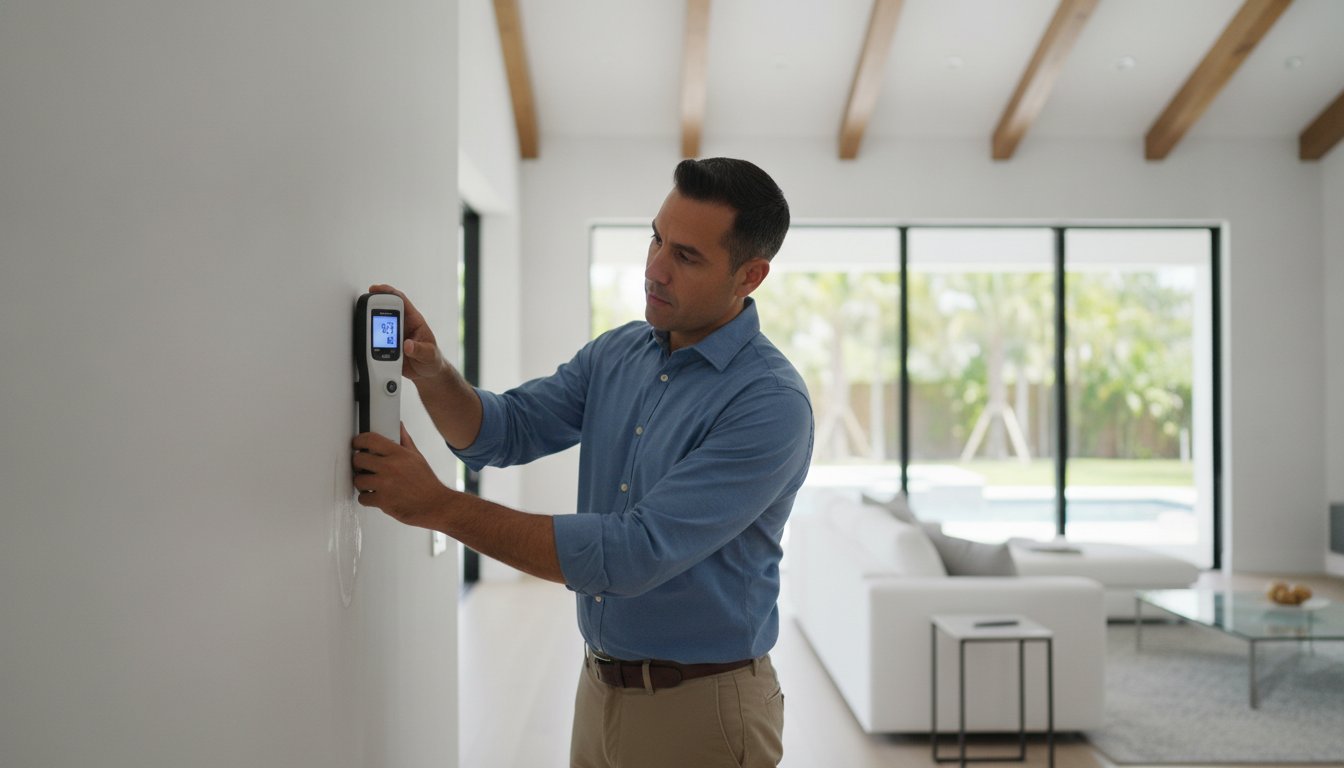
Moisture mapping utilizes non-invasive technology to find water trapped where you can’t see it. We use professional-grade hygrometers and moisture meters to identify “wet” zones that appear dry to the touch but hold enough moisture to fuel microbial growth. Thermal imaging is another essential tool in this process. Infrared cameras spot temperature anomalies behind drywall and under luxury vinyl plank (LVP) flooring, revealing active leaks or condensation pockets without the need for demolition. This precision allows us to pinpoint exactly where the plumbing failed so the repair is permanent. If you suspect a hidden leak is fueling growth behind your walls, you can schedule a professional diagnostic assessment to identify the source before the damage spreads.
Understanding Your Air Quality Report
Your final air quality report shouldn’t just be a list of numbers; it should be a roadmap for recovery. In South Florida, outdoor spore counts are naturally high due to our tropical climate. A professional report interprets these indoor-to-outdoor ratios to determine if the levels inside your home are truly “elevated.” If the indoor count of a specific species is significantly higher than the outdoor baseline, it indicates an active interior growth source that must be addressed in your water damage restoration plan. These lab-certified results are vital for insurance documentation. They provide the legal and scientific proof necessary to support your claim and ensure that the full scope of the damage is covered by your policy.
DIY Mold Kits vs. Professional Testing: Why Florida Humidity Changes the Game
Many homeowners reach for a retail test kit after a leak, but in South Florida, these products are often a waste of resources. Because our ambient air is naturally saturated with spores, a gravity-settling petri dish will almost always show growth, regardless of whether your home has a dangerous infestation. This creates a “Petri Dish Trap” where you’re left with a fuzzy plate but no scientific context. These kits fail to identify the signs of a water leak that caused the growth in the first place. When determining when to test for mold after water damage Broward County homeowners should realize that a professional assessment includes a forensic investigation of the structure, not just a sample of the air.
DIY kits are also prone to dangerous false negatives. They typically only sample a small area and cannot detect toxic species growing inside your HVAC system or deep within wall cavities. These kits also lack a “Chain of Custody.” Chain of Custody is the formal, documented process that tracks a sample from the moment of collection to its analysis in a lab, providing the legal verification necessary for insurance companies to accept the findings. It’s also worth noting that aging or failing water heaters are a frequently overlooked source of hidden moisture; a slow tank leak can saturate surrounding walls for weeks before it’s detected, which is why homeowners should consider water heater repair in Davie FL as part of a comprehensive moisture prevention strategy.
The Hidden Cost of Inaccurate DIY Results
A false sense of security is the most expensive mistake you can make. If a DIY kit tells you “everything is fine” while moisture is rotting your studs, you’ll face thousands in structural repairs later. These kits cannot distinguish between common “nuisance” molds and dangerous “toxigenic” species. Most importantly, insurance adjusters typically ignore results from home-bought test kits because they aren’t collected by a licensed Florida Mold Assessor (MRSA). Relying on amateur data can lead to a denied claim and a lingering health hazard in your home.
When a Pro is Mandatory: The 10 Square Foot Rule
According to EPA guidelines on Mold cleanup after disasters, any affected area larger than 10 square feet requires professional intervention. In high-humidity areas like Weston or Miramar, disturbing a large colony without proper containment can cross-contaminate your entire home. Professional testing is the final step in learning how to prevent mold from returning by verifying that the remediation was successful. Knowing when to test for mold after water damage Broward County professionals suggest means acting before that 10-square-foot threshold is crossed, ensuring your property remains safe and your insurance claim remains valid.
Homeowner’s Buying Guide: How to Vet a Mold Assessor in Weston and Miramar
Vetting a professional in South Florida requires more than just checking a review online. You’re dealing with a health-sensitive and legally complex situation that demands technical precision. When you are deciding when to test for mold after water damage Broward County homeowners should prioritize finding a licensed authority before the 48-hour colonization window closes. In Weston and Miramar, where many homes are built on monolithic slabs, an assessor must understand how a subterranean pinhole leak can fuel microbial growth long before you see a stain on your floor. A true expert doesn’t just look for spores; they look for the plumbing failures that invite them in. Our detailed 2026 guide to mold testing Weston FL homeowners can reference explains exactly what certifications to verify and what questions to ask before allowing any technician into your home.
Essential Florida Certifications
Florida law is very specific about who can evaluate your property. You must verify that your professional holds an active Mold Assessor (MRSA) license through the Florida Department of Business and Professional Regulation (DBPR). It’s a critical detail for this year: all Florida mold licenses expire at midnight on July 31, 2026, and require 14 hours of continuing education for renewal. Additionally, Florida law mandates that licensed assessors carry at least $1 million in general liability and errors and omissions insurance. This coverage is your primary protection if an assessment misses a major colony that later requires expensive remediation. Always ask to see proof of this insurance before allowing a technician into your home.
Red Flags to Avoid in a Quote
Be wary of extremely low teaser prices. Some contractors offer “free” or cheap inspections only to recommend expensive, unproven fogging treatments that don’t actually address the moisture source. A legitimate professional report must follow IICRC S520 standards, which are the industry benchmark for professional safety and mold removal. If an assessor arrives without moisture detection tools like thermal imaging cameras or hygrometers, they aren’t performing a forensic investigation. They’re just guessing. Vague reports that provide data without a clear, step-by-step remediation roadmap are another major red flag to avoid.
One of the strongest consumer protections in our state is Florida Statute 468.8419. This law prohibits the same company or individual from performing both the mold assessment and the remediation on the same property within a 12-month period. This ensures the person diagnosing the problem doesn’t have a financial incentive to exaggerate the scope of the work. We maintain a disciplined commitment to these standards across all areas served, providing the transparent, third-party verification you need for a successful insurance claim and total peace of mind.
The Tip Top Advantage: Why Finding the Leak is the First Step in Mold Safety
We operate with a strict “Source-First” philosophy because finding a spore is useless if you don’t find the water. Many restoration companies treat the symptom by cleaning the visible growth, but we prioritize the structural forensics of the intrusion. Our leak detection expertise allows us to identify the exact origin of moisture using advanced acoustic sensors and thermal imaging technology. This precision prevents mold from returning, ensuring that your investment in restoration isn’t wasted on a recurring problem that could have been stopped at the source.
Integrated restoration provides a streamlined path from crisis to clearance. We manage every phase of the process, moving from the emergency dry-out to the final lab-verified mold clearance. This comprehensive approach is vital for protecting your property value over the long term. When a future buyer’s inspector finds evidence of past water damage, your Tip Top documentation will prove the leak was professionally repaired and the air quality was scientifically verified. Deciding when to test for mold after water damage Broward County experts recommend depends on having the leak sealed first; otherwise, you’re just testing a moving target that will continue to deteriorate.
Miramar and Plantation Case Study: The Hidden Wall Leak
In a recent project involving a Miramar residence, a family discovered a whole-house air quality crisis triggered by a single pinhole copper leak. The leak was hidden behind a laundry room wall, allowing moisture to saturate the studs and insulation for weeks before a musty odor became undeniable. Our team provided a rapid response, stopping the leak and performing professional mold testing in a single visit to determine the extent of the spore migration. By identifying the exact moisture source immediately, we prevented the need for a full-house gutting and saved the homeowner thousands in unnecessary demolition. The result was a certified mold-free home that maintained its full market value during a subsequent sale later that year.
Your Healthy Home Action Plan
Your healthy home action plan starts the moment you suspect a moisture problem. First, turn off your main water supply to stop any active intrusion from plumbing failures. Second, limit your AC airflow to prevent spores from migrating through your ductwork to unaffected rooms. Finally, secure a professional assessment to document the damage for your insurance carrier. During your Tip Top moisture and mold assessment, we provide the technical proof you need to ensure your home is safe for your family. Understanding when to test for mold after water damage Broward County homeowners can rely on means acting within that critical 48-hour window before the damage becomes permanent.
Securing Your Home’s Future Health and Value
Protecting your property from microbial growth requires decisive action within the first 48 hours of a leak. By understanding exactly when to test for mold after water damage Broward County experts recommend, you can prevent structural rot and preserve your home’s air quality. Our team has been serving Broward County families for years, providing the technical precision and steady reassurance needed to navigate these high-stakes property crises with total confidence.
We utilize advanced thermal imaging technology to find moisture hidden deep within wall cavities, ensuring that no pocket of water is left behind to fuel future growth. Our Certified Florida Mold Assessors (MRSA) provide the legal documentation and lab-certified evidence necessary for successful insurance claims and future property sales. This “source-first” approach ensures that we don’t just identify the spores; we stop the water that invites them in, creating a permanent solution for your home.
You don’t have to face the anxiety of hidden damage or conflicting advice alone. Take the first step toward total property restoration today and breathe easy knowing your sanctuary is protected by local experts who value your health and peace of mind above all else.
Frequently Asked Questions
How much does professional mold testing cost in Broward County?
Total costs vary based on the square footage of your property and the number of air or surface samples required to provide a lab-certified result. A comprehensive diagnostic assessment involves more than just a visual check; it includes advanced moisture mapping and thermal imaging to find the root cause of the problem. You should always request a detailed estimate that includes all laboratory fees and a clear remediation roadmap to ensure there are no hidden expenses during the process.
Does Florida homeowners insurance cover mold testing after a leak?
Coverage depends on whether the moisture source is a covered peril, such as a sudden pipe burst or a storm-related intrusion. Most Florida policies include provisions for diagnostic testing and mitigation if the damage was sudden and accidental. It’s vital to have a licensed professional document the damage forensicly to support your claim. This evidence is often the deciding factor in whether your insurance carrier approves the necessary funds for a full restoration.
How long does it take to get mold test results back from the lab?
Standard laboratory analysis typically provides a finalized report within 24 to 48 hours after the samples are collected from your home. This window allows microbiologists to accurately identify specific species and calculate spore concentrations. Fast turnaround is essential when determining when to test for mold after water damage Broward County professionals recommend. If you’re in an emergency situation, expedited same-day results are often available to help you make immediate decisions about your property’s safety.
Can I stay in my Weston home if testing shows elevated spore levels?
Your ability to remain in the home depends on the concentration of spores and whether the affected area can be completely contained. If the growth is localized to a single room that can be sealed off, you may be able to stay in the unaffected parts of the house. However, if the HVAC system is contaminated or if toxigenic species are found in high volumes, temporary relocation is often the safest choice for your family’s health until the remediation is complete.
What is the difference between a mold inspection and a mold test?
A mold inspection is a physical investigation of the structure to find moisture sources, while a mold test is the scientific collection of samples for lab analysis. An inspection uses tools like moisture meters and infrared cameras to find “wet” zones behind your walls. Testing provides the specific data needed to identify the species and determine if the air quality is hazardous. Both are necessary components of a professional recovery plan to ensure the problem doesn’t return.
Should I test for mold before buying a home in Pembroke Pines?
Yes, a professional mold assessment is a critical step in the due diligence process for any South Florida real estate transaction. Standard home inspections often miss hidden moisture issues trapped under flooring or behind kitchen cabinets. Identifying an active leak or elevated spore count before you close can save you thousands in future repairs. It also provides the leverage needed to negotiate a repair credit or require the seller to perform a certified remediation before you move in.
Is black mold common in South Florida homes after a flood?
Stachybotrys chartarum, commonly known as black mold, is frequently found in Florida homes when porous materials like drywall remain wet for more than 72 hours. While the term “toxic mold” is often used, all species should be treated with professional caution. Because our tropical climate provides the perfect heat and humidity for these colonies to thrive, rapid dry-out and testing are your best defenses against a major infestation after a plumbing failure or flood.
Can a plumbing leak inside a wall cause mold in my AC ducts?
A hidden plumbing leak can definitely lead to ductwork contamination if the resulting spores are pulled into the return air system. Once spores enter the dark, damp environment of an AC unit, they can colonize the coils and be redistributed throughout your entire home. This is why deciding when to test for mold after water damage Broward County experts advise is so important. Finding the leak early prevents a localized plumbing issue from turning into a whole-house air quality crisis. Homeowners should also be aware that a failing water heater is another common hidden culprit; understanding the warning signs and pursuing timely expert water heater repair in Davie FL can stop a slow tank leak from silently saturating your walls and fueling dangerous spore growth.
Disclaimer
The information provided in this article is for general educational and informational purposes only and should not be considered professional plumbing, restoration, mold remediation, or legal advice. Every plumbing system, property, and situation is unique, and the recommendations discussed may not apply to your specific circumstances.
While Tip Top Plumbing & Restoration strives to provide accurate and up-to-date information, we make no warranties regarding the completeness, accuracy, or reliability of the content. Any actions you take based on this information are at your own risk.
Plumbing repairs, water damage restoration, and mold remediation should be performed by qualified professionals and in accordance with applicable local building codes and regulations. If you are experiencing a plumbing emergency, water leak, or property damage, contact a licensed professional for an on-site evaluation.
Tip Top Plumbing & Restoration is licensed and insured to provide plumbing and restoration services throughout Broward County, Florida.