

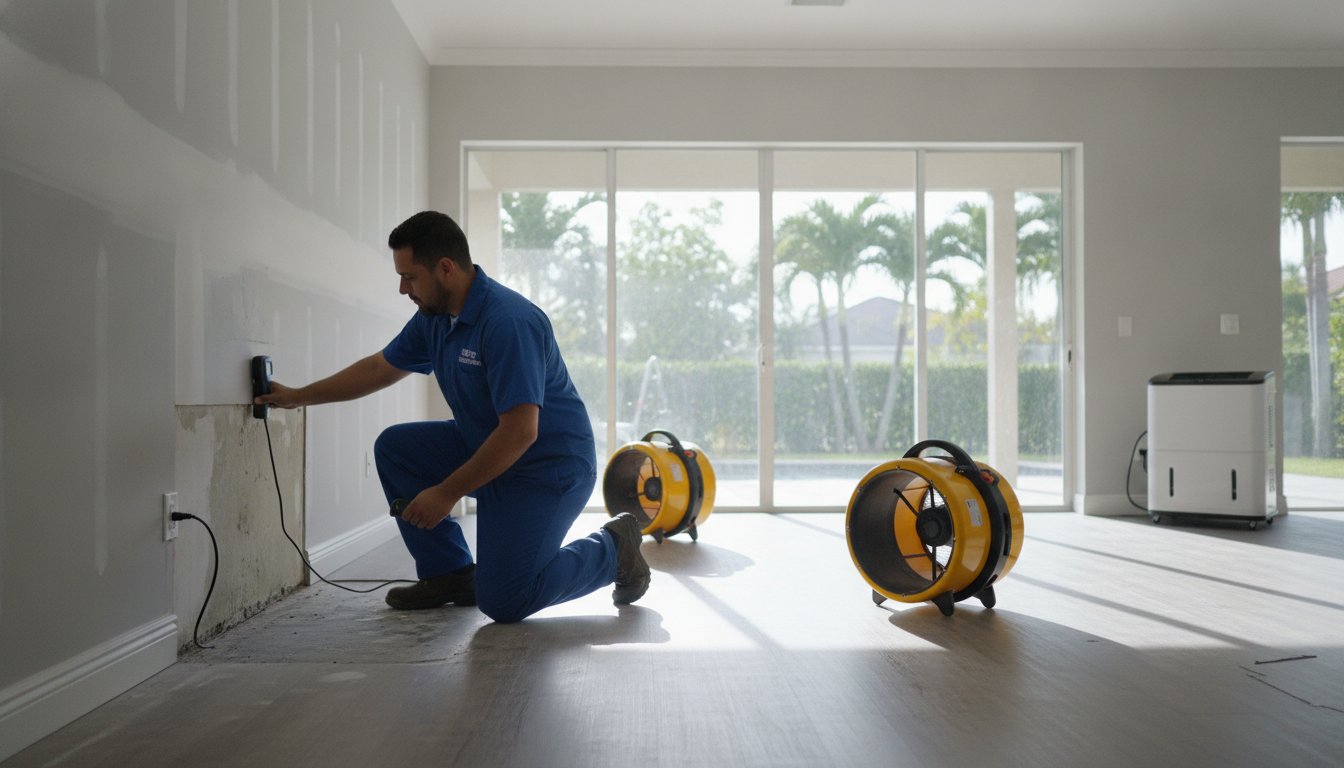
Imagine waking up in Silver Lakes to the muffled sound of dripping, only to find your baseboards damp and your luxury vinyl floors starting to warp. In Miramar, where humidity levels are high and tropical storms are a seasonal reality, a minor leak can evolve into a full-scale mold crisis in as little as 24 hours. If you’re standing in a puddle right now, professional water damage restoration Miramar services are your most critical defense against permanent structural failure and rising repair costs.
We understand the immediate stress of wondering if the leak is actually stopped or if hidden spores are already spreading behind your drywall. It’s frustrating to face a disaster while worrying about insurance documentation and the city’s new digital-only permit requirements. This guide promises to clear that confusion by providing professional strategies tailored for Miramar’s specific 2026 climate and infrastructure. You’ll learn how to achieve a completely dry, mold-free home through a logical progression of emergency mitigation, scientific drying techniques, and the precise documentation needed for a successful insurance claim.
Key Takeaways
- Learn how to secure your property by identifying electrical hazards and locating the main water shut-off valve during the critical first hour of a leak.
- Understand the unique impact Miramar’s hard water and shifting soil have on slab leaks and the long-term integrity of your home’s foundation.
- Discover how industrial-grade dehumidifiers and psychrometric science outperform consumer fans to ensure a deep, professional dry out.
- Navigate the complexities of insurance claims and 2026 digital permitting with professional documentation and mandatory mold testing protocols.
- Master the process of water damage restoration Miramar by combining precision leak detection with comprehensive structural remediation to protect your property value.
Immediate Steps for Water Damage in Miramar: The Critical First Hour
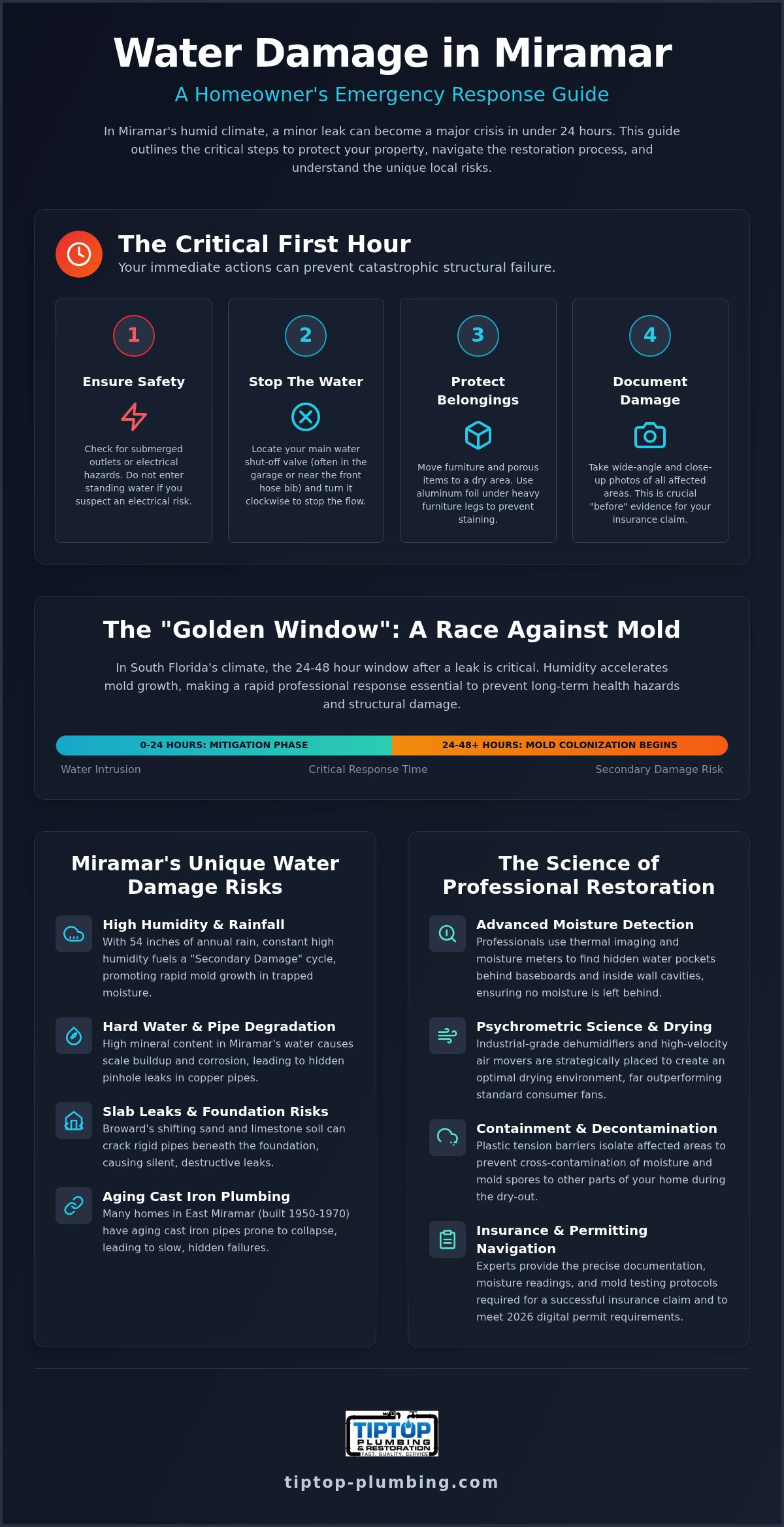
The first 60 minutes after discovering a leak are the most consequential for your home’s future. You must act with precision to prevent a localized spill from becoming a structural catastrophe. Before you step into any standing water, check for submerged electrical outlets or downed appliances. If the water has reached the level of your wall sockets, don’t enter the room. Your safety is paramount, and no amount of property preservation is worth the risk of electrocution.
Once you’ve confirmed the area is safe, locate your main water shut-off valve immediately. In most Miramar residences, especially those built during the expansion of West Miramar, this valve is typically found near the front hose bib or inside the garage. Turn the handle clockwise until it stops. This simple action halts the flow and prevents further saturation of your subflooring and drywall. If the source is a burst pipe or a failing water heater, you’ll need an emergency plumber in Miramar to secure the line before restoration can begin.
Timing is everything in South Florida. We call the first 24 to 48 hours the “Golden Window” because this is the timeframe before mold spores begin to colonize damp surfaces. The Science of Professional Water Remediation shows that humidity levels in Broward County accelerate this process, making professional extraction a race against the clock. While you wait for help, document everything. Take wide-angle photos of the entire room and close-up shots of the specific point of failure. These images provide the “before” evidence that insurance adjusters require to process your claim without delays.
Securing the Property and Preventing Further Loss
Protecting your belongings is the next priority. Move lightweight furniture and porous items like rugs or cardboard boxes to a dry, tiled area. If furniture is too heavy to move, place aluminum foil or plastic blocks under the legs to prevent wood stain transfer and “wicking,” where moisture climbs up the furniture fibers. These small steps significantly reduce the total cost of your water damage restoration Miramar project by saving salvageable assets.
The Role of Professional Assessment
Never assume a floor is safe just because it feels dry to the touch. Water often migrates behind baseboards and into the wall cavity, where it remains trapped against the studs. A professional inspection uses thermal imaging and moisture meters to find these hidden pockets. We use containment strategies, such as plastic tension barriers, to isolate the affected area and prevent moisture from migrating into unaffected rooms of your home. This methodical approach ensures that the “dry out” is total and permanent.
This high standard of professional care is consistent with top-tier firms nationwide, such as Floodsafe Restoration LLC, which emphasizes the same 24/7 emergency response and scientific approach to structural drying.
Why Miramar Properties Face Unique Water Damage Challenges
Miramar’s flat, low-lying landscape near the Everglades creates a specific set of challenges for local homeowners. High humidity and 54 inches of annual rainfall don’t just cause occasional floods; they fuel a “Secondary Damage” cycle where moisture trapped in porous materials triggers mold growth within 48 hours. In older neighborhoods, particularly in historic East Miramar, homes built between 1950 and 1970 often still rely on aging cast iron plumbing. These lines don’t just leak; they eventually collapse. This leads to slow, hidden failures that eventually require comprehensive water damage restoration Miramar to salvage the structure.
Hard Water and Pipe Degradation
Miramar’s water supply is notoriously hard. Over time, mineral scale builds up inside your plumbing, creating a corrosive environment. This leads to pinhole leaks in copper pipes, which are often too small to notice until the drywall is already saturated. If you’re seeing blue-green stains or experiencing unexplained drops in water pressure, it’s time to review our guide on copper pipe leak repair in Broward County. Catching these mineral-related failures early prevents the massive structural dry-out costs associated with a full-scale flood.
Slab Leaks and Foundation Risks
Slab leaks are the silent killers of South Florida homes. Broward County’s soil is a mix of sand and limestone that shifts significantly during the heavy rain season. When the ground moves, the rigid pipes buried beneath your foundation can crack or separate. Because these leaks happen under several inches of concrete, they often go undetected for months. Homeowners usually notice a hot spot on the floor or a sudden spike in the water bill first. We utilize advanced leak detection services to pinpoint these underground breaks without tearing up your entire floor. Understanding these risks is vital for Navigating the Recovery: Insurance, as coverage often depends on whether the damage was sudden or the result of long-term neglect.
If you suspect a hidden moisture issue or notice a musty odor near your baseboards, you can schedule a professional plumbing assessment to identify vulnerabilities before they lead to a catastrophic failure.
The Science of Professional Water Remediation and Dry Out Services
Drying a home in Miramar isn’t as simple as opening a window or pointing a household fan at a wet spot. Because our local humidity often exceeds 70%, the air itself is frequently too saturated to absorb more moisture. Professional water damage restoration Miramar relies on psychrometrics. This is the scientific study of air-vapor mixtures and how temperature and atmospheric pressure affect the rate of evaporation. Without controlling these variables, you aren’t actually drying your home; you’re just moving humid air around the room.
We use industrial-grade equipment that far outperforms anything available at a local hardware store. While a consumer fan might dry the surface of a carpet, it won’t reach the moisture trapped in the padding or the subfloor beneath it. We utilize thermal imaging cameras to see what the naked eye cannot. These devices detect temperature differentials that indicate hidden pockets of water behind your drywall. By identifying these “cool spots,” we ensure that every ounce of moisture is accounted for before we declare a project complete.
Structural Drying Techniques
Low Grain Refrigerant (LGR) dehumidifiers are the primary tools we use to combat South Florida’s heavy air. These machines are designed to remove large volumes of water vapor even in environments with low vapor pressure, which is essential for deep structural drying. We pair these with high-velocity air movers that create a vortex of airflow across wet surfaces. This process speeds up evaporation by constantly replacing saturated air with dry air. For high-value areas like custom kitchen cabinets or hardwood flooring, we employ Injectidry systems. These specialized tools allow us to push or pull air through tiny, non-invasive holes, saving expensive installations from demolition.
Monitoring and Verification
Precision is what separates a professional dry out from a DIY attempt. We don’t guess when your home is safe. Instead, we establish a “dry standard” by taking moisture readings from unaffected areas of your property. This gives us a baseline for what “normal” looks like for your specific structure. Every 24 hours, our technicians perform moisture mapping to track the progress of the drying cycle. We check the moisture content of studs, sill plates, and subflooring to ensure they’re trending toward that baseline. Only when every structural element meets the dry standard do we remove the equipment, giving you documented peace of mind that the environment is stable and mold-resistant.
Navigating the Recovery: Insurance, Mold Testing, and Timelines
Recovery from a flood occurs in two distinct phases: water mitigation and restoration. Mitigation is the emergency response designed to stop the bleeding; it includes water extraction, structural drying, and stabilization. Restoration is the subsequent phase where we rebuild what was lost, from replacing drywall to installing new flooring. For a successful water damage restoration Miramar project, these phases must be handled with a logical, “triage” approach that prioritizes structural integrity and health safety above aesthetics.
Post-Water Damage Mold Safety
In South Florida’s climate, mold isn’t a “maybe”; it’s a “when.” Florida’s environment allows mold spores to colonize damp surfaces within 24 to 48 hours of initial contact. Under Florida Statute §468.8411–468.8425, the state requires separate licenses for mold assessors and mold remediators. This means the company that tests your air quality cannot be the same company that performs the removal. This law protects you from a conflict of interest, ensuring that the verification of a “clean” home is unbiased. We insist on IICRC-certified mold testing before any reconstruction begins to ensure that moisture isn’t trapped behind new walls, which would lead to a secondary, more expensive crisis later.
While Miramar’s challenges are dictated by high humidity, the core principles of moisture control are universal; for those curious about how these services differ in drier regions, reviewing guidelines for mold remediation phoenix provides a helpful comparison of how professionals manage fungal risks across diverse environments.
Insurance Claim Mastery
Navigating insurance in 2026 requires meticulous digital documentation. As of January 1, 2026, Citizens Property Insurance has expanded flood insurance requirements for many policyholders, making the distinction between “water damage” and “flood damage” more critical than ever. To support your claim, we provide detailed moisture logs and a comprehensive “Scope of Work” that adjusters use to verify the necessity of every industrial dehumidifier and air mover used. All permit applications in Miramar must now be submitted digitally through the city’s Citizen Self Service portal. Even if your repairs fall under the $7,500 exemption threshold established by House Bill 803, plumbing and structural work still require formal permits and inspections. We handle this digital bureaucracy so your claim doesn’t stall over a missing PDF.
Timelines for a full water damage restoration Miramar project vary based on the category of water. A standard dry-out (mitigation) typically takes three to seven days of continuous equipment operation. Once the structural elements meet the “dry standard,” the restoration phase can begin. Depending on the availability of materials and the complexity of the repairs, you can expect the total recovery process to take anywhere from two weeks for minor leaks to several months for major flooding events.
The Tip Top Advantage: Plumbing Expertise Meets Full Restoration
Most homeowners don’t realize that standard restoration companies often lack the licensing to perform the actual plumbing repairs that caused the damage. This creates a dangerous delay where you are forced to coordinate between two different contractors while water continues to seep into your foundation. We eliminate this friction by providing a unified, “one-call” solution. Our team handles the immediate plumbing emergency and the subsequent water damage restoration Miramar process simultaneously, ensuring that the source is neutralized before the structural drying begins. Whether you are in Silver Lakes or historic East Miramar, our local presence allows for a rapid response that can save your property from total loss.
We believe in total system recovery rather than temporary patches. Our technicians utilize advanced diagnostics, including high-definition sewer camera inspections, to verify the integrity of your entire drainage network. If we find that a leak was caused by systemic blockages or root intrusion, we employ hydro jetting to clear the lines completely. This methodical approach prevents the “revolving door” of plumbing failures that many Broward County residents experience with less thorough providers. We don’t just dry your floors; we ensure the mechanical systems behind your walls are stable and built to last.
Total System Health After a Leak
A major leak is often a symptom of a larger problem within your home’s infrastructure. After the initial dry-out is complete, we perform a comprehensive health check on your pipes, water heater, and drainage lines. In Miramar homes where aging cast iron or corroded copper is present, a single leak often signals that the entire system is reaching the end of its lifespan. If your home has suffered multiple failures, it may be time to learn about whole house repiping in Broward County. This preventative maintenance, combined with post-restoration drain cleaning, ensures that your newly restored home stays dry for years to come.
Why Miramar Trusts Tip Top
Our identity as a “Reliable Local Authority” is built on transparency and precision. We live and work in the Miramar community, so we have an intimate understanding of Broward County building codes and the specific challenges posed by our local soil and weather patterns. We take pride in our “fix it once, fix it right” philosophy, which prioritizes long-term viability over quick, low-quality fixes. You can see the results of our commitment by reviewing our recent projects in Miramar and Broward County. We act as your protective guide, managing everything from the initial leak detection to the final digital permit submission, providing the peace of mind that only a local expert can deliver.
Securing Your Property and Health for the Long Term
Restoring your home after a leak is about more than just removing standing water. It requires a scientific approach to psychrometrics to prevent secondary mold growth and a deep understanding of Miramar’s unique plumbing challenges. By addressing the source of the leak and the structural saturation simultaneously, you ensure that your property remains a safe, dry environment for your family. Professional documentation is your best asset when dealing with insurance adjusters and city permits in 2026.
Our 24/7 rapid response team is ready to act as your reliable local authority during any household crisis. With IICRC-certified restoration technicians and licensed Florida plumbers on every job, we provide the precision needed for a complete recovery. Don’t let a minor drip turn into a major structural failure. Expert water damage restoration Miramar services are just one call away.
You have the tools and the knowledge to navigate this recovery with confidence. We’re here to provide the technical expertise and the peace of mind you deserve.
Frequently Asked Questions
How long does the water damage restoration process usually take in Miramar?
A standard mitigation phase for water damage restoration Miramar typically lasts between three and seven days. Full restoration, which includes rebuilding structural elements like drywall and flooring, can take anywhere from two weeks to several months depending on the scale of the damage. We use daily moisture mapping to track progress and ensure the environment meets the dry standard before we begin any reconstruction.
Will my homeowners insurance cover water damage restoration?
Most homeowners insurance policies cover water damage that is sudden and accidental, such as a burst pipe or a failing water heater. As of January 1, 2026, Citizens Property Insurance policyholders with dwelling coverage over $400,000 must also carry flood insurance. It’s vital to review your specific policy limits and the distinction between internal plumbing failures and external rising water.
Can I stay in my home during the dry-out process?
You can often stay in your home during minor dry-outs, but it isn’t always comfortable. The industrial air movers and LGR dehumidifiers required for water damage restoration Miramar are loud and generate significant heat as they pull moisture from the air. If the damage is widespread or involves the kitchen or primary bathroom, temporary relocation is usually the most practical choice.
How do I know if mold has already started growing after a leak?
Mold can begin to colonize within 24 to 48 hours of initial water intrusion. You’ll often notice a distinct musty odor or visible spotting on baseboards and drywall before the growth becomes extensive. Because mold often hides behind wall cavities, we utilize thermal imaging and moisture meters to identify high-risk zones that require professional testing.
What is the difference between water mitigation and water restoration?
Water mitigation is the emergency process of stopping the water and drying the structure to prevent further loss. In contrast, water restoration focuses on the permanent repairs and reconstruction needed to return your home to its pre-loss condition. We prioritize mitigation first to stabilize the environment and minimize the total cost of the eventual restoration phase.
Why is professional leak detection necessary if I can see where the water is?
Visible water is frequently just the exit point, not the actual source of the leak. Moisture often travels along wall studs or subflooring from a completely different room before it pools in a visible area. Professional leak detection uses acoustic sensors and thermal cameras to find the specific point of failure without unnecessary demolition of your walls or floors.
Does Miramar’s high humidity affect how fast my home will dry?
Miramar’s high humidity significantly slows down natural evaporation, making professional equipment essential. When the air is already saturated with moisture, it can’t absorb the water trapped in your home’s structural elements. Our LGR dehumidifiers are specifically designed to create a dry environment even in South Florida’s humid climate, ensuring a deep dry that prevents rot.
What should I do if I suspect a slab leak under my foundation?
If you suspect a slab leak, you should immediately turn off your main water valve and monitor your water meter for movement. Slab leaks are common in Broward County due to shifting soil and can cause significant foundation damage if left unaddressed. We utilize non-invasive leak detection to pinpoint the underground break and provide a precise repair plan for your home.
Disclaimer
The information provided in this article is for general educational and informational purposes only and should not be considered professional plumbing, restoration, mold remediation, or legal advice. Every plumbing system, property, and situation is unique, and the recommendations discussed may not apply to your specific circumstances.
While Tip Top Plumbing & Restoration strives to provide accurate and up-to-date information, we make no warranties regarding the completeness, accuracy, or reliability of the content. Any actions you take based on this information are at your own risk.
Plumbing repairs, water damage restoration, and mold remediation should be performed by qualified professionals and in accordance with applicable local building codes and regulations. If you are experiencing a plumbing emergency, water leak, or property damage, contact a licensed professional for an on-site evaluation.
Tip Top Plumbing & Restoration is licensed and insured to provide plumbing and restoration services throughout Broward County, Florida.